Silver anole (Anolis argenteolus)
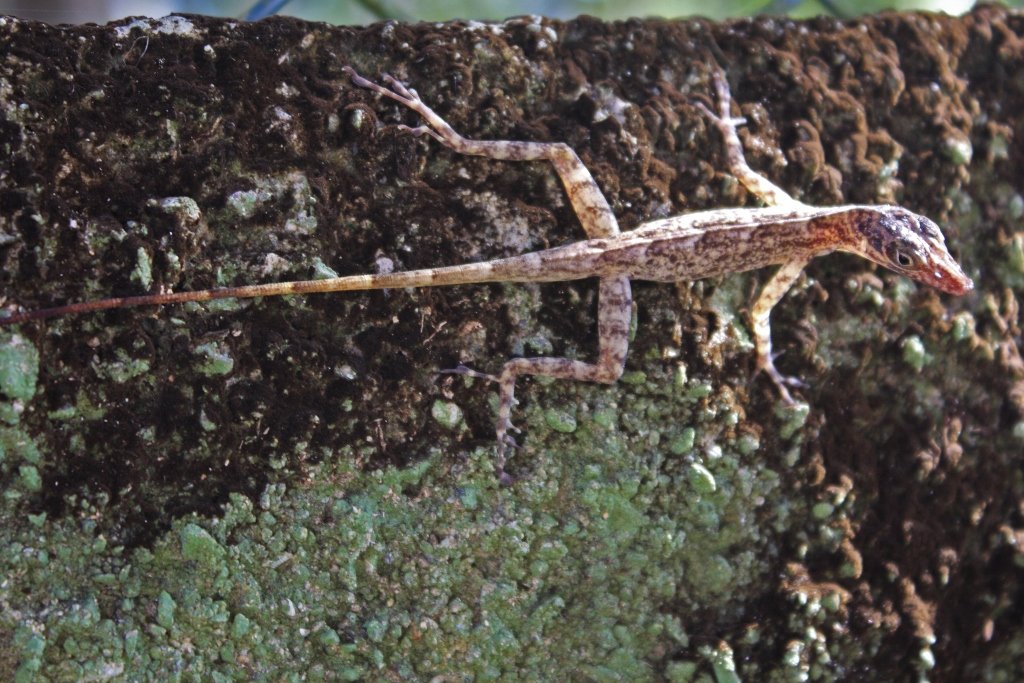
Iguanas · Difficulty: Beginner with some knowledge
Key facts and care guidance for Silver anole (Anolis argenteolus) (origin: Southeastern Cuba, Guantanamo Province and surroundings (type locality Monte Verde); lives on tree trunks, limestone rocks, walls and cave entrances in the lowest metres). Adult size around 12–15 cm. Life expectancy 4–8 years. The values below are carefully researched guidance.
Short answers
Silver anole: How big does the enclosure need to be?
50x50x80 cm for a pair, tall format. Vertical surfaces matter: a cork background, trunks, bark and stone slabs, plus dense planting as a visual screen.
Silver anole: What temperature does it need?
Daytime 25–30 °C, basking spot Basking spot 32–35 °C, at night 19–22 °C.
Silver anole: Does it need UVB lighting?
UVB: Essential (UVB 5.0).
Silver anole: How long do they live?
Life expectancy: 4–8 years.
Silver anole: Is it suitable for beginners?
Partly – manageable with some prior knowledge (difficulty: Beginner with some knowledge).
Climate
- Daytime temperature
- 25–30 °C
- Night temperature
- 19–22 °C
- Basking spot
- Basking spot 32–35 °C
- Humidity
- 65–85 %, mist in the morning
- UVB
- Essential (UVB 5.0)
Enclosure
- Minimum size
- 50x50x80 cm for a pair, tall format. Vertical surfaces matter: a cork background, trunks, bark and stone slabs, plus dense planting as a visual screen.
- Substrate
- Forest-floor substrate with live plants, plus thin branches and bamboo at all heights
Feeding
- Food
- Crickets, house crickets, flies, firebrats and wax moths, dusted regularly with calcium and vitamins
- Feeding interval
- adults 3–4×/week
Key facts
- Adult size
- 12–15 cm
- Life expectancy
- 4–8 years
- Origin
- Southeastern Cuba, Guantanamo Province and surroundings (type locality Monte Verde); lives on tree trunks, limestone rocks, walls and cave entrances in the lowest metres
- Protection status
- Not listed under CITES
- Brumation
- No winter rest; somewhat cooler in winter with a shorter photoperiod
- Cohabitation
- Pairs (1.1) are the safest option; never keep males together — they fight until seriously injured. Females also defend their own, smaller territories: a second female is often harassed so much by the dominant one that she eats less and hides. One male with two females only works, if at all, in a considerably larger, densely structured enclosure and only with a spare enclosure ready.
Notes
It lives on rocks and at cave entrances rather than on trees.
Do you keep this species?
Add your animal to Reptoria – Reptoria reminds you about feeding and shedding. Add your animal for free →
Look for Silver anole (Anolis argenteolus) in the marketplace →
Related species
- Ghost anole (Anolis lemurinus) – Intermediate
- Ahl's anole (Anolis ahli) – Intermediate
- Aliniger anole (Anolis aliniger) – Beginner with some knowledge
- Allogus anole (Anolis allogus) – Beginner with some knowledge
- Bahaman green anole (Anolis smaragdinus) – Beginner
- Bahoruco anole (Anolis bahorucoensis) – Beginner with some knowledge
- Baleatus giant anole (Anolis baleatus) – Intermediate
- Baracoa giant anole (Anolis baracoae) – Intermediate
What you need to start
To keep Silver anole (Anolis argenteolus) you typically need: a suitable enclosure (50x50x80 cm for a pair, tall format. Vertical surfaces matter: a cork background, trunks, bark and stone slabs, plus dense planting as a visual screen.), substrate (Forest-floor substrate with live plants, plus thin branches and bamboo at all heights), a heat source with a thermostat, UVB lighting, thermometer and hygrometer, a water dish and hides. You will find equipment in the Reptoria marketplace.
The complete, interactive care database is in the Reptoria app.
Last updated: 24 September 2026 · Editor: Reptoria editorial team · Sources include: reptile-database.reptarium.cz, anoleannals.org, Wikipedia EN, eu_annex.txt (lokal, VO (EU) 2026/1383), gutachten.txt (BML 1997, lokal)
All values are non-binding guidance and do not replace expert advice. Research thoroughly from several sources before acquiring and keeping an animal, and observe the applicable law (species and animal protection in particular).