Smith's dwarf chameleon (Bradypodion taeniabronchum)
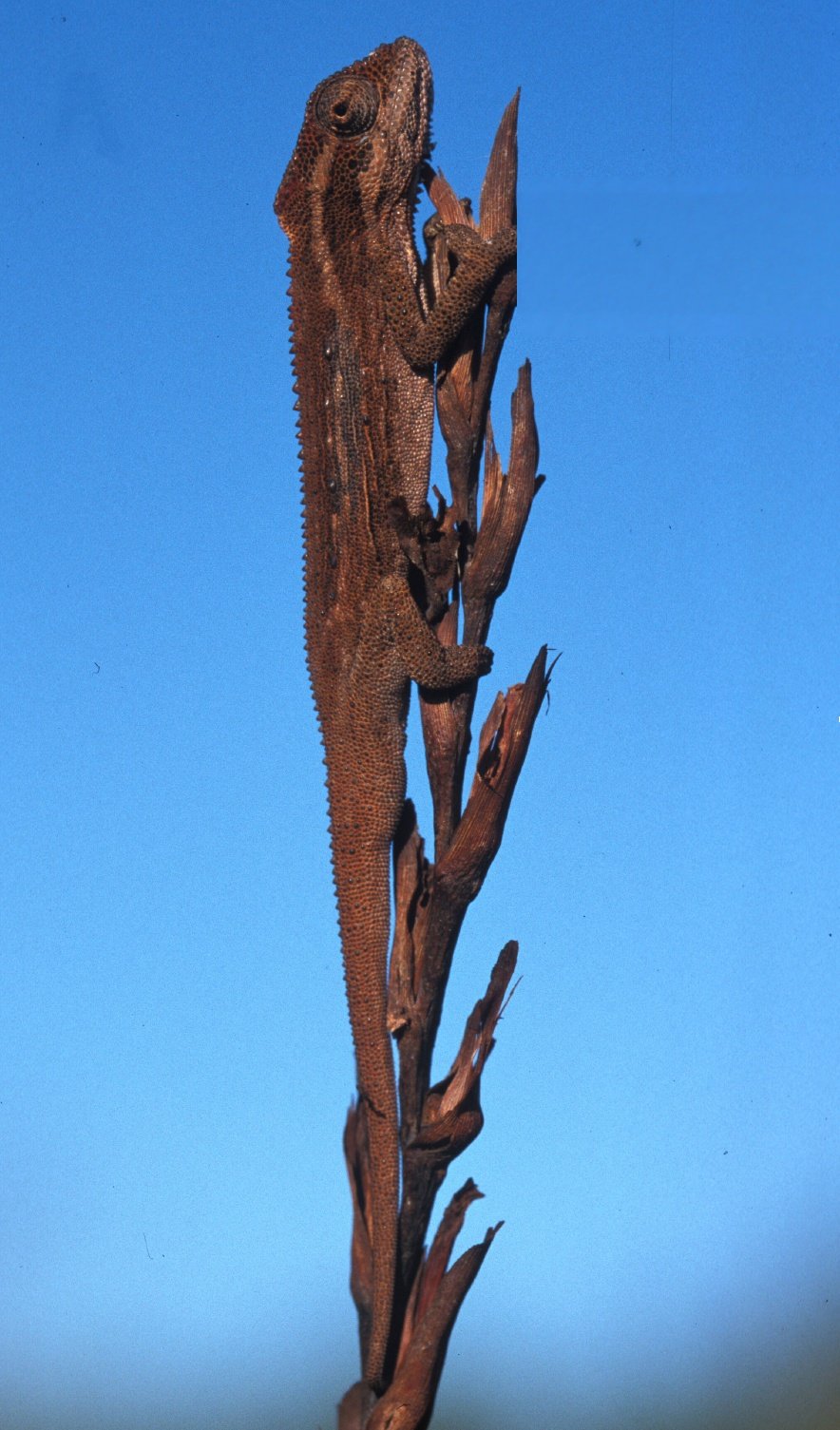
Chameleons · Difficulty: Intermediate
Key facts and care guidance for Smith's dwarf chameleon (Bradypodion taeniabronchum) (origin: The Eastern Cape, South Africa). Adult size around 8–11 cm. Life expectancy 4–8 years. The values below are carefully researched guidance.
Short answers
Smith's dwarf chameleon: How big does the enclosure need to be?
50×50×80 cm for one animal — airflow matters more than a tight seal.
Smith's dwarf chameleon: What temperature does it need?
Daytime 18–25 °C, basking spot Basking spot 26–29 °C, at night 11–15 °C.
Smith's dwarf chameleon: Does it need UVB lighting?
UVB: Essential (UVB 5.0–6.0).
Smith's dwarf chameleon: How long do they live?
Life expectancy: 4–8 years.
Smith's dwarf chameleon: Is it suitable for beginners?
Rather not – it is considered an intermediate species (difficulty: Intermediate).
Climate
- Daytime temperature
- 18–25 °C
- Night temperature
- 11–15 °C
- Basking spot
- Basking spot 26–29 °C
- Humidity
- 55–75 %
- UVB
- Essential (UVB 5.0–6.0)
Enclosure
- Minimum size
- 50×50×80 cm for one animal — airflow matters more than a tight seal
- Substrate
- Forest-floor substrate with live plants, dense branchwork
Feeding
- Food
- House crickets, crickets, roaches and flies in rotation, dusted regularly with calcium and vitamins
- Feeding interval
- adults every other day
Key facts
- Adult size
- 8–11 cm
- Life expectancy
- 4–8 years
- Origin
- The Eastern Cape, South Africa
- Protection status
- CITES II, IUCN "Endangered"
- Brumation
- No winter rest; cooler in winter
- Cohabitation
- Keep strictly singly — chameleons are not group animals, and mere visual contact alone means constant stress.
Notes
A fynbos dweller whose habitat is shrinking badly.
Do you keep this species?
Add your animal to Reptoria – Reptoria reminds you about feeding and shedding. Add your animal for free →
Look for Smith's dwarf chameleon (Bradypodion taeniabronchum) in the marketplace →
Related species
- Drakensberg dwarf chameleon (Bradypodion dracomontanum) – Intermediate
- Cape dwarf chameleon (Bradypodion pumilum) – Intermediate
- Karoo dwarf chameleon (Bradypodion karrooicum) – Intermediate
- Robertson dwarf chameleon (Bradypodion gutturale) – Intermediate
- Knysna dwarf chameleon (Bradypodion damaranum) – Intermediate
- Natal Midlands dwarf chameleon (Bradypodion thamnobates) – Expert
- Black-headed dwarf chameleon (Bradypodion melanocephalum) – Intermediate
- Setaro's dwarf chameleon (Bradypodion setaroi) – Intermediate
What you need to start
To keep Smith's dwarf chameleon (Bradypodion taeniabronchum) you typically need: a suitable enclosure (50×50×80 cm for one animal — airflow matters more than a tight seal), substrate (Forest-floor substrate with live plants, dense branchwork), a heat source with a thermostat, UVB lighting, thermometer and hygrometer, a water dish and hides. You will find equipment in the Reptoria marketplace.
The complete, interactive care database is in the Reptoria app.
Last updated: 9 October 2026 · Editor: Reptoria editorial team · Sources include: https://en.wikipedia.org/wiki/Smith%27s_dwarf_chameleon, https://www.tyroneping.co.za/chameleons/bradypodion-taeniabronchum/
All values are non-binding guidance and do not replace expert advice. Research thoroughly from several sources before acquiring and keeping an animal, and observe the applicable law (species and animal protection in particular).