Striped mud turtle (Kinosternon baurii)
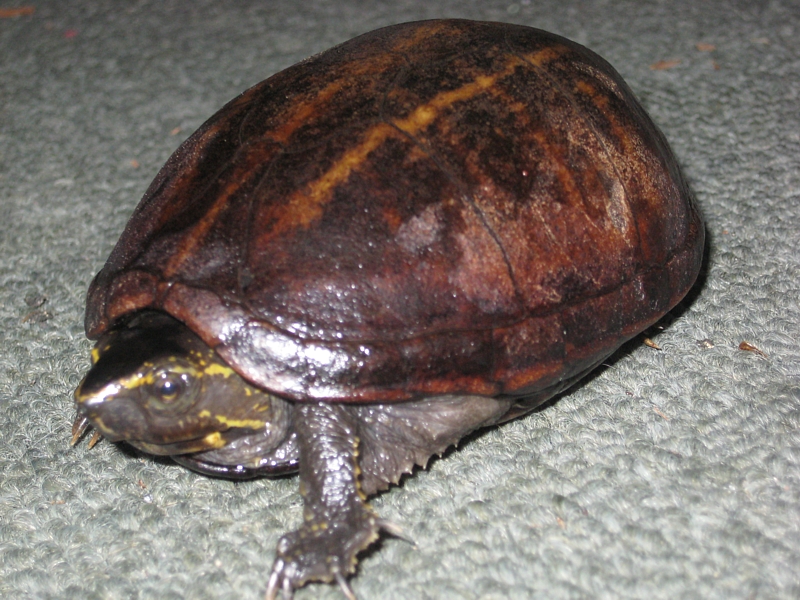
Turtles & tortoises · Difficulty: Beginner
Key facts and care guidance for Striped mud turtle (Kinosternon baurii) (origin: The south-eastern USA (Florida to Virginia)). Adult size around approx. 10 cm (small, usually under 12 cm). Life expectancy 20–30 years, sometimes up to ~50. The values below are carefully researched guidance.
Short answers
Striped mud turtle: How big does the enclosure need to be?
An aquarium from approx. 100×40 cm / 40 gal; shallow water plus an easily reached exit and basking spot.
Striped mud turtle: What temperature does it need?
Daytime 23–26 °C water (74–78 °F), basking spot 31–33 °C (88–92 °F, basking), at night 20–22 °C.
Striped mud turtle: Does it need UVB lighting?
UVB: UVB needed (10–12 h a day above the basking spot).
Striped mud turtle: How long do they live?
Life expectancy: 20–30 years, sometimes up to ~50.
Striped mud turtle: Is it suitable for beginners?
Yes – it is considered suitable for beginners (difficulty: Beginner).
Climate
- Daytime temperature
- 23–26 °C water (74–78 °F)
- Night temperature
- 20–22 °C
- Basking spot
- 31–33 °C (88–92 °F, basking)
- Humidity
- — (aquatic)
- UVB
- UVB needed (10–12 h a day above the basking spot)
Enclosure
- Minimum size
- an aquarium from approx. 100×40 cm / 40 gal; shallow water plus an easily reached exit and basking spot
- Substrate
- Fine sand or a soft floor
Feeding
- Food
- Carnivorous to omnivorous – invertebrates, snails, earthworms, prawns, fish, pellets
- Feeding interval
- adults 2–3×/week, juveniles daily
Key facts
- Adult size
- approx. 10 cm (small, usually under 12 cm)
- Life expectancy
- 20–30 years, sometimes up to ~50
- Origin
- The south-eastern USA (Florida to Virginia)
- Protection status
- CITES Appendix II (Kinosternon spp., CoP19 in 2022), EU Regulation Annex B; proof of origin required
- Brumation
- They come from warm regions (Florida) – no strict winter rest is needed; a mild rest period is optional for animals of northern origin
- Cohabitation
- Single housing recommended; no more than 1 animal per tank. The reason is territory: males ram and bite one another, and females are harassed so persistently during prolonged courtship that they visibly lose weight. Worn shell edges and bites on the hind legs are what you end up showing the vet.
Notes
A weak swimmer – shallow water and good climbing and exit options matter. A small-staying species; good filtration and water changes.
Do you keep this species?
Add your animal to Reptoria – Reptoria reminds you about feeding and shedding. Add your animal for free →
Look for Striped mud turtle (Kinosternon baurii) in the marketplace →
Related species
- Rough-footed mud turtle (Kinosternon hirtipes) – Intermediate
- Mississippi mud turtle (Kinosternon subrubrum hippocrepis) – Intermediate
- Scorpion mud turtle (Kinosternon scorpioides) – Intermediate
- Sonora mud turtle (Kinosternon sonoriense) – Intermediate
- Tabasco mud turtle (Kinosternon acutum) – Intermediate
- White-lipped mud turtle (Kinosternon leucostomum) – Intermediate
- Yellow mud turtle (Kinosternon flavescens) – Intermediate
- Eastern box turtle (Terrapene carolina) – Intermediate
What you need to start
To keep Striped mud turtle (Kinosternon baurii) you typically need: a suitable enclosure (an aquarium from approx. 100×40 cm / 40 gal; shallow water plus an easily reached exit and basking spot), substrate (Fine sand or a soft floor), a heat source with a thermostat, UVB lighting, thermometer and hygrometer, a water dish and hides. You will find equipment in the Reptoria marketplace.
The complete, interactive care database is in the Reptoria app.
Last updated: 30 October 2026 · Editor: Reptoria editorial team · Sources include: https://en.wikipedia.org/wiki/Kinosternon, https://en.wikipedia.org/wiki/Sternotherus_minor, https://en.wikipedia.org/wiki/Striped_mud_turtle
All values are non-binding guidance and do not replace expert advice. Research thoroughly from several sources before acquiring and keeping an animal, and observe the applicable law (species and animal protection in particular).