Usambara two-horned chameleon (Kinyongia multituberculata)
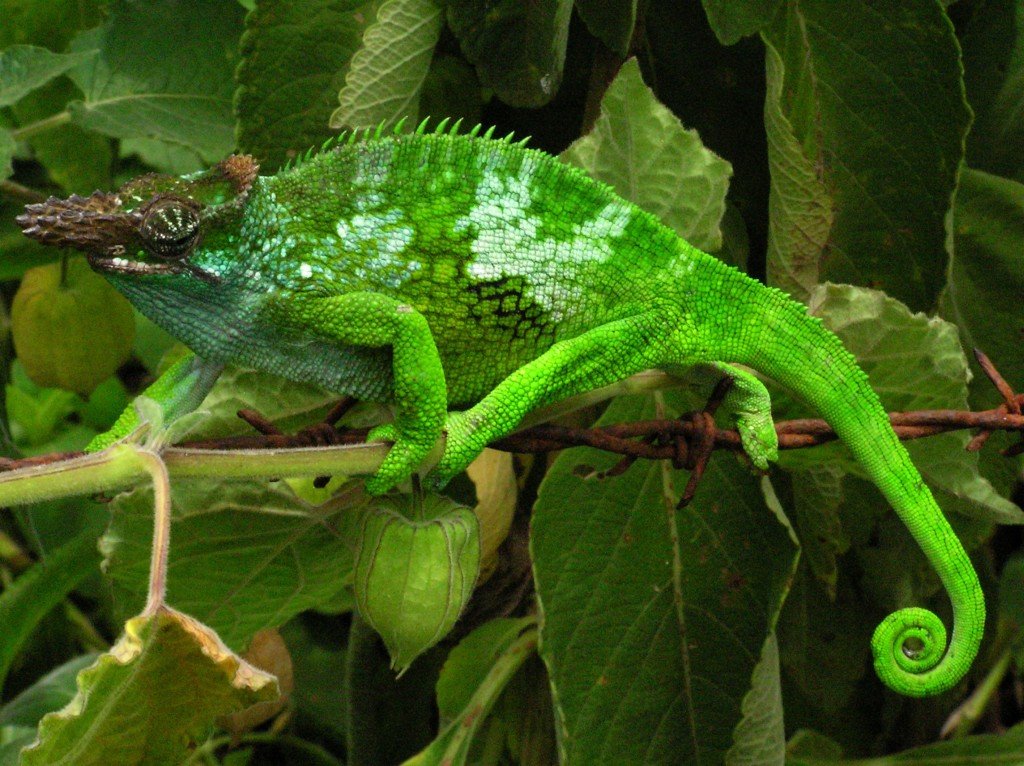
Chameleons · Difficulty: Intermediate
Key facts and care guidance for Usambara two-horned chameleon (Kinyongia multituberculata) (origin: Endemic to the West Usambara Mountains, Tanzania (the Eastern Arc); montane rainforest at about 1,200–2,500 m). Adult size around males up to approx. 34 cm total length (the tail more than half the length; SVL ~15–17 cm), females considerably smaller (SVL ~10–12 cm). Life expectancy approx. 5–10 years when kept well and cool (a mountain species, potentially long-lived; figures range from 4–6 to over 12 years). The values below are carefully researched guidance.
Short answers
Usambara two-horned chameleon: How big does the enclosure need to be?
80×50×100 cm (L×W×H) for one adult male; tall and vertical, mesh or gauze ventilation (the lid plus at least one side), densely planted.
Usambara two-horned chameleon: What temperature does it need?
Daytime 22–26 °C (not permanently above 28 °C – montane forest species, sensitive to heat), basking spot small basking spot up to approx. 28–30 °C (spot-sized, no warmer), at night 12–18 °C (a strong night-time drop is ESSENTIAL, all year round).
Usambara two-horned chameleon: Does it need UVB lighting?
UVB: UVB needed (Ferguson zone 2, partial shade, UV index approx. 2–3); e.g. a Solar Raptor / Bright Sun 50–70 W plus a halogen spot for warming up.
Usambara two-horned chameleon: How long do they live?
Life expectancy: approx. 5–10 years when kept well and cool (a mountain species, potentially long-lived; figures range from 4–6 to over 12 years).
Usambara two-horned chameleon: Is it suitable for beginners?
Rather not – it is considered an intermediate species (difficulty: Intermediate).
Climate
- Daytime temperature
- 22–26 °C (not permanently above 28 °C – montane forest species, sensitive to heat)
- Night temperature
- 12–18 °C (a strong night-time drop is ESSENTIAL, all year round)
- Basking spot
- small basking spot up to approx. 28–30 °C (spot-sized, no warmer)
- Humidity
- 60–80 % by day, higher at night and in the morning (up to ~90–100 %); a marked day–night swing
- UVB
- UVB needed (Ferguson zone 2, partial shade, UV index approx. 2–3); e.g. a Solar Raptor / Bright Sun 50–70 W plus a halogen spot for warming up
Enclosure
- Minimum size
- 80×50×100 cm (L×W×H) for one adult male; tall and vertical, mesh or gauze ventilation (the lid plus at least one side), densely planted
- Substrate
- Damp terrarium or garden soil (peat- and fertiliser-free); the females need at least 15 cm of depth for egg-laying; avoid pure sand (risk of impaction)
Feeding
- Food
- Flying insects preferred: butterflies and moths, green bottle and fruit flies, flies, small locusts; dusted with calcium and vitamins (house crickets and mealworms are often refused)
- Feeding interval
- adults 2–3×/week or every other day, juveniles daily
Key facts
- Adult size
- males up to approx. 34 cm total length (the tail more than half the length; SVL ~15–17 cm), females considerably smaller (SVL ~10–12 cm)
- Life expectancy
- approx. 5–10 years when kept well and cool (a mountain species, potentially long-lived; figures range from 4–6 to over 12 years)
- Origin
- Endemic to the West Usambara Mountains, Tanzania (the Eastern Arc); montane rainforest at about 1,200–2,500 m
- Protection status
- CITES Appendix II / EU Regulation Annex B → registration required under German nature conservation law, proof of origin needed (prefer captive-bred, ideally German-bred); it was only recognised as a species in 2010 (CoP15), and Tanzanian export is heavily limited and largely stopped after 2017; IUCN: Endangered
- Brumation
- No real winter rest; but a night-time drop in temperature is essential all year round (a day–night gradient) for health and life expectancy
- Cohabitation
- Keep them singly (strictly solitary and territorial). NEVER keep males together (territorial and ritual fights); keeping them permanently as a pair means stress. Bring them together only briefly and under supervision for breeding.
Notes
The commonest keeping mistakes: no night-time cooling (heat stress and a badly shortened lifespan – cooling equipment is usually needed), conditions that are too warm or too dry, and constant stress from keeping it as a pair or in a group. Wild-caught animals are often wormed and stressed → prefer captive-bred ones. Important: the species has often been wrongly traded as "Kinyongia fischeri" (over 95 % of the animals exported as fischeri were in fact K. multituberculata). It drinks from droplets and mist – a dripper and morning and evening misting are needed. One source generically gives pair keeping as possible – the majority view, the specialist consensus and the chameleon standard say: keep it singly.
Do you keep this species?
Add your animal to Reptoria – Reptoria reminds you about feeding and shedding. Add your animal for free →
Look for Usambara two-horned chameleon (Kinyongia multituberculata) in the marketplace →
Related species
- Adolf Friedrich's chameleon (Kinyongia adolfifriderici) – Expert
- Böhme's two-horned chameleon (Kinyongia boehmei) – Expert
- Carpenter's chameleon (Kinyongia carpenteri) – Expert
- Fischer's two-horned chameleon (Kinyongia fischeri) – Intermediate
- Taveta two-horned chameleon (Kinyongia tavetana) – Intermediate
- Magombera chameleon (Kinyongia magomberae) – Expert
- Matschie's two-horned chameleon (Kinyongia matschiei) – Intermediate
- Strange-nosed chameleon (Kinyongia xenorhina) – Expert
What you need to start
To keep Usambara two-horned chameleon (Kinyongia multituberculata) you typically need: a suitable enclosure (80×50×100 cm (L×W×H) for one adult male; tall and vertical, mesh or gauze ventilation (the lid plus at least one side), densely planted), substrate (Damp terrarium or garden soil (peat- and fertiliser-free); the females need at least 15 cm of depth for egg-laying; avoid pure sand (risk of impaction)), a heat source with a thermostat, UVB lighting, thermometer and hygrometer, a water dish and hides. You will find equipment in the Reptoria marketplace.
The complete, interactive care database is in the Reptoria app.
Last updated: 9 October 2026 · Editor: Reptoria editorial team · Sources include: https://en.wikipedia.org/wiki/Kinyongia_multituberculata, https://reptile-database.reptarium.cz/species?genus=Kinyongia&species=multituberculata
All values are non-binding guidance and do not replace expert advice. Research thoroughly from several sources before acquiring and keeping an animal, and observe the applicable law (species and animal protection in particular).