Western giant anole (Anolis luteogularis)
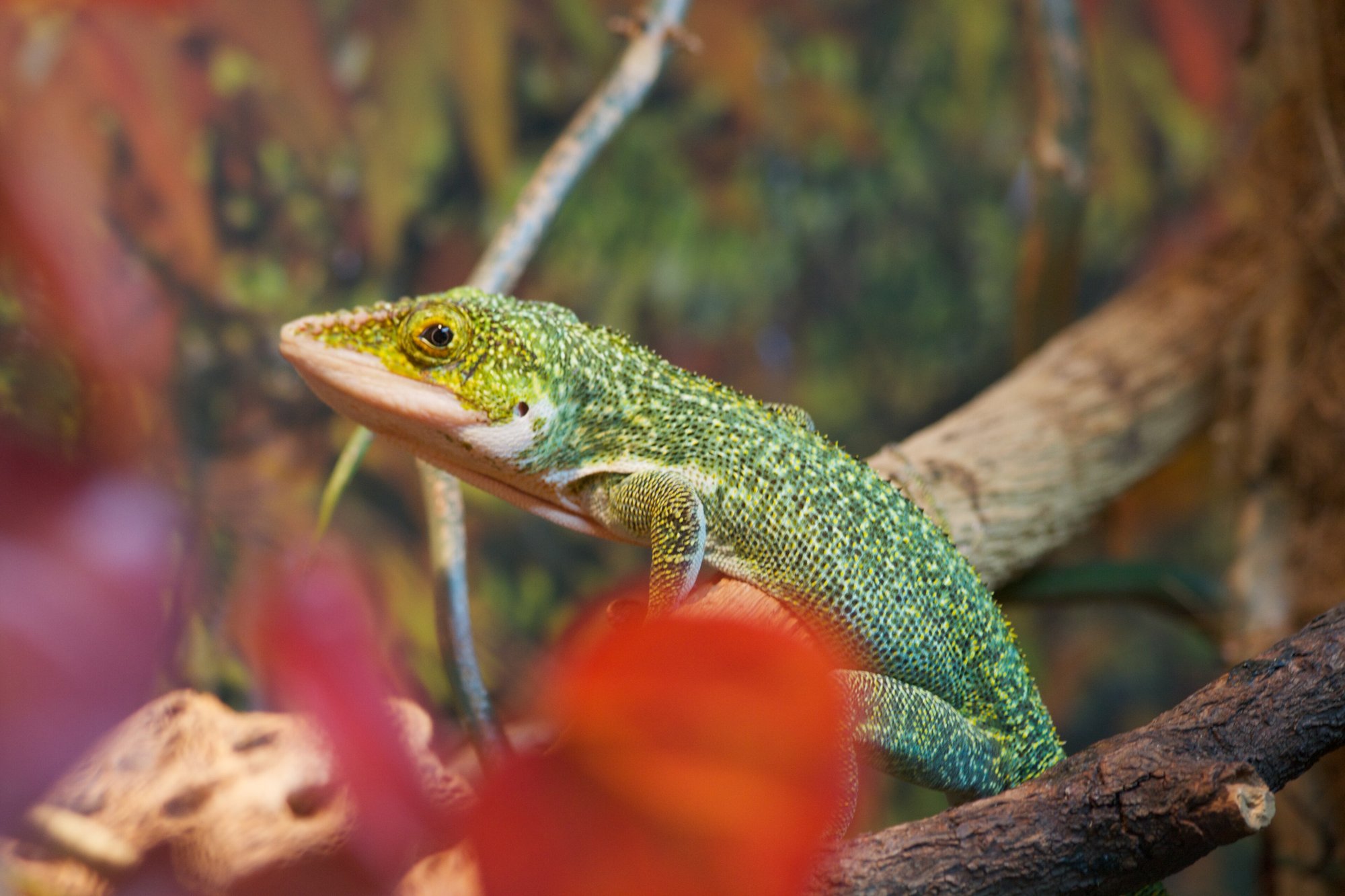
Iguanas · Difficulty: Expert
Key facts and care guidance for Western giant anole (Anolis luteogularis) (origin: Endemic to western Cuba including the Isla de la Juventud; a crown and trunk dweller of tall trees (the equestris complex)). Adult size around 40–55 cm total length; snout–vent length in males up to 19 cm, in females up to 17.5 cm. The largest anole species overall, with a massive, angular head. Life expectancy 10–15 years in captivity. The values below are carefully researched guidance.
Short answers
Western giant anole: How big does the enclosure need to be?
115×115×155 cm for one animal (expert report formula for arboreal anoles: 6×6×8 times the snout–vent length, at a 19 cm SVL). Arm-thick vertical and horizontal branches, sturdy trunks, a cork or rock background, good ventilation.
Western giant anole: What temperature does it need?
Daytime 26–30 °C, basking spot Basking spot 33–35 °C, at night 18–25 °C; brief drops to 16 °C are well tolerated.
Western giant anole: Does it need UVB lighting?
UVB: UVB needed (Ferguson zone 2–3, UV index 3–4).
Western giant anole: How long do they live?
Life expectancy: 10–15 years in captivity.
Western giant anole: Is it suitable for beginners?
No – better suited to experienced keepers (difficulty: Expert).
Climate
- Daytime temperature
- 26–30 °C
- Night temperature
- 18–25 °C; brief drops to 16 °C are well tolerated
- Basking spot
- Basking spot 33–35 °C
- Humidity
- 60–80 %
- UVB
- UVB needed (Ferguson zone 2–3, UV index 3–4)
Enclosure
- Minimum size
- 115×115×155 cm for one animal (expert report formula for arboreal anoles: 6×6×8 times the snout–vent length, at a 19 cm SVL). Arm-thick vertical and horizontal branches, sturdy trunks, a cork or rock background, good ventilation
- Substrate
- Forest floor or coco humus with leaf litter, sturdy climbing branches and trunks, live planting
Feeding
- Food
- Large insects: migratory locusts, large crickets, roaches; plus fruit and occasionally small vertebrates; calcium and vitamins
- Feeding interval
- adults 2–3×/week, juveniles daily
Key facts
- Adult size
- 40–55 cm total length; snout–vent length in males up to 19 cm, in females up to 17.5 cm. The largest anole species overall, with a massive, angular head
- Life expectancy
- 10–15 years in captivity
- Origin
- Endemic to western Cuba including the Isla de la Juventud; a crown and trunk dweller of tall trees (the equestris complex)
- Protection status
- No CITES or EU regulation protection; not specially protected. Prefer captive-bred animals (a Cuban endemic).
- Brumation
- A slightly cooler seasonal spell is possible (Cuba); no strict winter rest is required
- Cohabitation
- Very large and strongly territorial. Keep them singly; NEVER keep males together (serious injuries). Keep them as a pair only for breeding, in a very large enclosure and under supervision.
Notes
Its giant size calls for a very large terrarium, strong lighting and UVB, and warmth. It can bite hard. Specific husbandry data are limited – the climate figures are derived from care of the large Cuban anoles (the knight anole / equestris group).
Do you keep this species?
Add your animal to Reptoria – Reptoria reminds you about feeding and shedding. Add your animal for free →
Look for Western giant anole (Anolis luteogularis) in the marketplace →
Related species
- Ghost anole (Anolis lemurinus) – Intermediate
- Ahl's anole (Anolis ahli) – Intermediate
- Aliniger anole (Anolis aliniger) – Beginner with some knowledge
- Allogus anole (Anolis allogus) – Beginner with some knowledge
- Bahaman green anole (Anolis smaragdinus) – Beginner
- Bahoruco anole (Anolis bahorucoensis) – Beginner with some knowledge
- Baleatus giant anole (Anolis baleatus) – Intermediate
- Baracoa giant anole (Anolis baracoae) – Intermediate
What you need to start
To keep Western giant anole (Anolis luteogularis) you typically need: a suitable enclosure (115×115×155 cm for one animal (expert report formula for arboreal anoles: 6×6×8 times the snout–vent length, at a 19 cm SVL). Arm-thick vertical and horizontal branches, sturdy trunks, a cork or rock background, good ventilation), substrate (Forest floor or coco humus with leaf litter, sturdy climbing branches and trunks, live planting), a heat source with a thermostat, UVB lighting, thermometer and hygrometer, a water dish and hides. You will find equipment in the Reptoria marketplace.
The complete, interactive care database is in the Reptoria app.
Last updated: 9 October 2026 · Editor: Reptoria editorial team · Sources include: EUR-Lex VO (EU) 2026/1383, Wikipedia EN, anoleannals.org (Losos: Lizards in an Evolutionary Tree, Kap. 3), anolesatoz.weebly.com, eu_annex.txt (lokal)
All values are non-binding guidance and do not replace expert advice. Research thoroughly from several sources before acquiring and keeping an animal, and observe the applicable law (species and animal protection in particular).