Western hognose snake (Heterodon nasicus)
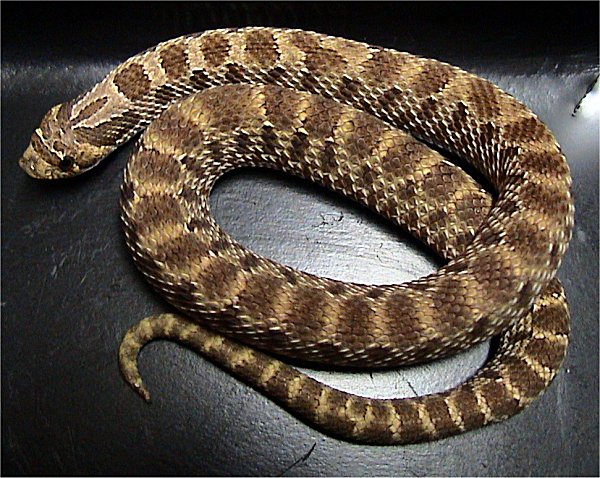
Snakes · Difficulty: Beginner
Key facts and care guidance for Western hognose snake (Heterodon nasicus) (origin: Central and North America, dry prairie). Adult size around 45–65 cm (♀ larger, up to 90 cm). Life expectancy 15–20 years. The values below are carefully researched guidance.
Short answers
Western hognose snake: How big does the enclosure need to be?
From 90×45×45 cm for one animal, from 100×50×50 cm for a pair.
Western hognose snake: What temperature does it need?
Daytime 25–30 °C, basking spot 32–35 °C, at night 17–20 °C.
Western hognose snake: Does it need UVB lighting?
UVB: Optional.
Western hognose snake: How long do they live?
Life expectancy: 15–20 years.
Western hognose snake: Is it suitable for beginners?
Yes – it is considered suitable for beginners (difficulty: Beginner).
Climate
- Daytime temperature
- 25–30 °C
- Night temperature
- 17–20 °C
- Basking spot
- 32–35 °C
- Humidity
- 40–60 %
- UVB
- Optional
Enclosure
- Minimum size
- from 90×45×45 cm for one animal, from 100×50×50 cm for a pair
- Substrate
- A sand and soil mix or forest floor, 6–10 cm deep for digging
Feeding
- Food
- Mice (frozen-thawed), preferably smaller prey
- Feeding interval
- adults every 7–14 days
Key facts
- Adult size
- 45–65 cm (♀ larger, up to 90 cm)
- Life expectancy
- 15–20 years
- Origin
- Central and North America, dry prairie
- Protection status
- —
- Brumation
- Optional: winter rest of 8–12 weeks at 10–15 °C, shortened lighting, with food withheld for two weeks beforehand; not for animals under one year old. It's necessary for breeding. Even without a winter rest, many animals don't eat for weeks in winter.
- Cohabitation
- Keeping singly is the least stressful; only put animals together briefly and under supervision for mating. A pair or a small group is possible, but: the animals compete for basking spot and hides, and there is a risk of cannibalism at feeding time — so always feed separately and choose a sufficiently large enclosure.
Notes
A dry terrarium with somewhere to dig. Opisthoglyphous (mildly venomous), practically harmless to humans, and it rarely bites; refusing food and bluffing are typical.
Do you keep this species?
Add your animal to Reptoria – Reptoria reminds you about feeding and shedding. Add your animal for free →
Western hognose snake (Heterodon nasicus) currently offered
- 1.0 Hakennasennatter Toffee Conda 2026 – Toffee Conda · Wuppertal · 60 €
- 0.1 Hakennasennatter Super Arctic Toffee 2024 ( Pet Only) – Super Arctic Toffee · Wuppertal · 80 €
- Hakennasennattern abzugeben – Super Yeti, Arctic Sunburst, Superconda , Arctic Albino Conda · Reinbek · 80 €
- Heterodon Lemon Ghost (Woma) Nachzuchten – Lemon Ghost · Lampertheim
- Schlangen abzugeben – Hamburg · 60 €
- Heterodon nasicus NZ 2024 – Tiger Conda 66% het. lavendar · Jerxheim · 200 €
Related species
- Mexican hognose snake (Heterodon kennerlyi) – Beginner
- Eastern hognose snake (Heterodon platirhinos) – Intermediate
- Southern hognose snake (Heterodon simus) – Intermediate
- Blonde hognose snake (Leioheterodon modestus) – Intermediate
- Malagasy giant hognose (Leioheterodon madagascariensis) – Intermediate
- Geay's hognose snake (Leioheterodon geayi) – Intermediate
- Tricolor hognose snake (Xenodon pulcher) – Intermediate
- Egyptian sand boa (Eryx colubrinus colubrinus) – Beginner
What you need to start
To keep Western hognose snake (Heterodon nasicus) you typically need: a suitable enclosure (from 90×45×45 cm for one animal, from 100×50×50 cm for a pair), substrate (A sand and soil mix or forest floor, 6–10 cm deep for digging), a heat source with a thermostat, UVB lighting, thermometer and hygrometer, a water dish and hides. You will find equipment in the Reptoria marketplace.
The complete, interactive care database is in the Reptoria app.
Last updated: 4 November 2026 · Editor: Reptoria editorial team · Sources include: einrichtungsbeispiele.de, exotische-tierwelt.de, koenigzucker.de, tropic-shop.de, Gutachten 1997
All values are non-binding guidance and do not replace expert advice. Research thoroughly from several sources before acquiring and keeping an animal, and observe the applicable law (species and animal protection in particular).