Eastern hognose snake (Heterodon platirhinos)
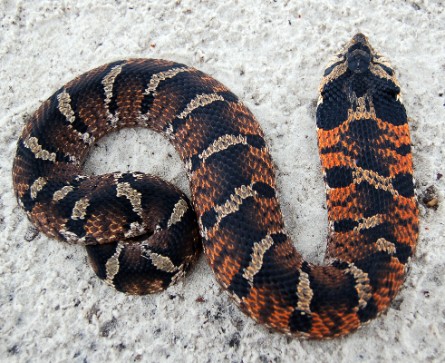
Snakes · Difficulty: Intermediate
Key facts and care guidance for Eastern hognose snake (Heterodon platirhinos) (origin: The eastern USA and south-eastern Canada (forest, grassland, sandy soils)). Adult size around males approx. 50–70 cm, females approx. 80–115 cm. Life expectancy approx. 10–15+ years. The values below are carefully researched guidance.
Short answers
Eastern hognose snake: How big does the enclosure need to be?
From 115×60×60 cm (minimum size according to the 1997 expert report, hognose snakes).
Eastern hognose snake: What temperature does it need?
Daytime 24–28 °C, basking spot 32–35 °C, at night 18–21 °C.
Eastern hognose snake: Does it need UVB lighting?
UVB: UVB not essential, weak UVB (Ferguson zone 1–2) recommended.
Eastern hognose snake: How long do they live?
Life expectancy: approx. 10–15+ years.
Eastern hognose snake: Is it suitable for beginners?
Rather not – it is considered an intermediate species (difficulty: Intermediate).
Climate
- Daytime temperature
- 24–28 °C
- Night temperature
- 18–21 °C
- Basking spot
- 32–35 °C
- Humidity
- 50–60 %
- UVB
- UVB not essential, weak UVB (Ferguson zone 1–2) recommended
Enclosure
- Minimum size
- from 115×60×60 cm (minimum size according to the 1997 expert report, hognose snakes)
- Substrate
- Loose sandy substrate they can dig in (a sand-soil mix), at least 10 cm deep
Feeding
- Food
- A toad specialist in the wild; in captivity rodents (usually offered scented) plus frogs and toads
- Feeding interval
- adults every 7–10 days, juveniles every 5–7 days
Key facts
- Adult size
- males approx. 50–70 cm, females approx. 80–115 cm
- Life expectancy
- approx. 10–15+ years
- Origin
- The eastern USA and south-eastern Canada (forest, grassland, sandy soils)
- Protection status
- Not listed under CITES; no special EU requirements
- Brumation
- Brumation is recommended (they come from a temperate climate): several weeks at about 8–13 °C, mainly to prepare for breeding
- Cohabitation
- Keep them singly (territorial, with stress and competition over food when housed together). Never keep males together; only for supervised breeding
Notes
Opisthoglyphous (rear-fanged), with a mild Duvernoy's secretion – usually harmless to humans, and only rarely an allergic reaction. It can play dead or show a threat display as a bluff. Feeding problems are common (a specialised feeder) – hence advanced. The size differs strongly between the sexes.
Do you keep this species?
Add your animal to Reptoria – Reptoria reminds you about feeding and shedding. Add your animal for free →
Look for Eastern hognose snake (Heterodon platirhinos) in the marketplace →
Related species
- Mexican hognose snake (Heterodon kennerlyi) – Beginner
- Southern hognose snake (Heterodon simus) – Intermediate
- Western hognose snake (Heterodon nasicus) – Beginner
- Blonde hognose snake (Leioheterodon modestus) – Intermediate
- Malagasy giant hognose (Leioheterodon madagascariensis) – Intermediate
- Geay's hognose snake (Leioheterodon geayi) – Intermediate
- Tricolor hognose snake (Xenodon pulcher) – Intermediate
- Common egg-eating snake (Dasypeltis scabra) – Intermediate
What you need to start
To keep Eastern hognose snake (Heterodon platirhinos) you typically need: a suitable enclosure (from 115×60×60 cm (minimum size according to the 1997 expert report, hognose snakes)), substrate (Loose sandy substrate they can dig in (a sand-soil mix), at least 10 cm deep), a heat source with a thermostat, UVB lighting, thermometer and hygrometer, a water dish and hides. You will find equipment in the Reptoria marketplace.
The complete, interactive care database is in the Reptoria app.
Last updated: 30 October 2026 · Editor: Reptoria editorial team · Sources include: https://en.wikipedia.org/wiki/Eastern_hognose_snake, https://hiphogs.com/hognose-basic-care, https://reptifiles.com/wp-content/uploads/2020/11/Eastern-Hognose-Snake-Care-Sheet-PDF-1.pdf, https://reptile-database.reptarium.cz/species?genus=Heterodon&species=platirhinos
All values are non-binding guidance and do not replace expert advice. Research thoroughly from several sources before acquiring and keeping an animal, and observe the applicable law (species and animal protection in particular).