Zebra skink (Trachylepis dichroma)
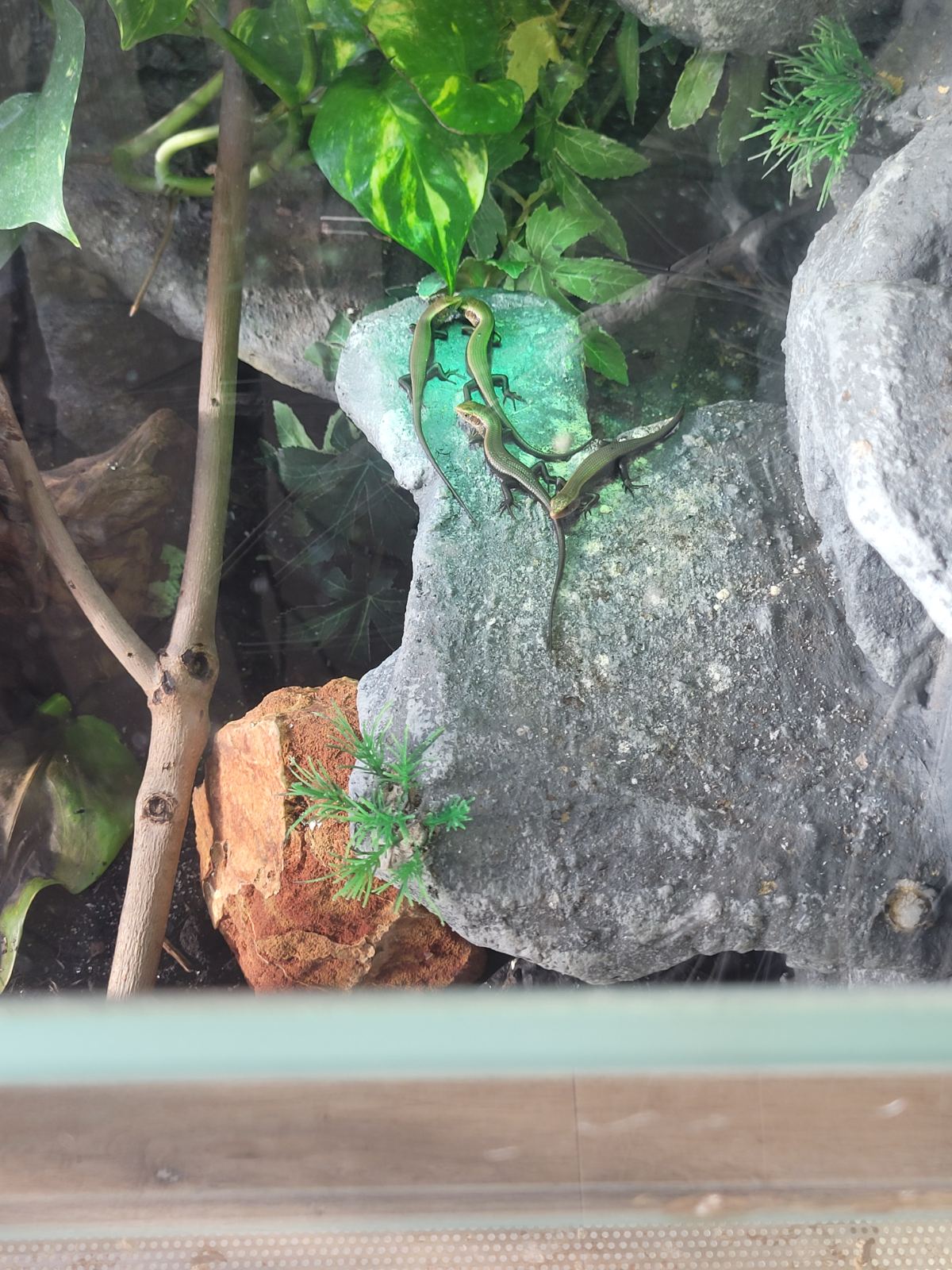
Skinks · Difficulty: Beginner
Key facts and care guidance for Zebra skink (Trachylepis dichroma) (origin: East Africa — Kenya and Tanzania (partly Uganda); dry savannah and steppe, semi-arid grassland). Adult size around 25–30 cm total length (including the tail; ~10–12 inches). Life expectancy approx. 15 years in captivity. The values below are carefully researched guidance.
Short answers
Zebra skink: How big does the enclosure need to be?
100×50×50 cm for one adult animal; correspondingly larger and longer for groups.
Zebra skink: What temperature does it need?
Daytime 24–28 °C (ambient/background ~22–25 °C, warm zone up to ~30 °C), basking spot 35–40 °C (basking spot; some care sheets give 32–35 °C — choose the safe middle range), at night 18–21 °C (not below 15 °C).
Zebra skink: Does it need UVB lighting?
UVB: UVB needed (Ferguson zone 2–3, UV index 2–4; a T5 HO 5.0/6 % or a metal-halide lamp).
Zebra skink: How long do they live?
Life expectancy: approx. 15 years in captivity.
Zebra skink: Is it suitable for beginners?
Yes – it is considered suitable for beginners (difficulty: Beginner).
Climate
- Daytime temperature
- 24–28 °C (ambient/background ~22–25 °C, warm zone up to ~30 °C)
- Night temperature
- 18–21 °C (not below 15 °C)
- Basking spot
- 35–40 °C (basking spot; some care sheets give 32–35 °C — choose the safe middle range)
- Humidity
- 40–60 % (adapted to dry conditions, at the lower end during the day; briefly higher at night)
- UVB
- UVB needed (Ferguson zone 2–3, UV index 2–4; a T5 HO 5.0/6 % or a metal-halide lamp)
Enclosure
- Minimum size
- 100×50×50 cm for one adult animal; correspondingly larger and longer for groups
- Substrate
- A sand-loam mix they can dig in (sandy soil), with stones, cork bark and several hides
Feeding
- Food
- Omnivorous with an insect focus: house crickets, crickets, roaches, locusts, occasionally mealworms; supplemented with a little fruit and vegetables, rarely egg or a commercial omnivore or gecko diet
- Feeding interval
- adults 2–3×/week, juveniles (almost) daily; dust insects with calcium and vitamin D3
Key facts
- Adult size
- 25–30 cm total length (including the tail; ~10–12 inches)
- Life expectancy
- approx. 15 years in captivity
- Origin
- East Africa — Kenya and Tanzania (partly Uganda); dry savannah and steppe, semi-arid grassland
- Protection status
- Not protected — not listed under CITES, the EU Species Protection Regulation or German nature conservation law; no registration duty. Even so, prefer captive breeding and proof of origin.
- Brumation
- No true brumation is required; a slight winter cooling (they usually retreat from November) is optional and helps put them in breeding condition
- Cohabitation
- Group keeping is possible — one of the few social skink species with pronounced parental care (the parents protect the young). Recommended: one male plus several females (a harem, 1.2 or 1.3 for example) or groups of females alone. Do NOT keep several adult males together (territorial fights, especially in the mating season). The conditions: plenty of space, visual barriers, several basking spots and hides per animal, and watching for biting.
Notes
Strong sexual dimorphism: the males have a red-orange throat and chest (especially in the mating season), while the females keep the zebra striping. Egg-laying (about 4–8 eggs, incubation at about 26–28 °C, 60–90 days). Common keeping mistakes: conditions that are too damp (the species is adapted to dry), too small or too cool a basking spot, and missing UVB. A robust, reliably feeding beginner's species that becomes quite tame with calm handling. Note: the basking-spot figures scatter by source (32–40 °C); one retailer wrongly gave a South African origin — the consensus and the Reptile Database document East Africa (Kenya/Tanzania).
Do you keep this species?
Add your animal to Reptoria – Reptoria reminds you about feeding and shedding. Add your animal for free →
Look for Zebra skink (Trachylepis dichroma) in the marketplace →
Related species
- African five-lined skink (Trachylepis quinquetaeniata) – Intermediate
- Variable skink (Trachylepis varia) – Beginner with some knowledge
- Speckle-lipped skink (Trachylepis maculilabris) – Beginner with some knowledge
- African striped skink (Trachylepis striata) – Beginner with some knowledge
- Cape skink (Trachylepis capensis) – Beginner with some knowledge
- Rainbow skink (Trachylepis margaritifera) – Beginner
- Teita skink (Trachylepis perrotetii) – Beginner with some knowledge
- Algerian skink (Eumeces algeriensis) – Intermediate
What you need to start
To keep Zebra skink (Trachylepis dichroma) you typically need: a suitable enclosure (100×50×50 cm for one adult animal; correspondingly larger and longer for groups), substrate (A sand-loam mix they can dig in (sandy soil), with stones, cork bark and several hides), a heat source with a thermostat, UVB lighting, thermometer and hygrometer, a water dish and hides. You will find equipment in the Reptoria marketplace.
The complete, interactive care database is in the Reptoria app.
Last updated: 30 October 2026 · Editor: Reptoria editorial team · Sources include: https://reptile-database.reptarium.cz/species?genus=Trachylepis&species=dichroma, https://www.alismenagerie.co.uk/care/reptiles-and-amphibians/kenyan-zebra-skink-care, https://www.monkfieldreptile.com/blog/zebra-skink-care-sheet
All values are non-binding guidance and do not replace expert advice. Research thoroughly from several sources before acquiring and keeping an animal, and observe the applicable law (species and animal protection in particular).