Amazonian horned frog (Ceratophrys cornuta)
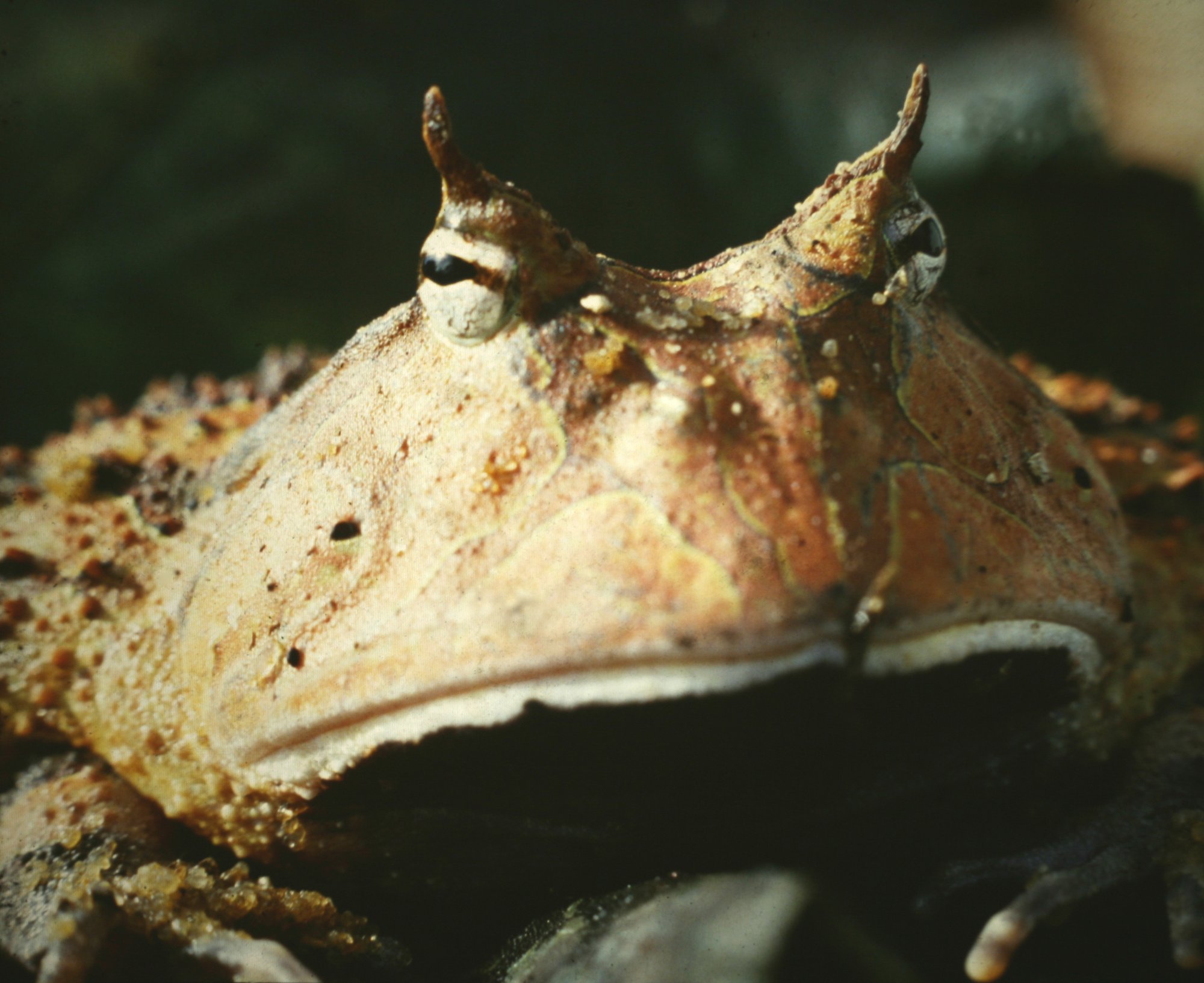
Amphibians · Difficulty: Intermediate
Key facts and care guidance for Amazonian horned frog (Ceratophrys cornuta) (origin: Amazon basin and Guiana Shield (Brazil, Colombia, Ecuador, Peru, Bolivia, Venezuela, Guyana, Suriname, French Guiana)). Adult size around 9–15 cm (females larger). Life expectancy 10–15 years. The values below are carefully researched guidance.
Short answers
Amazonian horned frog: How big does the enclosure need to be?
From 80 × 40 × 40 cm for an adult animal; height is unimportant, but plenty of floor space with deep substrate is needed.
Amazonian horned frog: What temperature does it need?
Daytime 24–28 °C, basking spot No basking spot needed, at night 20–22 °C.
Amazonian horned frog: Does it need UVB lighting?
UVB: Not essential.
Amazonian horned frog: How long do they live?
Life expectancy: 10–15 years.
Amazonian horned frog: Is it suitable for beginners?
Rather not – it is considered an intermediate species (difficulty: Intermediate).
Climate
- Daytime temperature
- 24–28 °C
- Night temperature
- 20–22 °C
- Basking spot
- No basking spot needed
- Humidity
- 70–90 %
- UVB
- Not essential
Enclosure
- Minimum size
- from 80 × 40 × 40 cm for an adult animal; height is unimportant, but plenty of floor space with deep substrate is needed
- Substrate
- Damp coco humus or sphagnum for burying, a shallow water dish
Feeding
- Food
- Insects, occasionally nestlings or fish
- Feeding interval
- Adults every 7–10 days, juveniles every 2–3 days.
Key facts
- Adult size
- 9–15 cm (females larger)
- Life expectancy
- 10–15 years
- Origin
- Amazon basin and Guiana Shield (Brazil, Colombia, Ecuador, Peru, Bolivia, Venezuela, Guyana, Suriname, French Guiana)
- Protection status
- Not listed under CITES
- Brumation
- None
- Cohabitation
- Keep them strictly singly. This species eats anything that fits in its mouth — including its own kind, and even animals of roughly the same size. For breeding, put them together only briefly and under observation.
Notes
It eats anything that fits in its mouth – including its own kind. Never keep two together. It sits buried and lies in wait; it runs strongly to obesity when overfed.
Do you keep this species?
Add your animal to Reptoria – Reptoria reminds you about feeding and shedding. Add your animal for free →
Look for Amazonian horned frog (Ceratophrys cornuta) in the marketplace →
Related species
- Brazilian horned frog (Ceratophrys aurita) – Intermediate
- Caatinga horned frog (Ceratophrys joazeirensis) – Intermediate
- Cranwell's horned frog (Ceratophrys cranwelli) – Beginner
- Ornate horned frog (Ceratophrys ornata) – Beginner
- African bullfrog (Pyxicephalus adspersus) – Beginner to intermediate
- Budgett's frog (Lepidobatrachus laevis) – Intermediate
- Chaco dwarf frog (Chacophrys pierottii) – Intermediate
- Edible bullfrog (Pyxicephalus edulis) – Beginner
What you need to start
To keep Amazonian horned frog (Ceratophrys cornuta) you typically need: a suitable enclosure (from 80 × 40 × 40 cm for an adult animal; height is unimportant, but plenty of floor space with deep substrate is needed), substrate (Damp coco humus or sphagnum for burying, a shallow water dish), a heat source with a thermostat, UVB lighting, thermometer and hygrometer, a water dish and hides. You will find equipment in the Reptoria marketplace.
The complete, interactive care database is in the Reptoria app.
Last updated: 2 November 2026 · Editor: Reptoria editorial team · Sources include: animaldiversity.org, Wikipedia EN, EUR-Lex VO (EU) 2026/1383, drta-archiv.de, einrichtungsbeispiele.de
All values are non-binding guidance and do not replace expert advice. Research thoroughly from several sources before acquiring and keeping an animal, and observe the applicable law (species and animal protection in particular).