American bullfrog (Lithobates catesbeianus)
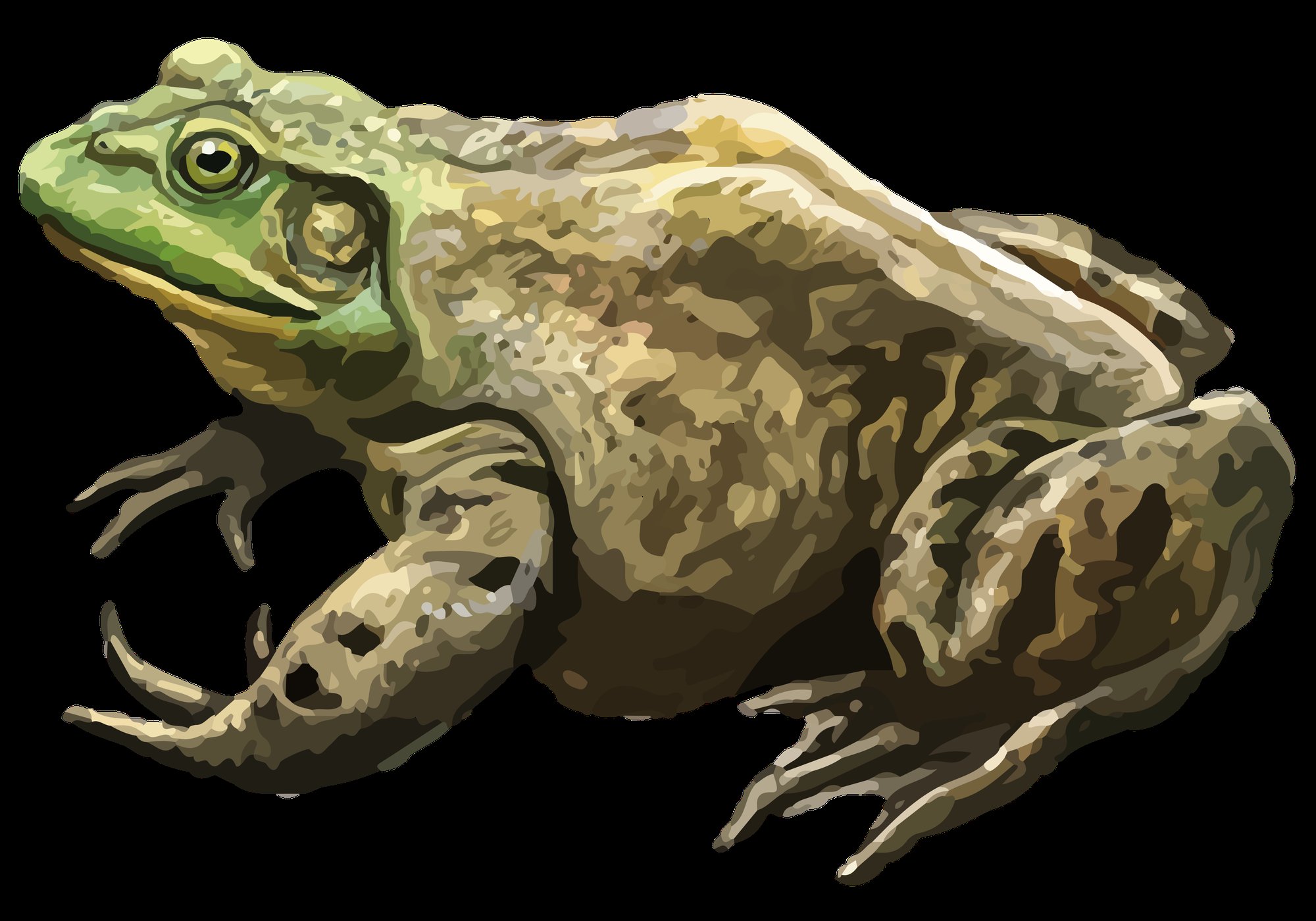
Amphibians · Difficulty: Intermediate
Key facts and care guidance for American bullfrog (Lithobates catesbeianus) (origin: North America (the USA, Canada); introduced as an invasive species to Europe, Asia and South America). Adult size around up to approx. 20 cm SVL (females), up to ~800 g; males smaller. Life expectancy approx. 7–10 years (individuals up to 15+). The values below are carefully researched guidance.
Short answers
American bullfrog: How big does the enclosure need to be?
An aqua-paludarium from approx. 150×60×60 cm for one animal, water at least 30 cm deep (they need a lot of space).
American bullfrog: What temperature does it need?
Daytime 24–28 °C, at night 20–22 °C.
American bullfrog: Does it need UVB lighting?
UVB: UVB not essential; weak lighting or UVB recommended.
American bullfrog: How long do they live?
Life expectancy: approx. 7–10 years (individuals up to 15+).
American bullfrog: Is it suitable for beginners?
Rather not – it is considered an intermediate species (difficulty: Intermediate).
Climate
- Daytime temperature
- 24–28 °C
- Night temperature
- 20–22 °C
- Basking spot
- —
- Humidity
- 70–90 %
- UVB
- UVB not essential; weak lighting or UVB recommended
Enclosure
- Minimum size
- an aqua-paludarium from approx. 150×60×60 cm for one animal, water at least 30 cm deep (they need a lot of space)
- Substrate
- Semi-aquatic: a large water section plus a land section; soil or gravel on land, dense bank vegetation
Feeding
- Food
- Insects, earthworms, fish, small vertebrates – it eats anything that fits in its mouth
- Feeding interval
- adults 1–2×/week, juveniles noticeably more often
Key facts
- Adult size
- up to approx. 20 cm SVL (females), up to ~800 g; males smaller
- Life expectancy
- approx. 7–10 years (individuals up to 15+)
- Origin
- North America (the USA, Canada); introduced as an invasive species to Europe, Asia and South America
- Protection status
- CAUTION: Generally PROHIBITED in the EU – listed on the Union list of invasive species (EU Regulation 1143/2014). Keeping, breeding, trading, transporting and releasing it are all forbidden. Only animals held before the listing are grandfathered (escape-proof, no breeding, until they die naturally). NO new acquisitions.
- Brumation
- In their temperate native climate an overwintering or winter rest (cool) is possible; for EU keepers this is practically irrelevant, as new acquisitions are prohibited anyway
- Cohabitation
- Single keeping. The bullfrog is an ambush hunter that eats conspecifics and other frogs; cannibalism is documented, and males defend shoreline stretches against rivals. Keeping with others is out of the question. Note: new acquisition is banned in the EU (Union list of invasive species).
Notes
The most important point: keeping it is banned in the EU (an invasive species on the Union list) – do not acquire or import it. Very large, extremely voracious, loud callers, with a high space and water requirement. Ecologically dangerous as a neozoon; release is strictly prohibited.
Do you keep this species?
Add your animal to Reptoria – Reptoria reminds you about feeding and shedding. Add your animal for free →
Look for American bullfrog (Lithobates catesbeianus) in the marketplace →
Related species
- African bullfrog (Pyxicephalus adspersus) – Beginner to intermediate
- Amazonian horned frog (Ceratophrys cornuta) – Intermediate
- Brazilian horned frog (Ceratophrys aurita) – Intermediate
- Budgett's frog (Lepidobatrachus laevis) – Intermediate
- Caatinga horned frog (Ceratophrys joazeirensis) – Intermediate
- Chaco dwarf frog (Chacophrys pierottii) – Intermediate
- Cranwell's horned frog (Ceratophrys cranwelli) – Beginner
- Edible bullfrog (Pyxicephalus edulis) – Beginner
What you need to start
To keep American bullfrog (Lithobates catesbeianus) you typically need: a suitable enclosure (an aqua-paludarium from approx. 150×60×60 cm for one animal, water at least 30 cm deep (they need a lot of space)), substrate (Semi-aquatic: a large water section plus a land section; soil or gravel on land, dense bank vegetation), a heat source with a thermostat, UVB lighting, thermometer and hygrometer, a water dish and hides. You will find equipment in the Reptoria marketplace.
The complete, interactive care database is in the Reptoria app.
Last updated: 7 November 2026 · Editor: Reptoria editorial team · Sources include: https://animaldiversity.org/accounts/Lithobates_catesbeianus/, https://de.wikipedia.org/wiki/Amerikanischer_Ochsenfrosch, https://en.wikipedia.org/wiki/American_bullfrog, https://environment.ec.europa.eu/topics/nature-and-biodiversity/invasive-alien-species_en, https://eur-lex.europa.eu/legal-content/DE/TXT/?uri=CELEX:32014R1143
All values are non-binding guidance and do not replace expert advice. Research thoroughly from several sources before acquiring and keeping an animal, and observe the applicable law (species and animal protection in particular).