Anegada ground iguana (Cyclura pinguis)
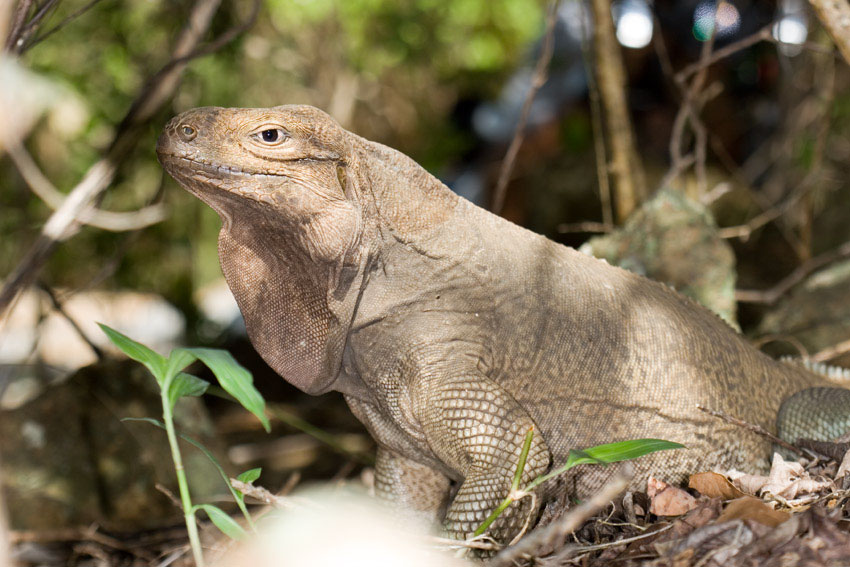
Iguanas · Difficulty: Expert
Key facts and care guidance for Anegada ground iguana (Cyclura pinguis) (origin: British Virgin Islands: Anegada (the only original population) plus introduced populations on Guana Island and three other islands; historically also Puerto Rico and St. Thomas. Tropical dry scrub forest with rock crevices and large shade trees). Adult size around up to about 115 cm total length (snout–vent 43–55 cm plus a tail of equal length); males 6–7.2 kg, females 4.3–5.1 kg. Life expectancy 40 years and more, individual animals up to about 80 years. The values below are carefully researched guidance.
Short answers
Anegada ground iguana: How big does the enclosure need to be?
From 280×220×170 cm for a pair (expert report: 5 × 4 × 3 times snout–vent length at 55 cm), at least 250×180×180 cm for a single animal; a secure outdoor enclosure is markedly better in summer.
Anegada ground iguana: What temperature does it need?
Daytime 30–35 °C, basking spot 43–48 °C, at night 20–24 °C.
Anegada ground iguana: Does it need UVB lighting?
UVB: Essential (UVB 12.0 — a very high requirement in herbivorous species).
Anegada ground iguana: How long do they live?
Life expectancy: 40 years and more, individual animals up to about 80 years.
Anegada ground iguana: Is it suitable for beginners?
No – better suited to experienced keepers (difficulty: Expert).
Climate
- Daytime temperature
- 30–35 °C
- Night temperature
- 20–24 °C
- Basking spot
- 43–48 °C
- Humidity
- 40–60 %
- UVB
- Essential (UVB 12.0 — a very high requirement in herbivorous species)
Enclosure
- Minimum size
- from 280×220×170 cm for a pair (expert report: 5 × 4 × 3 times snout–vent length at 55 cm), at least 250×180×180 cm for a single animal; a secure outdoor enclosure is markedly better in summer
- Substrate
- A sand-loam mix they can dig in, with solid rock structures and climbing branches
Feeding
- Food
- Purely plant-based: about 80% dark leafy greens, 15% grated vegetables and squash, 5% fruit. No animal protein
- Feeding interval
- adults 6–7×/week
Key facts
- Adult size
- up to about 115 cm total length (snout–vent 43–55 cm plus a tail of equal length); males 6–7.2 kg, females 4.3–5.1 kg
- Life expectancy
- 40 years and more, individual animals up to about 80 years
- Origin
- British Virgin Islands: Anegada (the only original population) plus introduced populations on Guana Island and three other islands; historically also Puerto Rico and St. Thomas. Tropical dry scrub forest with rock crevices and large shade trees
- Protection status
- CITES Appendix I, IUCN "Critically Endangered" — trade is effectively ruled out
- Brumation
- No winter dormancy. A seasonal variation in day length and temperature is worthwhile, but within the warm range
- Cohabitation
- 1.1 or 1.2; never keep males together — with these species it quickly turns fatal
Notes
Only a few hundred animals remain in the wild. Conservation breeding only.
Do you keep this species?
Add your animal to Reptoria – Reptoria reminds you about feeding and shedding. Add your animal for free →
Look for Anegada ground iguana (Cyclura pinguis) in the marketplace →
Related species
- Grand Cayman blue iguana (Cyclura lewisi) – Expert
- Jamaican iguana (Cyclura collei) – Expert
- Cuban rock iguana (Cyclura nubila) – Expert
- Rhinoceros iguana (Cyclura cornuta) – Expert
- Ricord's iguana (Cyclura ricordii) – Expert
- San Salvador rock iguana (Cyclura rileyi) – Expert
- Turks and Caicos rock iguana (Cyclura carinata) – Expert
- Common chuckwalla (Sauromalus ater) – Intermediate
What you need to start
To keep Anegada ground iguana (Cyclura pinguis) you typically need: a suitable enclosure (from 280×220×170 cm for a pair (expert report: 5 × 4 × 3 times snout–vent length at 55 cm), at least 250×180×180 cm for a single animal; a secure outdoor enclosure is markedly better in summer), substrate (A sand-loam mix they can dig in, with solid rock structures and climbing branches), a heat source with a thermostat, UVB lighting, thermometer and hygrometer, a water dish and hides. You will find equipment in the Reptoria marketplace.
The complete, interactive care database is in the Reptoria app.
Last updated: 2 November 2026 · Editor: Reptoria editorial team · Sources include: journals.ku.edu (Iguana / IRCF), critter.science, jessesjungle.com, dubiaroaches.com, portals.iucn.org (Species Recovery Plan)
All values are non-binding guidance and do not replace expert advice. Research thoroughly from several sources before acquiring and keeping an animal, and observe the applicable law (species and animal protection in particular).