Cuban rock iguana (Cyclura nubila)
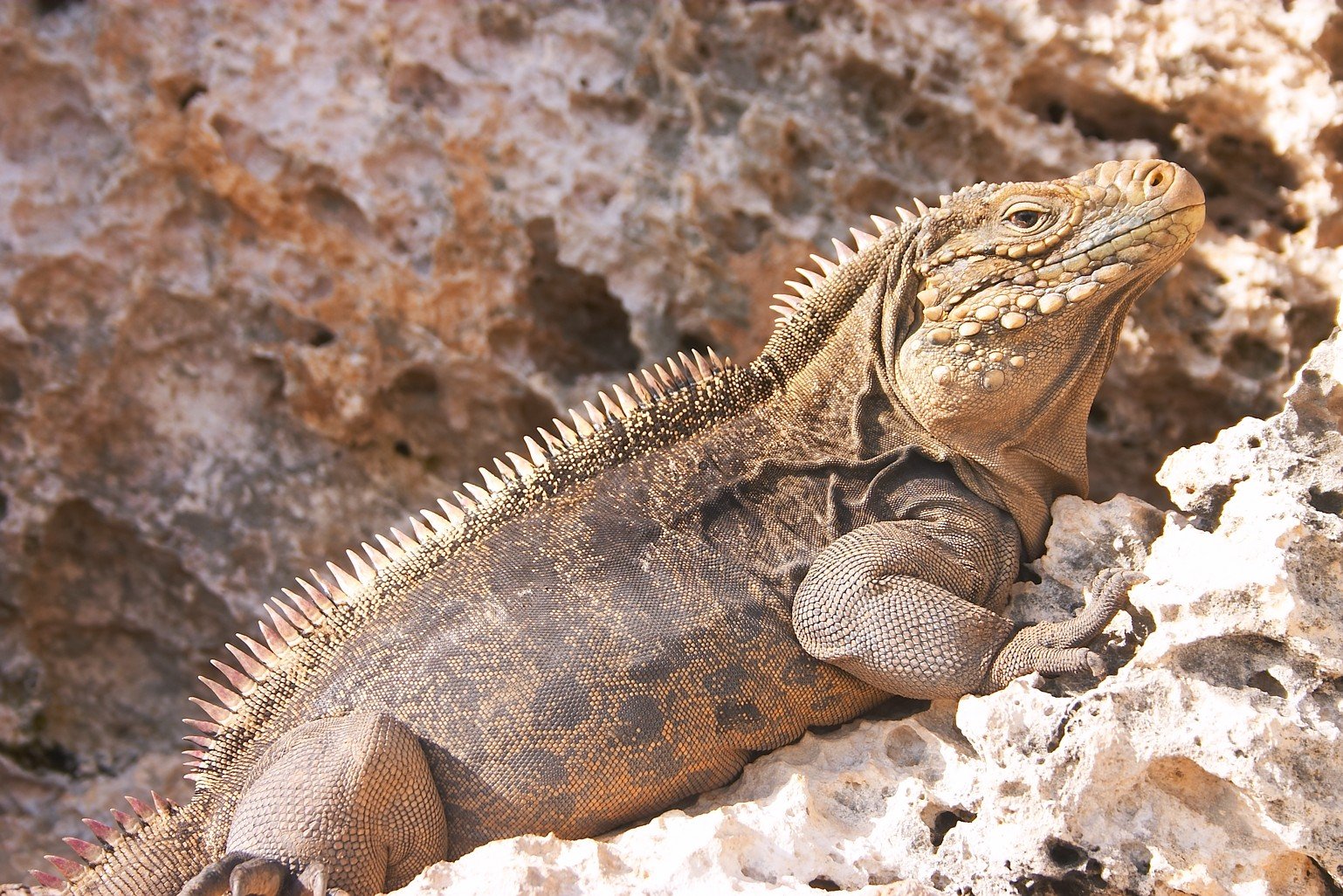
Iguanas · Difficulty: Expert
Key facts and care guidance for Cuban rock iguana (Cyclura nubila) (origin: Cuba and its offshore islands (including Cayo Largo del Sur)). Adult size around up to ~150 cm total length (males), a very powerful body – the largest Cyclura species. Life expectancy 25–40+ years (Cyclura are very long-lived). The values below are carefully researched guidance.
Short answers
Cuban rock iguana: How big does the enclosure need to be?
Very large; at least ~250×150×150 cm for one adult animal, better a room or outdoor facility of several m².
Cuban rock iguana: What temperature does it need?
Daytime 28–32 °C, basking spot 45–50 °C (hot basking spot), at night 22–24 °C.
Cuban rock iguana: Does it need UVB lighting?
UVB: UVB essential, high (an open-country sun species, Ferguson zone 3–4, UV index 4–6).
Cuban rock iguana: How long do they live?
Life expectancy: 25–40+ years (Cyclura are very long-lived).
Cuban rock iguana: Is it suitable for beginners?
No – better suited to experienced keepers (difficulty: Expert).
Climate
- Daytime temperature
- 28–32 °C
- Night temperature
- 22–24 °C
- Basking spot
- 45–50 °C (hot basking spot)
- Humidity
- 60–80 %
- UVB
- UVB essential, high (an open-country sun species, Ferguson zone 3–4, UV index 4–6)
Enclosure
- Minimum size
- Very large; at least ~250×150×150 cm for one adult animal, better a room or outdoor facility of several m²
- Substrate
- A sand, soil and loam mix they can dig in (quartz sand, for example) with stones and roots as heat stores
Feeding
- Food
- Mostly plant-based (leaves, flowers, vegetables, herbs, little fruit), occasionally animal food (a mouse now and then)
- Feeding interval
- adults plant food daily to every other day
Key facts
- Adult size
- up to ~150 cm total length (males), a very powerful body – the largest Cyclura species
- Life expectancy
- 25–40+ years (Cyclura are very long-lived)
- Origin
- Cuba and its offshore islands (including Cayo Largo del Sur)
- Protection status
- CITES Appendix I / EU Regulation Annex A – strictly protected, IUCN "Vulnerable". Proof of origin plus commercial-use and registration duties; only documented captive-bred animals are legal
- Brumation
- No real winter rest; seasonal climate and light cycles (a cooler, shorter winter spell) encourage reproduction
- Cohabitation
- Keep them singly; outside the mating season it is extremely aggressive and territorial. NEVER keep males together. Only temporarily 1.1 under supervision with a great deal of space and structure
Notes
It grows very large, very old and powerful – a genuine lifetime commitment with an enormous space, warmth and UV requirement. A powerful bite. CITES papers are essential. Adults are mainly plant-eating (too much animal food → gout and kidney damage).
Do you keep this species?
Add your animal to Reptoria – Reptoria reminds you about feeding and shedding. Add your animal for free →
Look for Cuban rock iguana (Cyclura nubila) in the marketplace →
Related species
- Anegada ground iguana (Cyclura pinguis) – Expert
- Grand Cayman blue iguana (Cyclura lewisi) – Expert
- Jamaican iguana (Cyclura collei) – Expert
- Rhinoceros iguana (Cyclura cornuta) – Expert
- Ricord's iguana (Cyclura ricordii) – Expert
- San Salvador rock iguana (Cyclura rileyi) – Expert
- Turks and Caicos rock iguana (Cyclura carinata) – Expert
- Common chuckwalla (Sauromalus ater) – Intermediate
What you need to start
To keep Cuban rock iguana (Cyclura nubila) you typically need: a suitable enclosure (Very large; at least ~250×150×150 cm for one adult animal, better a room or outdoor facility of several m²), substrate (A sand, soil and loam mix they can dig in (quartz sand, for example) with stones and roots as heat stores), a heat source with a thermostat, UVB lighting, thermometer and hygrometer, a water dish and hides. You will find equipment in the Reptoria marketplace.
The complete, interactive care database is in the Reptoria app.
Last updated: 2 November 2026 · Editor: Reptoria editorial team · Sources include: https://en.wikipedia.org/wiki/Cyclura_nubila, https://reptile-database.reptarium.cz/species?genus=Cyclura&species=cyclura_nubila
All values are non-binding guidance and do not replace expert advice. Research thoroughly from several sources before acquiring and keeping an animal, and observe the applicable law (species and animal protection in particular).