Grand Cayman blue iguana (Cyclura lewisi)
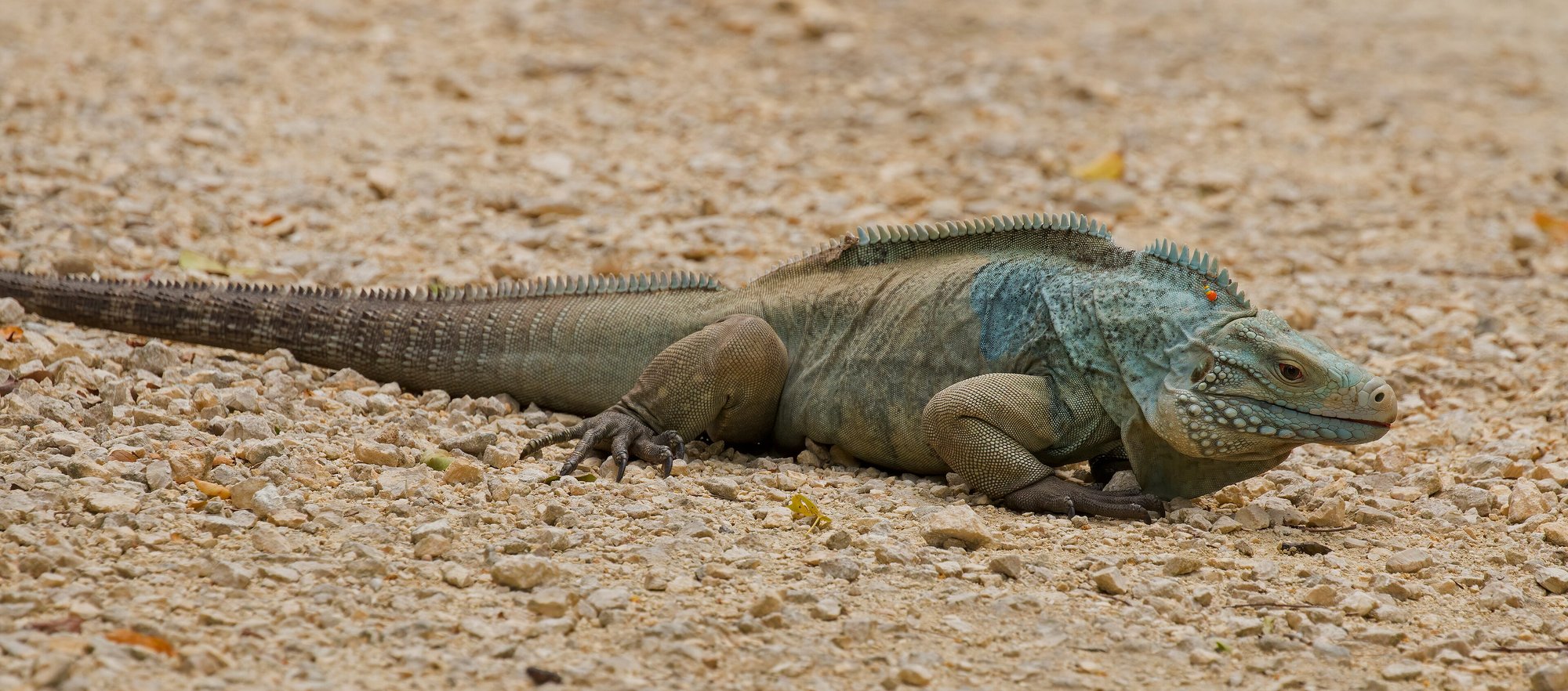
Iguanas · Difficulty: Expert
Key facts and care guidance for Grand Cayman blue iguana (Cyclura lewisi) (origin: Grand Cayman (endemic)). Adult size around Up to ~1.5 m total length, up to 14 kg. Life expectancy Several decades; 40–60 years is achievable in human care, and one animal died in 2004 at an estimated 69 years old. The values below are carefully researched guidance.
Short answers
Grand Cayman blue iguana: How big does the enclosure need to be?
For one animal or a pair according to the expert report (5 x 4 x 3 times snout–vent length, valid for up to two animals), at 60 cm SVL about 300 x 240 x 180 cm; only sensible as a walk-in room enclosure, plus an outdoor enclosure in summer.
Grand Cayman blue iguana: What temperature does it need?
Daytime 30–35 °C, basking spot Basking spot 38–40 °C, at night 24–27 °C.
Grand Cayman blue iguana: Does it need UVB lighting?
UVB: Essential (10–14 h a day).
Grand Cayman blue iguana: How long do they live?
Life expectancy: Several decades; 40–60 years is achievable in human care, and one animal died in 2004 at an estimated 69 years old.
Grand Cayman blue iguana: Is it suitable for beginners?
No – better suited to experienced keepers (difficulty: Expert).
Climate
- Daytime temperature
- 30–35 °C
- Night temperature
- 24–27 °C
- Basking spot
- Basking spot 38–40 °C
- Humidity
- 40–70 %
- UVB
- Essential (10–14 h a day)
Enclosure
- Minimum size
- For one animal or a pair according to the expert report (5 x 4 x 3 times snout–vent length, valid for up to two animals), at 60 cm SVL about 300 x 240 x 180 cm; only sensible as a walk-in room enclosure, plus an outdoor enclosure in summer
- Substrate
- A sand and soil mix, large rock structures
Feeding
- Food
- Mostly plant-based (leaves, vegetables, little fruit)
- Feeding interval
- Plant food daily for adults
Key facts
- Adult size
- Up to ~1.5 m total length, up to 14 kg
- Life expectancy
- Several decades; 40–60 years is achievable in human care, and one animal died in 2004 at an estimated 69 years old
- Origin
- Grand Cayman (endemic)
- Protection status
- CITES Appendix I / EU A, "Critically Endangered", strictly protected, registration required
- Brumation
- None
- Cohabitation
- Single housing or a pair; males are aggressive. The reason: several males fight over territory and basking spot until one is injured or permanently sits in the corner. Females also defend their own territories and form a hierarchy among themselves, so several females need a lot of space and their own basking and hiding spots each. In breeding facilities a pair is usually only put together for the mating season, because after egg-laying males often attack females as well; feed separately if sizes differ.
Notes
A critically endangered species in breeding programmes — practically unavailable in the private trade and legally problematic. A giant lizard with an enormous space requirement.
Do you keep this species?
Add your animal to Reptoria – Reptoria reminds you about feeding and shedding. Add your animal for free →
Look for Grand Cayman blue iguana (Cyclura lewisi) in the marketplace →
Related species
- Anegada ground iguana (Cyclura pinguis) – Expert
- Jamaican iguana (Cyclura collei) – Expert
- Cuban rock iguana (Cyclura nubila) – Expert
- Rhinoceros iguana (Cyclura cornuta) – Expert
- Ricord's iguana (Cyclura ricordii) – Expert
- San Salvador rock iguana (Cyclura rileyi) – Expert
- Turks and Caicos rock iguana (Cyclura carinata) – Expert
- Common chuckwalla (Sauromalus ater) – Intermediate
What you need to start
To keep Grand Cayman blue iguana (Cyclura lewisi) you typically need: a suitable enclosure (For one animal or a pair according to the expert report (5 x 4 x 3 times snout–vent length, valid for up to two animals), at 60 cm SVL about 300 x 240 x 180 cm; only sensible as a walk-in room enclosure, plus an outdoor enclosure in summer), substrate (A sand and soil mix, large rock structures), a heat source with a thermostat, UVB lighting, thermometer and hygrometer, a water dish and hides. You will find equipment in the Reptoria marketplace.
The complete, interactive care database is in the Reptoria app.
Last updated: 9 October 2026 · Editor: Reptoria editorial team · Sources include: Wikipedia DE, Wikipedia EN, eu_annex.txt (lokal, VO (EU) 2026/1383), gutachten.txt (BML 1997, lokal), petrosaurus.de
All values are non-binding guidance and do not replace expert advice. Research thoroughly from several sources before acquiring and keeping an animal, and observe the applicable law (species and animal protection in particular).