Angel's chameleon (Furcifer angeli)
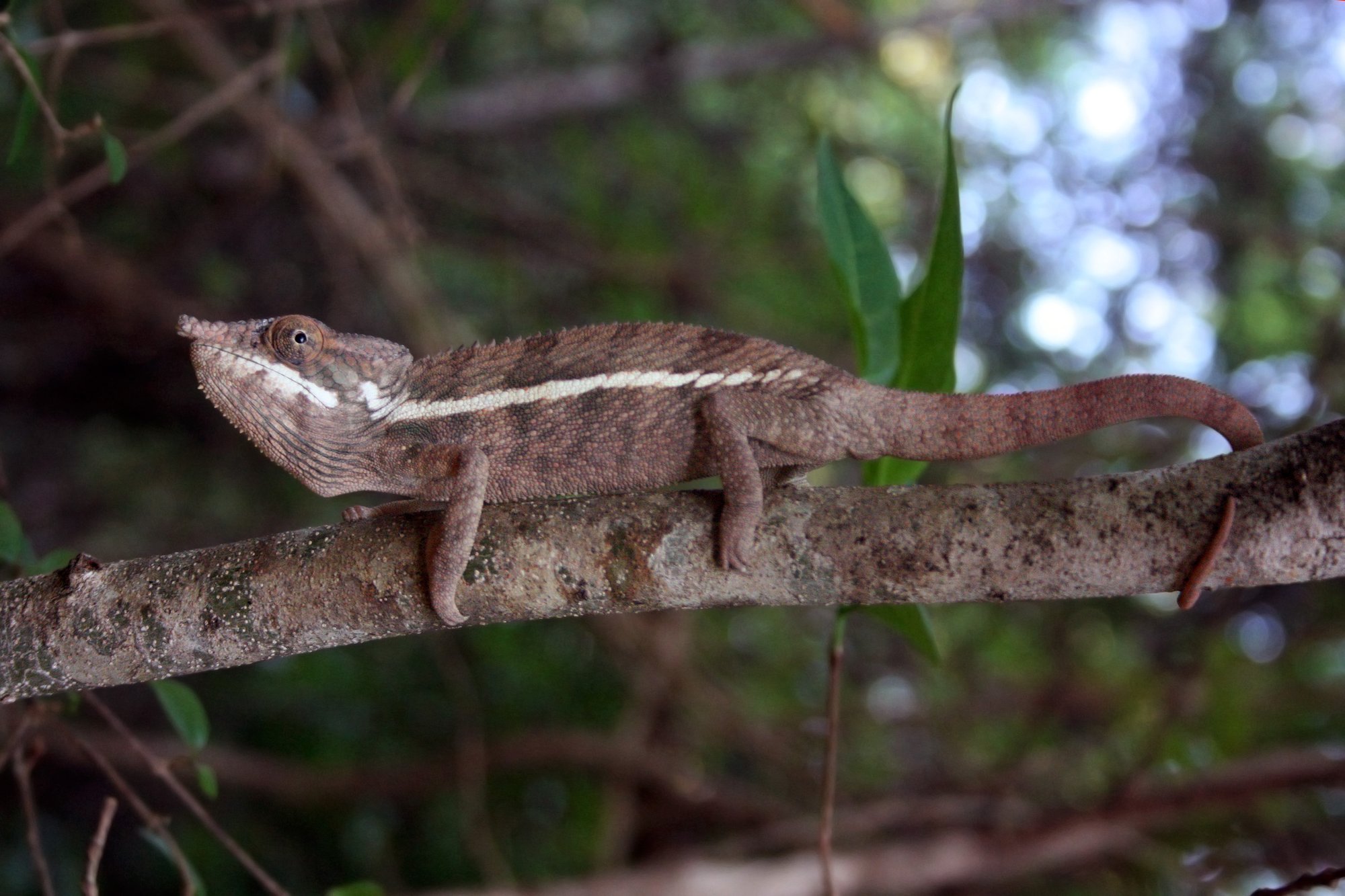
Chameleons · Difficulty: Expert
Key facts and care guidance for Angel's chameleon (Furcifer angeli) (origin: Northwest Madagascar: Ankarafantsika National Park, Bongolava, Namoroka and forest remnants near Port-Bergé and Mahajanga; dry forest at 40–300 m altitude). Adult size around males 33–42 cm, females 21–30 cm total length. Life expectancy 4–8 years. The values below are carefully researched guidance.
Short answers
Angel's chameleon: How big does the enclosure need to be?
60×60×120 cm for one animal — height and airflow, not a closed glass tank.
Angel's chameleon: What temperature does it need?
Daytime 24–28 °C, basking spot 30–33 °C, at night 18–23 °C.
Angel's chameleon: Does it need UVB lighting?
UVB: Essential (UVB 5.0–6.0).
Angel's chameleon: How long do they live?
Life expectancy: 4–8 years.
Angel's chameleon: Is it suitable for beginners?
No – better suited to experienced keepers (difficulty: Expert).
Climate
- Daytime temperature
- 24–28 °C
- Night temperature
- 18–23 °C
- Basking spot
- 30–33 °C
- Humidity
- rainy season 60–80 %, dry season 40–60 %; mist once or twice daily and let it dry out completely between mistings
- UVB
- Essential (UVB 5.0–6.0)
Enclosure
- Minimum size
- 60×60×120 cm for one animal — height and airflow, not a closed glass tank
- Substrate
- Forest-floor substrate with live plants and dense branches at all heights; for females, a soil-sand mix 25–30 cm deep for egg-laying, lightly moist and diggable
Feeding
- Food
- House crickets, crickets, roaches, flies and wax moths in rotation, dusted regularly with calcium and vitamins
- Feeding interval
- adults every other day
Key facts
- Adult size
- males 33–42 cm, females 21–30 cm total length
- Life expectancy
- 4–8 years
- Origin
- Northwest Madagascar: Ankarafantsika National Park, Bongolava, Namoroka and forest remnants near Port-Bergé and Mahajanga; dry forest at 40–300 m altitude
- Protection status
- CITES II, and Madagascar's export quota is zero for some species — insist on captive-bred animals
- Brumation
- No winter dormancy. Instead, replicate a dry season of four to six months: less misting, lower humidity, temperatures stay the same
- Cohabitation
- Strictly singly — chameleons are not group animals, and even being in sight of another is constant stress
Notes
A dry-forest species; it tolerates permanent damp poorly.
Do you keep this species?
Add your animal to Reptoria – Reptoria reminds you about feeding and shedding. Add your animal for free →
Look for Angel's chameleon (Furcifer angeli) in the marketplace →
Related species
- Antimena chameleon (Furcifer antimena) – Intermediate to expert
- Campan's chameleon (Furcifer campani) – Expert
- Unicorn chameleon (Furcifer monoceras) – Expert
- Forked chameleon (Furcifer bifidus) – Expert
- Belted chameleon (Furcifer balteatus) – Expert
- Minor chameleon (Furcifer minor) – Expert
- Labord's chameleon (Furcifer labordi) – Expert
- Rhinoceros chameleon (Furcifer rhinoceratus) – Intermediate
What you need to start
To keep Angel's chameleon (Furcifer angeli) you typically need: a suitable enclosure (60×60×120 cm for one animal — height and airflow, not a closed glass tank), substrate (Forest-floor substrate with live plants and dense branches at all heights; for females, a soil-sand mix 25–30 cm deep for egg-laying, lightly moist and diggable), a heat source with a thermostat, UVB lighting, thermometer and hygrometer, a water dish and hides. You will find equipment in the Reptoria marketplace.
The complete, interactive care database is in the Reptoria app.
Last updated: 30 October 2026 · Editor: Reptoria editorial team · Sources include: madcham.de, Wikipedia EN, BML-Gutachten Reptilien 1997 (lokal), EUR-Lex VO (EU) 2026/1383, adcham.com
All values are non-binding guidance and do not replace expert advice. Research thoroughly from several sources before acquiring and keeping an animal, and observe the applicable law (species and animal protection in particular).