Labord's chameleon (Furcifer labordi)
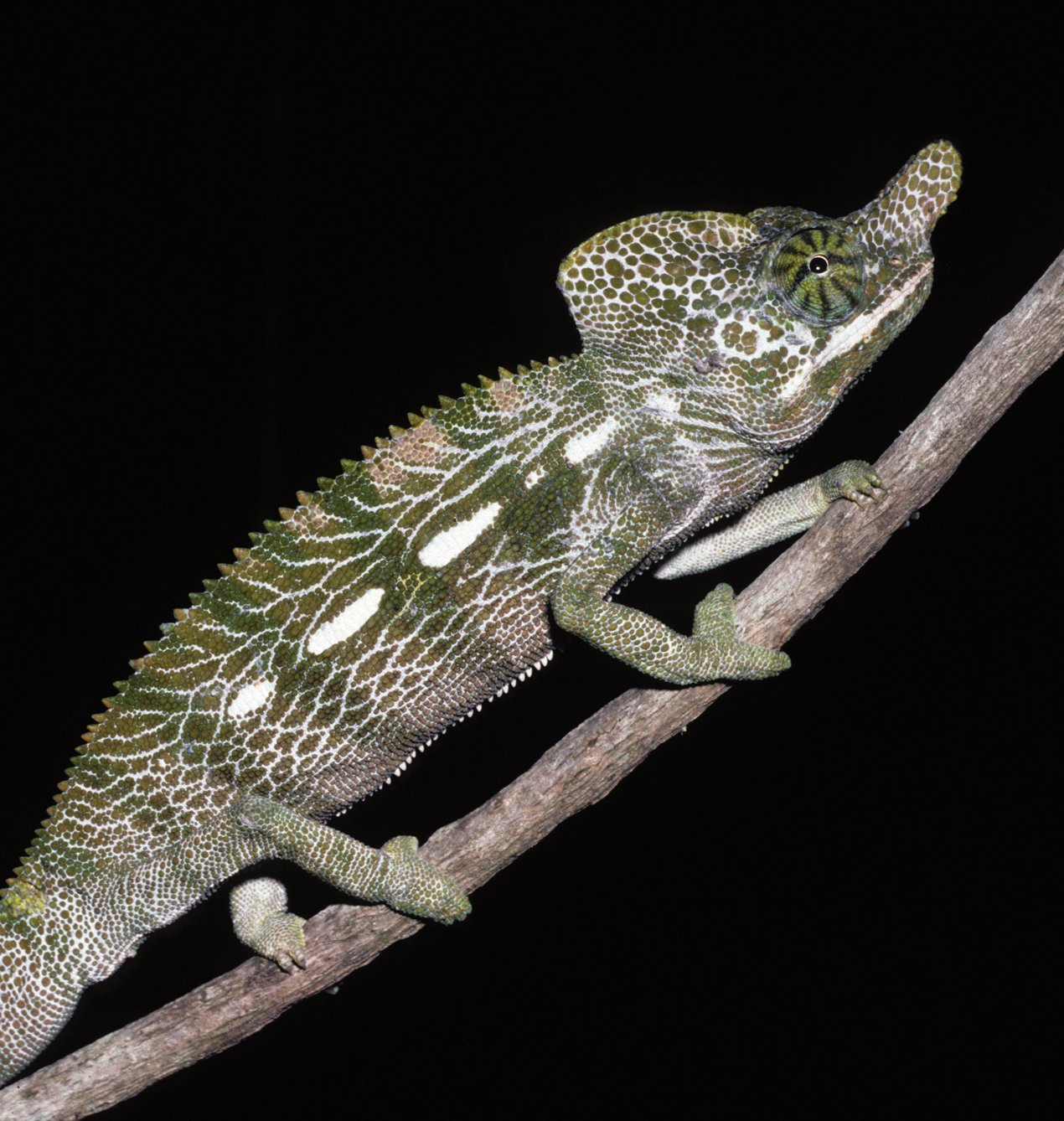
Chameleons · Difficulty: Expert
Key facts and care guidance for Labord's chameleon (Furcifer labordi) (origin: South-western Madagascar, dry forest (Kirindy, Ranobe), 20–100 m). Adult size around ~9–14 cm with the tail (males larger). Life expectancy only 4–5 months in the wild (the shortest known lifespan of any land vertebrate); up to ~16 months in captivity. The values below are carefully researched guidance.
Short answers
Labord's chameleon: How big does the enclosure need to be?
60×45×80 cm (by analogy with similarly sized Furcifer), planted and ventilated.
Labord's chameleon: What temperature does it need?
Daytime 24–30 °C (rainy season, dry forest), basking spot 32–35 °C, at night 15–20 °C.
Labord's chameleon: Does it need UVB lighting?
UVB: UVB needed (Ferguson zone 2–3, UV index 2–4).
Labord's chameleon: How long do they live?
Life expectancy: only 4–5 months in the wild (the shortest known lifespan of any land vertebrate); up to ~16 months in captivity.
Labord's chameleon: Is it suitable for beginners?
No – better suited to experienced keepers (difficulty: Expert).
Climate
- Daytime temperature
- 24–30 °C (rainy season, dry forest)
- Night temperature
- 15–20 °C
- Basking spot
- 32–35 °C
- Humidity
- rainy season 60–80 % (higher at night), dry season clearly lower
- UVB
- UVB needed (Ferguson zone 2–3, UV index 2–4)
Enclosure
- Minimum size
- 60×45×80 cm (by analogy with similarly sized Furcifer), planted and ventilated
- Substrate
- A loose soil, sand and coco mix, deep enough for egg-laying
Feeding
- Food
- Insects: crickets, house crickets, locusts, flies, roaches – plenty of them and well gut-loaded
- Feeding interval
- adults almost daily and generously (extremely fast growth), juveniles daily
Key facts
- Adult size
- ~9–14 cm with the tail (males larger)
- Life expectancy
- only 4–5 months in the wild (the shortest known lifespan of any land vertebrate); up to ~16 months in captivity
- Origin
- South-western Madagascar, dry forest (Kirindy, Ranobe), 20–100 m
- Protection status
- CITES Appendix II; NO legal export from Madagascar → practically not legally obtainable; proof of origin required
- Brumation
- A pronounced seasonal dry spell; the species is annual and semelparous (its life cycle is tied to the rainy season)
- Cohabitation
- Single housing – males extremely aggressive, bite each other to death. Chameleons are pronounced loners, and mere visual contact with a conspecific already means constant stress — an animal that is always threatening or fleeing eats less and becomes ill. So keep even neighbouring enclosures visually screened from each other.
Notes
An annual species with a one-year life cycle; extremely short-lived and hardly sensible or lawful to keep. Only for specialised breeding projects, not for ordinary keepers. Some husbandry measurements are derived from related Furcifer.
Do you keep this species?
Add your animal to Reptoria – Reptoria reminds you about feeding and shedding. Add your animal for free →
Look for Labord's chameleon (Furcifer labordi) in the marketplace →
Related species
- Angel's chameleon (Furcifer angeli) – Expert
- Antimena chameleon (Furcifer antimena) – Intermediate to expert
- Campan's chameleon (Furcifer campani) – Expert
- Unicorn chameleon (Furcifer monoceras) – Expert
- Forked chameleon (Furcifer bifidus) – Expert
- Belted chameleon (Furcifer balteatus) – Expert
- Minor chameleon (Furcifer minor) – Expert
- Rhinoceros chameleon (Furcifer rhinoceratus) – Intermediate
What you need to start
To keep Labord's chameleon (Furcifer labordi) you typically need: a suitable enclosure (60×45×80 cm (by analogy with similarly sized Furcifer), planted and ventilated), substrate (A loose soil, sand and coco mix, deep enough for egg-laying), a heat source with a thermostat, UVB lighting, thermometer and hygrometer, a water dish and hides. You will find equipment in the Reptoria marketplace.
The complete, interactive care database is in the Reptoria app.
Last updated: 9 October 2026 · Editor: Reptoria editorial team · Sources include: https://de.wikipedia.org/wiki/Furcifer_labordi, https://www.madcham.de/en/furcifer-labordi/
All values are non-binding guidance and do not replace expert advice. Research thoroughly from several sources before acquiring and keeping an animal, and observe the applicable law (species and animal protection in particular).