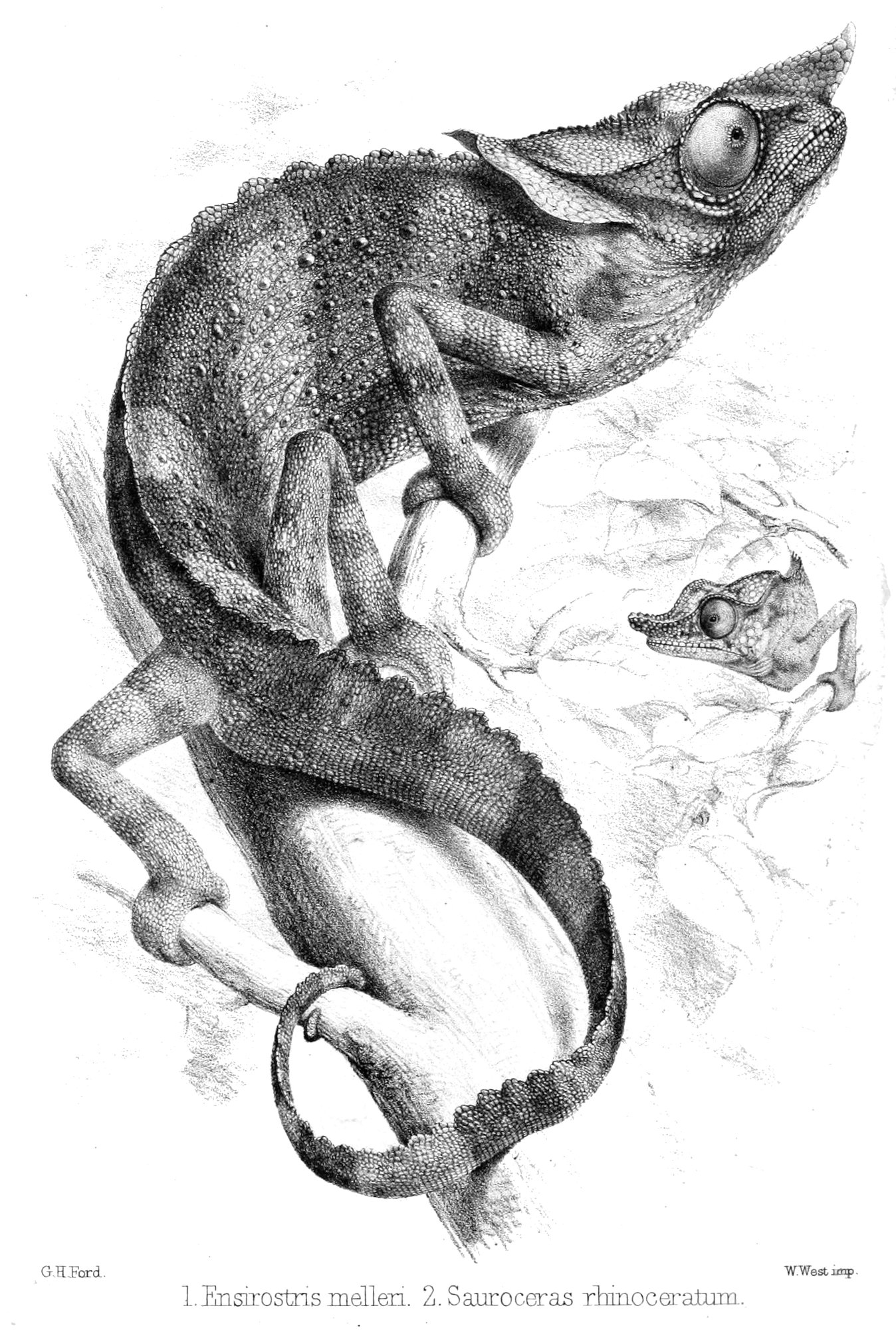
Rhinoceros chameleon (Furcifer rhinoceratus)
Chameleons · Difficulty: Intermediate
Key facts and care guidance for Rhinoceros chameleon (Furcifer rhinoceratus) (origin: Western Madagascar – dry forest). Adult size around Males up to ~27 cm, females approx. 13–15 cm total length. Life expectancy 2–5 years. The values below are carefully researched guidance.
Short answers
Rhinoceros chameleon: How big does the enclosure need to be?
60×60×90 cm (mesh / height).
Rhinoceros chameleon: What temperature does it need?
Daytime 26–32 °C, basking spot 35 °C, at night 17–21 °C.
Rhinoceros chameleon: Does it need UVB lighting?
UVB: Essential (UVB 5.0–10.0).
Rhinoceros chameleon: How long do they live?
Life expectancy: 2–5 years.
Rhinoceros chameleon: Is it suitable for beginners?
Rather not – it is considered an intermediate species (difficulty: Intermediate).
Climate
- Daytime temperature
- 26–32 °C
- Night temperature
- 17–21 °C
- Basking spot
- 35 °C
- Humidity
- 50–70 %
- UVB
- Essential (UVB 5.0–10.0)
Enclosure
- Minimum size
- 60×60×90 cm (mesh / height)
- Substrate
- Coco humus and sand, planting, branches, a rain system
Feeding
- Food
- House crickets, crickets, roaches
- Feeding interval
- daily to every other day
Key facts
- Adult size
- Males up to ~27 cm, females approx. 13–15 cm total length
- Life expectancy
- 2–5 years
- Origin
- Western Madagascar – dry forest
- Protection status
- CITES II
- Brumation
- A dry spell of 8–10 weeks
- Cohabitation
- Keep them singly. Chameleons are pronounced loners, and even the mere sight of another of their kind means constant stress — you can see it in dark colouring, refusal to feed and weakened defences. Males fight in earnest, and females are harassed by males. So screen neighbouring enclosures from each other as well. For breeding, introduce the female briefly, stay with them and separate them again afterwards.
Notes
A dry-forest species; the male has a long, rhinoceros-like nasal appendage. To be kept markedly drier and hotter than the Madagascan rainforest chameleons.
Do you keep this species?
Add your animal to Reptoria – Reptoria reminds you about feeding and shedding. Add your animal for free →
Look for Rhinoceros chameleon (Furcifer rhinoceratus) in the marketplace →
Related species
- Angel's chameleon (Furcifer angeli) – Expert
- Antimena chameleon (Furcifer antimena) – Intermediate to expert
- Campan's chameleon (Furcifer campani) – Expert
- Unicorn chameleon (Furcifer monoceras) – Expert
- Forked chameleon (Furcifer bifidus) – Expert
- Belted chameleon (Furcifer balteatus) – Expert
- Minor chameleon (Furcifer minor) – Expert
- Labord's chameleon (Furcifer labordi) – Expert
What you need to start
To keep Rhinoceros chameleon (Furcifer rhinoceratus) you typically need: a suitable enclosure (60×60×90 cm (mesh / height)), substrate (Coco humus and sand, planting, branches, a rain system), a heat source with a thermostat, UVB lighting, thermometer and hygrometer, a water dish and hides. You will find equipment in the Reptoria marketplace.
The complete, interactive care database is in the Reptoria app.
Last updated: 30 October 2026 · Editor: Reptoria editorial team · Sources include: https://de.wikipedia.org/wiki/Rhinozeros-Cham%C3%A4leon, https://en.wikipedia.org/wiki/Rhinoceros_chameleon, https://www.madcham.de/en/furcifer-rhinoceratus/
All values are non-binding guidance and do not replace expert advice. Research thoroughly from several sources before acquiring and keeping an animal, and observe the applicable law (species and animal protection in particular).