Annam stick insect (Ramulus artemis)
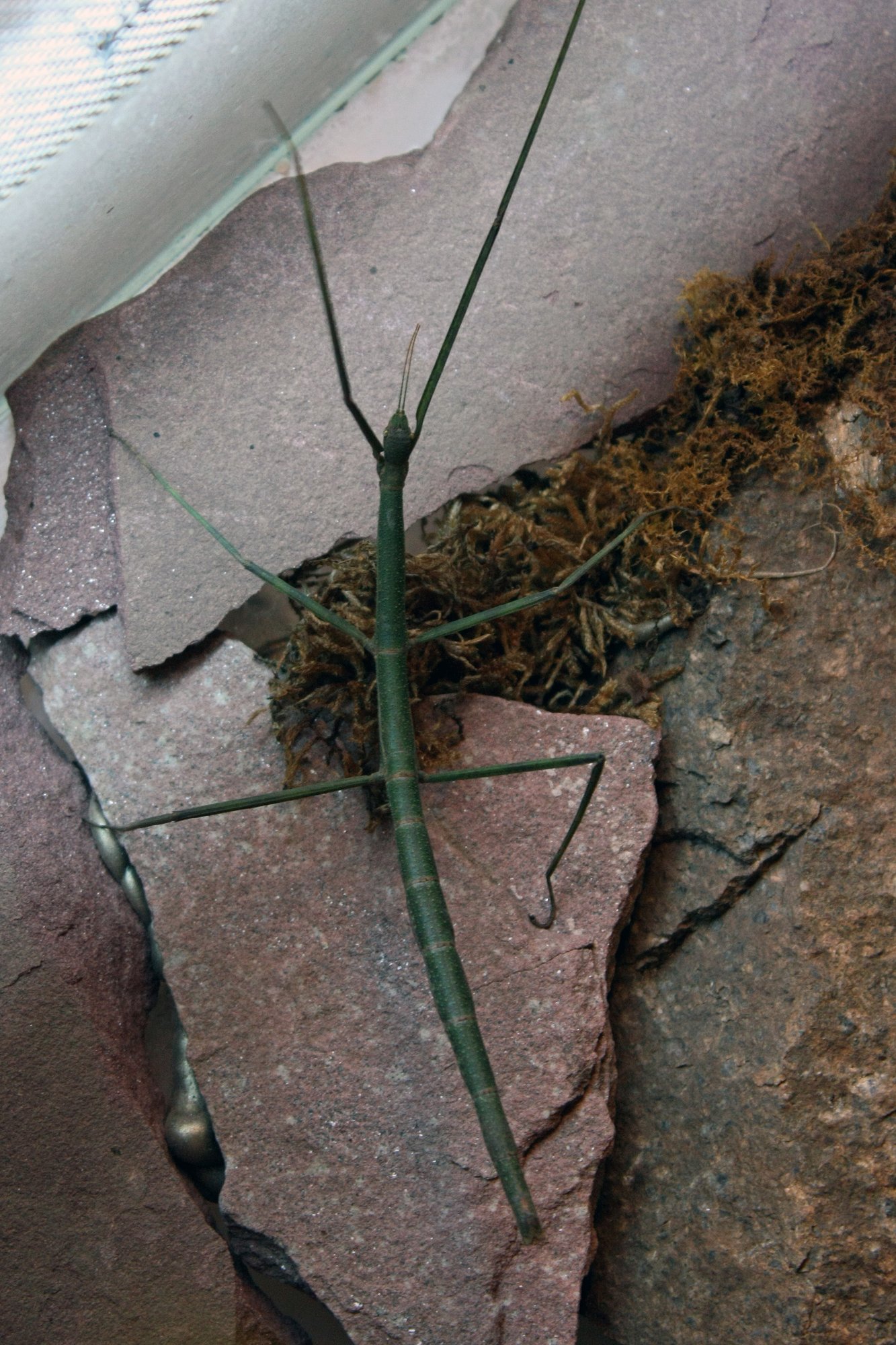
Invertebrates · Difficulty: Beginner
Key facts and care guidance for Annam stick insect (Ramulus artemis) (origin: Vietnam). Adult size around body length 8.5–12.5 cm (females 9–12.5 cm, males about 8.5 cm); with the front legs stretched out the animals appear noticeably longer. Life expectancy 8–14 months. The values below are carefully researched guidance.
Short answers
Annam stick insect: How big does the enclosure need to be?
30×30×50 cm for up to five adult animals; the rule of thumb is three times body length for height and twice for width, with larger groups needing correspondingly more.
Annam stick insect: What temperature does it need?
Daytime 20–26 °C, basking spot No basking spot, at night 17–21 °C.
Annam stick insect: Does it need UVB lighting?
UVB: Not required.
Annam stick insect: How long do they live?
Life expectancy: 8–14 months.
Annam stick insect: Is it suitable for beginners?
Yes – it is considered suitable for beginners (difficulty: Beginner).
Climate
- Daytime temperature
- 20–26 °C
- Night temperature
- 17–21 °C
- Basking spot
- No basking spot
- Humidity
- 60–75 %
- UVB
- Not required
Enclosure
- Minimum size
- 30×30×50 cm for up to five adult animals; the rule of thumb is three times body length for height and twice for width, with larger groups needing correspondingly more
- Substrate
- Coco fibre, or a mix of about one-third sandy clay and two-thirds soil; for natural egg-laying, this layer can safely be deep. Plus climbing branches and a mesh or grille lid the animals can grip onto when moulting.
Feeding
- Food
- Bramble (available year-round and the reliable staple), plus raspberry, oak, beech, hazel, rose, hawthorn and cotoneaster. Always keep branches fresh in a sealed water bottle.
- Feeding interval
- fresh food always available
Key facts
- Adult size
- body length 8.5–12.5 cm (females 9–12.5 cm, males about 8.5 cm); with the front legs stretched out the animals appear noticeably longer
- Life expectancy
- 8–14 months
- Origin
- Vietnam
- Protection status
- Not listed under CITES
- Brumation
- None
- Cohabitation
- Group housing, as many animals as there is space for. The species has no social behaviour, no territory and no hierarchy; in a group you simply see them more often. Kept singly, an animal carries on exactly the same and continues laying eggs even without a male.
Notes
A very long, thin stick insect, and parthenogenetic. As undemanding as the Indian stick insect, but markedly larger – a good starting point with a "wow" factor.
Do you keep this species?
Add your animal to Reptoria – Reptoria reminds you about feeding and shedding. Add your animal for free →
Look for Annam stick insect (Ramulus artemis) in the marketplace →
Related species
- Giant prickly stick insect (Extatosoma tiaratum) – Beginner
- Brueckner's stick insect (Trachyaretaon brueckneri) – Beginner
- Ceylon leaf insect (Phyllium bioculatum) – Intermediate
- Chan's megastick (Phobaeticus chani) – Expert
- Giant spiny stick insect (Aretaon asperrimus) – Beginner
- Giant spiny stick insect (Eurycantha calcarata) – Beginner
- Jungle nymph (Heteropteryx dilatata) – Intermediate
- Common leaf insect (Phyllium siccifolium) – Intermediate
What you need to start
To keep Annam stick insect (Ramulus artemis) you typically need: a suitable enclosure (30×30×50 cm for up to five adult animals; the rule of thumb is three times body length for height and twice for width, with larger groups needing correspondingly more), substrate (Coco fibre, or a mix of about one-third sandy clay and two-thirds soil; for natural egg-laying, this layer can safely be deep. Plus climbing branches and a mesh or grille lid the animals can grip onto when moulting.), a heat source with a thermostat, thermometer and hygrometer, a water dish and hides. You will find equipment in the Reptoria marketplace.
The complete, interactive care database is in the Reptoria app.
Last updated: 30 October 2026 · Editor: Reptoria editorial team · Sources include: Wikipedia DE, dahmstierleben.de, keepinginsects.com, eur-lex.europa.eu (VO (EU) 2026/1383), eu_annex.txt (lokal)
All values are non-binding guidance and do not replace expert advice. Research thoroughly from several sources before acquiring and keeping an animal, and observe the applicable law (species and animal protection in particular).