Chan's megastick (Phobaeticus chani)
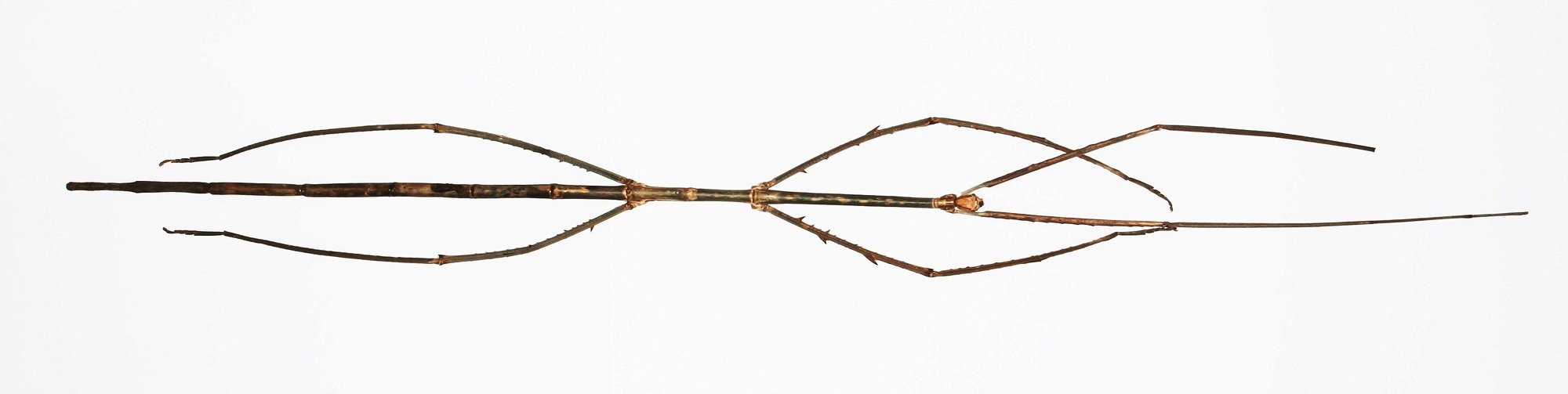
Invertebrates · Difficulty: Expert
Key facts and care guidance for Chan's megastick (Phobaeticus chani) (origin: Borneo (the Malaysian state of Sabah); rainforest, endemic and extremely rare). Adult size around females: body approx. 35–36 cm, up to ~56 cm with the legs outstretched (one of the longest insects in the world). Life expectancy unknown; with large stick insects usually approx. 1–1.5 years. The values below are carefully researched guidance.
Short answers
Chan's megastick: How big does the enclosure need to be?
Needs to be very tall (height at least 3× the body length, i.e. over 100 cm) – a purely theoretical figure, as it is not kept in practice.
Chan's megastick: What temperature does it need?
Daytime 24–28 °C, at night 20–23 °C.
Chan's megastick: Does it need UVB lighting?
UVB: No UVB needed; normal room lighting or daylight.
Chan's megastick: How long do they live?
Life expectancy: unknown; with large stick insects usually approx. 1–1.5 years.
Chan's megastick: Is it suitable for beginners?
No – better suited to experienced keepers (difficulty: Expert).
Climate
- Daytime temperature
- 24–28 °C
- Night temperature
- 20–23 °C
- Basking spot
- —
- Humidity
- 70–90 %
- UVB
- No UVB needed; normal room lighting or daylight
Enclosure
- Minimum size
- Needs to be very tall (height at least 3× the body length, i.e. over 100 cm) – a purely theoretical figure, as it is not kept in practice
- Substrate
- Damp soil or coco humus; tall climbing branches for shedding
Feeding
- Food
- Presumably a leaf-eater (nocturnal); for related Phobaeticus species these work: eucalyptus, Syzygium (lilly pilly), bramble or Rubus, oak – not confirmed for P. chani
- Feeding interval
- presumably continuous feeding on fresh leaves (as with other stick insects)
Key facts
- Adult size
- females: body approx. 35–36 cm, up to ~56 cm with the legs outstretched (one of the longest insects in the world)
- Life expectancy
- unknown; with large stick insects usually approx. 1–1.5 years
- Origin
- Borneo (the Malaysian state of Sabah); rainforest, endemic and extremely rare
- Protection status
- No formal CITES listing is known; an extremely rare rainforest species known from only a few specimens – no legal stock in the hobby, and import or collection is problematic
- Brumation
- None (tropical)
- Cohabitation
- Group: no documented husbandry experience exists for Phobaeticus chani itself. Stick insects are generally group-compatible as peaceful herbivores, and many species also reproduce parthenogenetically (without males) — but neither is confirmed for this species, only transferred from the genus.
Notes
IMPORTANT: this species is NOT established in the hobby and practically not in culture – only a handful of museum specimens are known (the holotype is in the Natural History Museum, London). There are NO solid husbandry data; all the figures are derived from related Phobaeticus and giant phasmids and from the tropical Borneo climate (low confidence). It is not realistically keepable – this entry is primarily informative. A Guinness record for the longest body length of an insect.
Do you keep this species?
Add your animal to Reptoria – Reptoria reminds you about feeding and shedding. Add your animal for free →
Look for Chan's megastick (Phobaeticus chani) in the marketplace →
Related species
- Annam stick insect (Ramulus artemis) – Beginner
- Giant prickly stick insect (Extatosoma tiaratum) – Beginner
- Brueckner's stick insect (Trachyaretaon brueckneri) – Beginner
- Ceylon leaf insect (Phyllium bioculatum) – Intermediate
- Giant spiny stick insect (Aretaon asperrimus) – Beginner
- Giant spiny stick insect (Eurycantha calcarata) – Beginner
- Jungle nymph (Heteropteryx dilatata) – Intermediate
- Common leaf insect (Phyllium siccifolium) – Intermediate
What you need to start
To keep Chan's megastick (Phobaeticus chani) you typically need: a suitable enclosure (Needs to be very tall (height at least 3× the body length, i.e. over 100 cm) – a purely theoretical figure, as it is not kept in practice), substrate (Damp soil or coco humus; tall climbing branches for shedding), a heat source with a thermostat, UVB lighting, thermometer and hygrometer, a water dish and hides. You will find equipment in the Reptoria marketplace.
The complete, interactive care database is in the Reptoria app.
Last updated: 9 October 2026 · Editor: Reptoria editorial team · Sources include: https://en.wikipedia.org/wiki/Phobaeticus, https://en.wikipedia.org/wiki/Phobaeticus_chani
All values are non-binding guidance and do not replace expert advice. Research thoroughly from several sources before acquiring and keeping an animal, and observe the applicable law (species and animal protection in particular).