Asian leaf turtle (Cyclemys dentata)
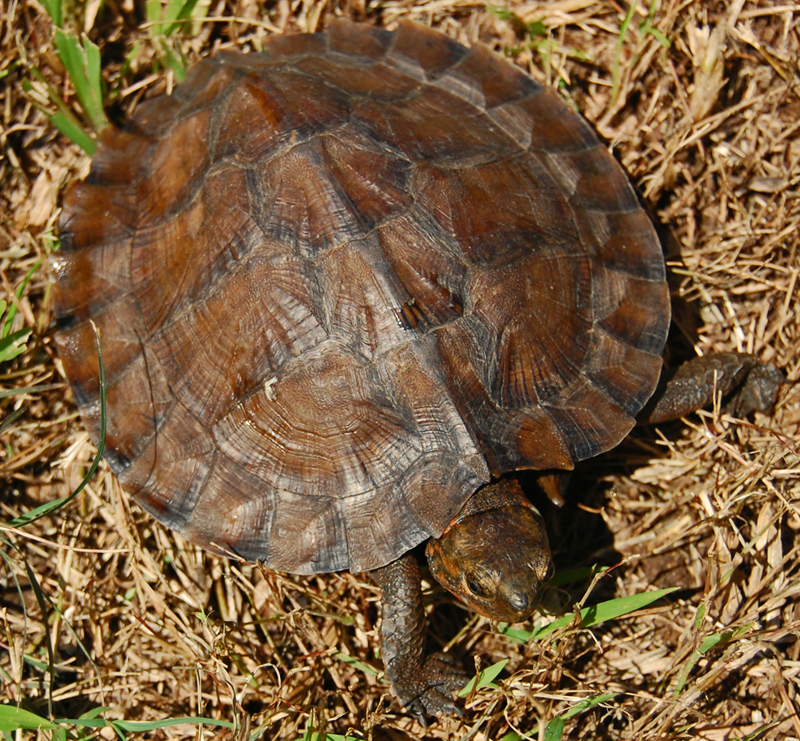
Turtles & tortoises · Difficulty: Intermediate
Key facts and care guidance for Asian leaf turtle (Cyclemys dentata) (origin: South and South-East Asia (Indochina, the Sunda Islands, the Philippines)). Adult size around 15–24 cm carapace length. Life expectancy 20–30 years. The values below are carefully researched guidance.
Short answers
Asian leaf turtle: How big does the enclosure need to be?
A semi-aquatic aqua-terrarium from 120–150 cm with a large water and land section, shallow water.
Asian leaf turtle: What temperature does it need?
Daytime water 24–28 °C, air 26–30 °C, basking spot 32–40 °C at the basking spot, at night 22–24 °C.
Asian leaf turtle: Does it need UVB lighting?
UVB: Yes, UVB over the basking spot (e.g. a 5.0 fluorescent tube or a mercury vapour lamp with a UV component), 12 hours a day.
Asian leaf turtle: How long do they live?
Life expectancy: 20–30 years.
Asian leaf turtle: Is it suitable for beginners?
Rather not – it is considered an intermediate species (difficulty: Intermediate).
Climate
- Daytime temperature
- water 24–28 °C, air 26–30 °C
- Night temperature
- 22–24 °C
- Basking spot
- 32–40 °C at the basking spot
- Humidity
- High, 70–90 %
- UVB
- Yes, UVB over the basking spot (e.g. a 5.0 fluorescent tube or a mercury vapour lamp with a UV component), 12 hours a day
Enclosure
- Minimum size
- a semi-aquatic aqua-terrarium from 120–150 cm with a large water and land section, shallow water
- Substrate
- Structured shallow water; a damp land section with leaf litter
Feeding
- Food
- Omnivorous with a plant-based emphasis: at least half aquatic plants, greens and some fruit, plus snails, earthworms, crustaceans, fish and insects
- Feeding interval
- juveniles daily, adults 2–3×/week
Key facts
- Adult size
- 15–24 cm carapace length
- Life expectancy
- 20–30 years
- Origin
- South and South-East Asia (Indochina, the Sunda Islands, the Philippines)
- Protection status
- CITES Appendix II – registration and proof required
- Brumation
- None (tropical); a slight seasonal drop is possible
- Cohabitation
- Solitary or pair; juveniles more aquatic, adults more terrestrial. Two males harass each other and the females; during prolonged courtship a female visibly loses weight. So a pair only works with a way to separate them — as soon as the male harasses the female, it must come out. Anyone with more space keeps one male with several females.
Notes
Semi-aquatic and a poor swimmer (especially when young) – shallow water plus exit aids. A warm, humid tropical climate; wild-caught animals are often delicate.
Do you keep this species?
Add your animal to Reptoria – Reptoria reminds you about feeding and shedding. Add your animal for free →
Look for Asian leaf turtle (Cyclemys dentata) in the marketplace →
Related species
- Annam leaf turtle (Mauremys annamensis) – Intermediate
- Chinese striped-neck turtle (Mauremys sinensis) – Beginner to intermediate
- Reeves' turtle (Mauremys reevesii) – Beginner
- Spiny turtle (Heosemys spinosa) – Expert
- Yellow pond turtle (Mauremys mutica) – Intermediate
- Indian black turtle (Melanochelys trijuga) – Intermediate
- Japanese pond turtle (Mauremys japonica) – Intermediate
- Caspian turtle (Mauremys caspica) – Beginner
What you need to start
To keep Asian leaf turtle (Cyclemys dentata) you typically need: a suitable enclosure (a semi-aquatic aqua-terrarium from 120–150 cm with a large water and land section, shallow water), substrate (Structured shallow water; a damp land section with leaf litter), a heat source with a thermostat, UVB lighting, thermometer and hygrometer, a water dish and hides. You will find equipment in the Reptoria marketplace.
The complete, interactive care database is in the Reptoria app.
Last updated: 9 October 2026 · Editor: Reptoria editorial team · Sources include: zierschildkroete.de, dubiaroaches.com, Wikipedia EN, eu_annex.txt (lokal), gutachten.txt (BML 1997, lokal)
All values are non-binding guidance and do not replace expert advice. Research thoroughly from several sources before acquiring and keeping an animal, and observe the applicable law (species and animal protection in particular).