Annam leaf turtle (Mauremys annamensis)
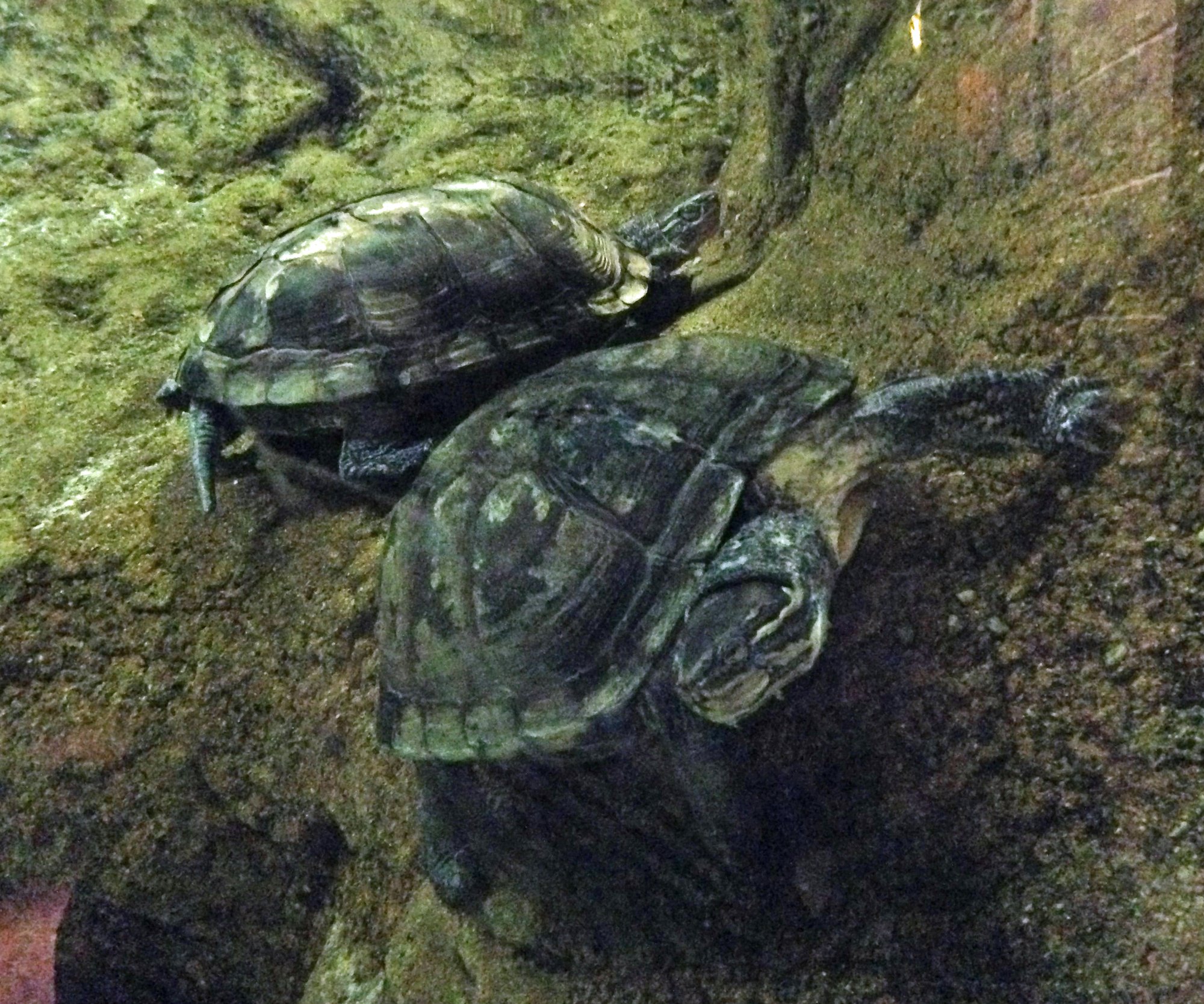
Turtles & tortoises · Difficulty: Intermediate
Key facts and care guidance for Annam leaf turtle (Mauremys annamensis) (origin: Central Vietnam, Quang Nam province; swamps, slow-flowing streams, small lakes, ponds and shoreline zones up to about 100 m altitude). Adult size around 20–28 cm. Life expectancy about 45 years. The values below are carefully researched guidance.
Short answers
Annam leaf turtle: How big does the enclosure need to be?
150×75 cm floor area for one or two adult animals, water depth 30–40 cm, plus a land area and basking spot; add 10% more floor space from the third animal, 20% from the fifth.
Annam leaf turtle: What temperature does it need?
Daytime 24–29 °C, basking spot 33 °C (basking spot), at night 20–23 °C.
Annam leaf turtle: Does it need UVB lighting?
UVB: Essential (UVB 6 %).
Annam leaf turtle: How long do they live?
Life expectancy: about 45 years.
Annam leaf turtle: Is it suitable for beginners?
Rather not – it is considered an intermediate species (difficulty: Intermediate).
Climate
- Daytime temperature
- 24–29 °C
- Night temperature
- 20–23 °C
- Basking spot
- 33 °C (basking spot)
- Humidity
- Aquatic with a land section
- UVB
- Essential (UVB 6 %)
Enclosure
- Minimum size
- 150×75 cm floor area for one or two adult animals, water depth 30–40 cm, plus a land area and basking spot; add 10% more floor space from the third animal, 20% from the fifth
- Substrate
- A water section 25–40 cm deep, a sandy bank, dense planting, a basking spot
Feeding
- Food
- Omnivorous: aquatic plants, leaves and small amounts of fruit, plus fish, snails, worms, aquatic insects and high-quality pellets
- Feeding interval
- 3×/week
Key facts
- Adult size
- 20–28 cm
- Life expectancy
- about 45 years
- Origin
- Central Vietnam, Quang Nam province; swamps, slow-flowing streams, small lakes, ponds and shoreline zones up to about 100 m altitude
- Protection status
- CITES I / EU Annex A – sale only with a valid EU commercial-use certificate; IUCN "Critically Endangered"
- Brumation
- No winter dormancy. As a tropical species from central Vietnam it doesn't hibernate; a slightly cooler, darker phase in winter is possible — the expert report lists this as 'optional' for Mauremys.
- Cohabitation
- Single housing or 1.2. Two males harass each other and the females; a constantly harassed female visibly loses weight and gets bite wounds on the neck and front legs, so plan one male to several females and a way to separate them. Also crucial: never house together with other pond turtles. In captivity the species hybridises with closely related species, and every hybrid is lost to the conservation breeding of this critically endangered species.
Notes
Possibly already extinct in the wild – the species survives almost only in conservation breeding programmes. Annex A: without yellow CITES papers any sale is prohibited.
Do you keep this species?
Add your animal to Reptoria – Reptoria reminds you about feeding and shedding. Add your animal for free →
Look for Annam leaf turtle (Mauremys annamensis) in the marketplace →
Related species
- Balkan terrapin (Mauremys rivulata) – Intermediate
- Chinese striped-neck turtle (Mauremys sinensis) – Beginner to intermediate
- Reeves' turtle (Mauremys reevesii) – Beginner
- Yellow pond turtle (Mauremys mutica) – Intermediate
- Japanese pond turtle (Mauremys japonica) – Intermediate
- Caspian turtle (Mauremys caspica) – Beginner
- Mediterranean pond turtle (Mauremys leprosa) – Intermediate
- Black-breasted leaf turtle (Mauremys nigricans) – Intermediate
What you need to start
To keep Annam leaf turtle (Mauremys annamensis) you typically need: a suitable enclosure (150×75 cm floor area for one or two adult animals, water depth 30–40 cm, plus a land area and basking spot; add 10% more floor space from the third animal, 20% from the fifth), substrate (A water section 25–40 cm deep, a sandy bank, dense planting, a basking spot), a heat source with a thermostat, UVB lighting, thermometer and hygrometer, a water dish and hides. You will find equipment in the Reptoria marketplace.
The complete, interactive care database is in the Reptoria app.
Last updated: 2 November 2026 · Editor: Reptoria editorial team · Sources include: Wikipedia DE, zoo.ch (Zoo Zürich), Wikipedia EN, bmleh.de (Gutachten Reptilien 1997), eur-lex.europa.eu (VO (EU) 2026/1383)
All values are non-binding guidance and do not replace expert advice. Research thoroughly from several sources before acquiring and keeping an animal, and observe the applicable law (species and animal protection in particular).