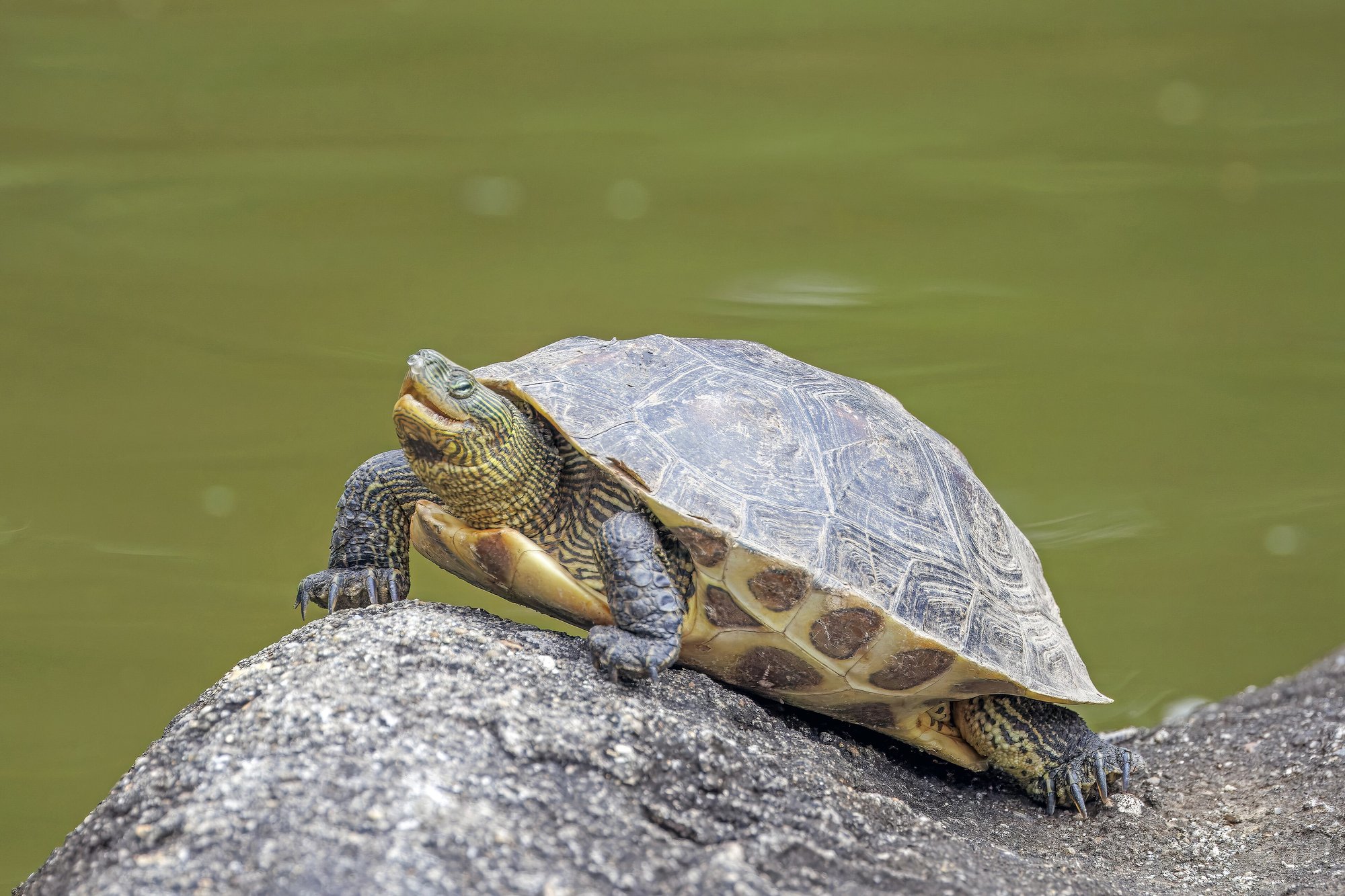
Chinese striped-neck turtle (Mauremys sinensis)
Turtles & tortoises · Difficulty: Beginner to intermediate
Key facts and care guidance for Chinese striped-neck turtle (Mauremys sinensis) (origin: East Asia (China, Taiwan, Vietnam)). Adult size around females up to about 27 cm carapace length, males at most about 20 cm. Life expectancy 20–30+ years. The values below are carefully researched guidance.
Short answers
Chinese striped-neck turtle: How big does the enclosure need to be?
Aqua-terrarium from 160 × 60 × 60 cm for a female, from 120 cm length for a male; the guideline for adult animals leans more towards 200 × 100 cm — the official expert report calculates length as 5 × carapace length, with width about half the length.
Chinese striped-neck turtle: What temperature does it need?
Daytime water 24–28 °C, basking spot 35–40 °C (basking spot on land), at night 20–22 °C.
Chinese striped-neck turtle: Does it need UVB lighting?
UVB: Essential (above the basking spot).
Chinese striped-neck turtle: How long do they live?
Life expectancy: 20–30+ years.
Chinese striped-neck turtle: Is it suitable for beginners?
Partly – manageable with some prior knowledge (difficulty: Beginner to intermediate).
Climate
- Daytime temperature
- water 24–28 °C
- Night temperature
- 20–22 °C
- Basking spot
- 35–40 °C (basking spot on land)
- Humidity
- —
- UVB
- Essential (above the basking spot)
Enclosure
- Minimum size
- aqua-terrarium from 160 × 60 × 60 cm for a female, from 120 cm length for a male; the guideline for adult animals leans more towards 200 × 100 cm — the official expert report calculates length as 5 × carapace length, with width about half the length
- Substrate
- Fine gravel or sand, or bare-bottomed; a structured dry land section
Feeding
- Food
- Omnivorous: water plants, fish, snails, insects, aquatic turtle food; adults are more plant-focused
- Feeding interval
- juveniles daily, adults 2–3×/week
Key facts
- Adult size
- females up to about 27 cm carapace length, males at most about 20 cm
- Life expectancy
- 20–30+ years
- Origin
- East Asia (China, Taiwan, Vietnam)
- Protection status
- CITES Appendix III / an EU annex – proof of origin recommended
- Brumation
- 2–3 months of winter dormancy at 10–15 °C
- Cohabitation
- Keeping them singly is the least stressful option; males are generally kept alone and only introduced for mating. With plenty of space a group of one male and several females is possible, the drawback being: two males harass each other and the females, and under constant courtship a female visibly loses weight. Females do not always get along with each other either, so always plan a way to separate them.
Notes
A moderate swimmer – it needs resting places and a dry basking spot. A good filter is essential; do not heat the water at night.
Do you keep this species?
Add your animal to Reptoria – Reptoria reminds you about feeding and shedding. Add your animal for free →
Look for Chinese striped-neck turtle (Mauremys sinensis) in the marketplace →
Related species
- Annam leaf turtle (Mauremys annamensis) – Intermediate
- Balkan terrapin (Mauremys rivulata) – Intermediate
- Reeves' turtle (Mauremys reevesii) – Beginner
- Yellow pond turtle (Mauremys mutica) – Intermediate
- Japanese pond turtle (Mauremys japonica) – Intermediate
- Caspian turtle (Mauremys caspica) – Beginner
- Mediterranean pond turtle (Mauremys leprosa) – Intermediate
- Black-breasted leaf turtle (Mauremys nigricans) – Intermediate
What you need to start
To keep Chinese striped-neck turtle (Mauremys sinensis) you typically need: a suitable enclosure (aqua-terrarium from 160 × 60 × 60 cm for a female, from 120 cm length for a male; the guideline for adult animals leans more towards 200 × 100 cm — the official expert report calculates length as 5 × carapace length, with width about half the length), substrate (Fine gravel or sand, or bare-bottomed; a structured dry land section), a heat source with a thermostat, UVB lighting, thermometer and hygrometer, a water dish and hides. You will find equipment in the Reptoria marketplace.
The complete, interactive care database is in the Reptoria app.
Last updated: 2 November 2026 · Editor: Reptoria editorial team · Sources include: Wikipedia EN, bmleh.de, eur-lex.europa.eu, interaquaristik.de, megazoo-nord.de
All values are non-binding guidance and do not replace expert advice. Research thoroughly from several sources before acquiring and keeping an animal, and observe the applicable law (species and animal protection in particular).