Caspian turtle (Mauremys caspica)
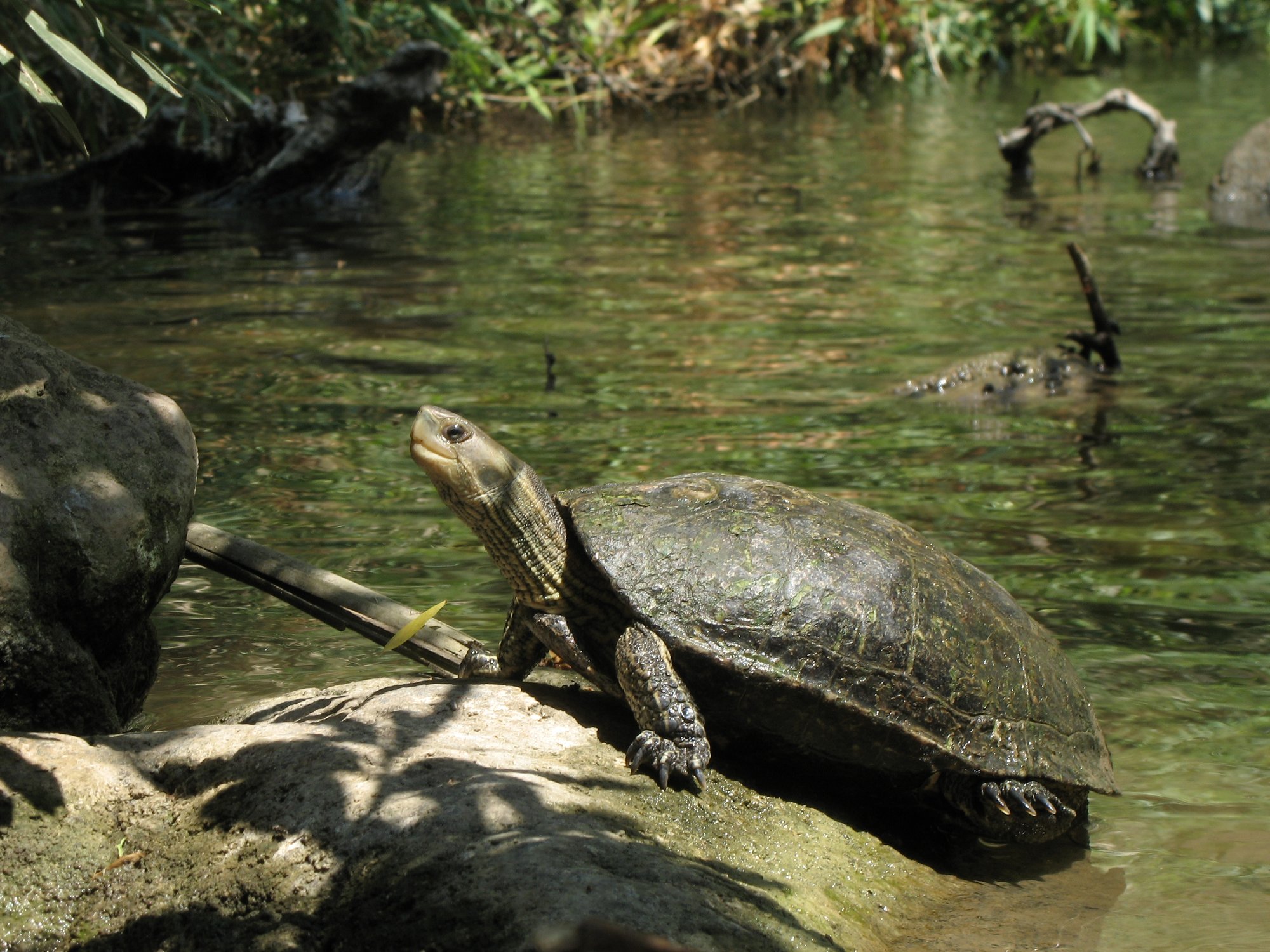
Turtles & tortoises · Difficulty: Beginner
Key facts and care guidance for Caspian turtle (Mauremys caspica) (origin: South-eastern Europe (the Balkans), the Caucasus, Asia Minor to Iran and Iraq, the Near East). Adult size around 20–25 cm shell length (females larger). Life expectancy over 50 years is possible. The values below are carefully researched guidance.
Short answers
Caspian turtle: How big does the enclosure need to be?
A 130×50×50 cm aqua-terrarium (water ~30 cm deep) per adult animal.
Caspian turtle: What temperature does it need?
Daytime 24–28 °C (water, summer), basking spot 35–42 °C, at night 20–22 °C.
Caspian turtle: Does it need UVB lighting?
UVB: UVB needed (Ferguson zone 2–3, UV index 2–4).
Caspian turtle: How long do they live?
Life expectancy: over 50 years is possible.
Caspian turtle: Is it suitable for beginners?
Yes – it is considered suitable for beginners (difficulty: Beginner).
Climate
- Daytime temperature
- 24–28 °C (water, summer)
- Night temperature
- 20–22 °C
- Basking spot
- 35–42 °C
- Humidity
- — (aquatic)
- UVB
- UVB needed (Ferguson zone 2–3, UV index 2–4)
Enclosure
- Minimum size
- a 130×50×50 cm aqua-terrarium (water ~30 cm deep) per adult animal
- Substrate
- Sand or fine gravel in the water; a sand mound or land section for egg-laying
Feeding
- Food
- A mixed feeder: fish, snails, aquatic insects, worms, crustaceans; on the plant side elodea, hornwort and duckweed, a little carrot; pellets only rarely
- Feeding interval
- adults 2–3×/week, juveniles (almost) daily
Key facts
- Adult size
- 20–25 cm shell length (females larger)
- Life expectancy
- over 50 years is possible
- Origin
- South-eastern Europe (the Balkans), the Caucasus, Asia Minor to Iran and Iraq, the Near East
- Protection status
- Not listed under CITES/the EU Wildlife Trade Regulation - keeping it generally has no registration requirement. (Bern Convention Annex II; some sources mistakenly cite Habitats Directive protection - that actually applies to M. leprosa or Emys.) IUCN: Least Concern/Near Threatened.
- Brumation
- Yes – a winter rest from about December to February at ~10 °C (with the water level reduced to 10–20 cm), for about 2–3 months; it benefits health and reproduction.
- Cohabitation
- Keeping them singly is recommended; territorial. In large enclosures a group of females may be possible; the males harass the females – never two males together.
Notes
A robust, long-lived aquatic turtle, suitable for ambitious beginners. It needs strong filtration and a basking spot to dry off. Common mistakes: too small a tank, no winter rest, and no UVB. The final size is underestimated.
Do you keep this species?
Add your animal to Reptoria – Reptoria reminds you about feeding and shedding. Add your animal for free →
Look for Caspian turtle (Mauremys caspica) in the marketplace →
Related species
- Annam leaf turtle (Mauremys annamensis) – Intermediate
- Balkan terrapin (Mauremys rivulata) – Intermediate
- Chinese striped-neck turtle (Mauremys sinensis) – Beginner to intermediate
- Reeves' turtle (Mauremys reevesii) – Beginner
- Yellow pond turtle (Mauremys mutica) – Intermediate
- Japanese pond turtle (Mauremys japonica) – Intermediate
- Mediterranean pond turtle (Mauremys leprosa) – Intermediate
- Black-breasted leaf turtle (Mauremys nigricans) – Intermediate
What you need to start
To keep Caspian turtle (Mauremys caspica) you typically need: a suitable enclosure (a 130×50×50 cm aqua-terrarium (water ~30 cm deep) per adult animal), substrate (Sand or fine gravel in the water; a sand mound or land section for egg-laying), a heat source with a thermostat, UVB lighting, thermometer and hygrometer, a water dish and hides. You will find equipment in the Reptoria marketplace.
The complete, interactive care database is in the Reptoria app.
Last updated: 30 October 2026 · Editor: Reptoria editorial team · Sources include: https://de.wikipedia.org/wiki/Kaspische_Bachschildkr%C3%B6te, https://en.wikipedia.org/wiki/Mauremys
All values are non-binding guidance and do not replace expert advice. Research thoroughly from several sources before acquiring and keeping an animal, and observe the applicable law (species and animal protection in particular).