Bark jumping spider (Marpissa muscosa)
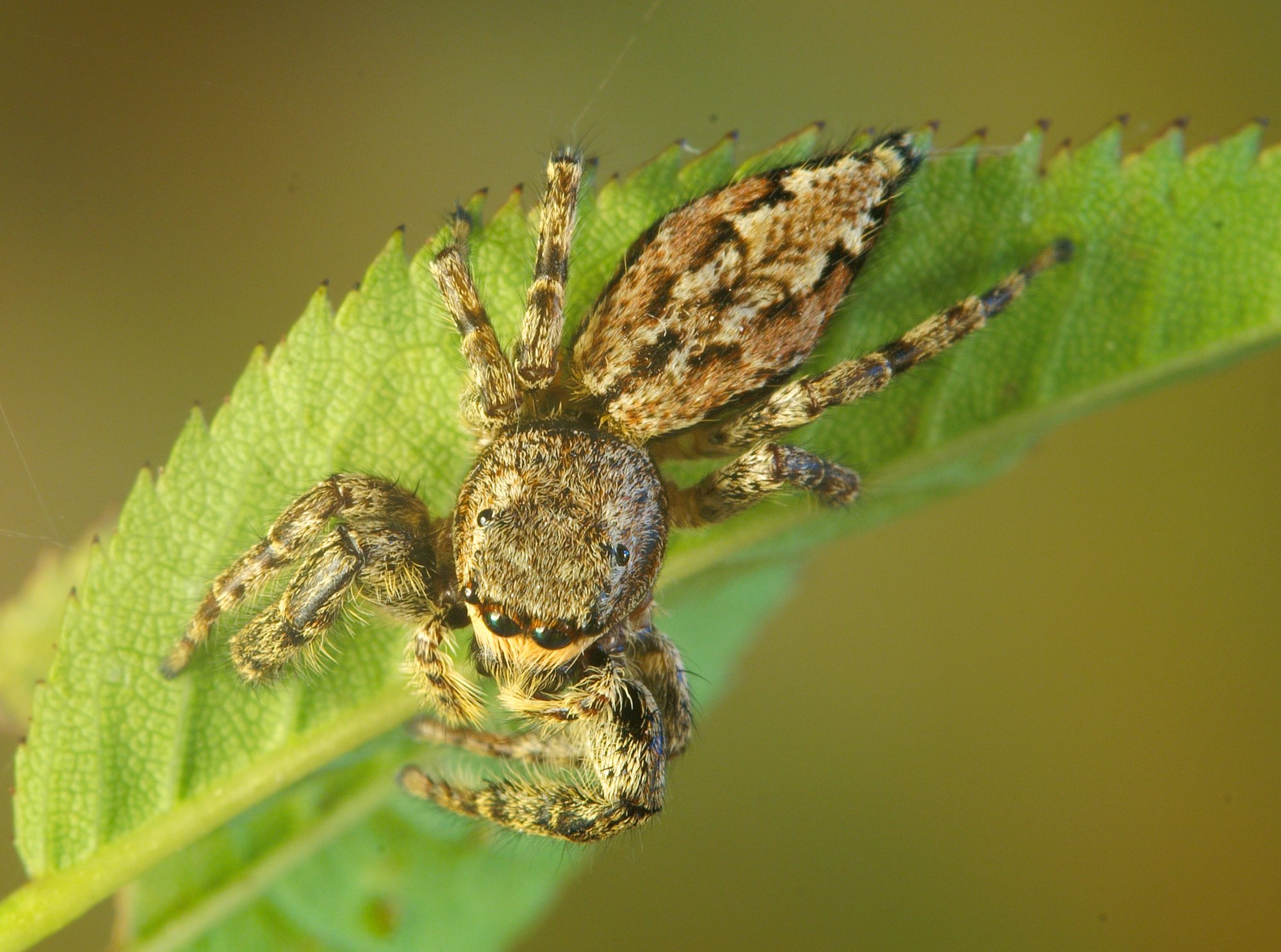
Invertebrates · Difficulty: Beginner
Key facts and care guidance for Bark jumping spider (Marpissa muscosa) (origin: Europe (southern Scandinavia to the Mediterranean) and parts of Asia (Turkey, the Caucasus); structurally rich dry habitats, on bark, fences and walls). Adult size around females approx. 8–11 mm, males approx. 7–8 mm body length. Life expectancy approx. 1–2 years (can live several years if overwintered). The values below are carefully researched guidance.
Short answers
Bark jumping spider: How big does the enclosure need to be?
15×15×20 cm (rather flat and richly structured, with bark surfaces).
Bark jumping spider: What temperature does it need?
Daytime 20–25 °C, at night 16–20 °C (slight night-time drop).
Bark jumping spider: Does it need UVB lighting?
UVB: UVB not essential; bright lighting with a daylight spectrum encourages natural behaviour.
Bark jumping spider: How long do they live?
Life expectancy: approx. 1–2 years (can live several years if overwintered).
Bark jumping spider: Is it suitable for beginners?
Yes – it is considered suitable for beginners (difficulty: Beginner).
Climate
- Daytime temperature
- 20–25 °C
- Night temperature
- 16–20 °C (slight night-time drop)
- Basking spot
- —
- Humidity
- 50–60 %
- UVB
- UVB not essential; bright lighting with a daylight spectrum encourages natural behaviour
Enclosure
- Minimum size
- 15×15×20 cm (rather flat and richly structured, with bark surfaces)
- Substrate
- Dry to moderately damp (coco humus or sand); plenty of bark, twigs and old pieces of wood to climb on and hide under
Feeding
- Food
- Fruit flies (Drosophila), micro crickets, small springtails; small flies as adults
- Feeding interval
- adults 2–3×/week, juveniles every 1–2 days
Key facts
- Adult size
- females approx. 8–11 mm, males approx. 7–8 mm body length
- Life expectancy
- approx. 1–2 years (can live several years if overwintered)
- Origin
- Europe (southern Scandinavia to the Mediterranean) and parts of Asia (Turkey, the Caucasus); structurally rich dry habitats, on bark, fences and walls
- Protection status
- A native species, not specially protected, no CITES; take from the wild sparingly and gently, and prefer captive breeding
- Brumation
- In the wild it overwinters as a subadult in a silk chamber under bark; kept indoors no deliberate winter rest is needed, though a cooler spell (10–15 °C) is natural for it
- Cohabitation
- Keep them singly. Solitary and territorial, with cannibalism – no permanent pairs or groups.
Notes
The largest native jumping spider, easy to keep and to watch. A bark dweller – flat, broad climbing surfaces matter more than height. Keep it rather drier and cooler than tropical species. Sources: Wikipedia, arages.de, naturspektrum.
Do you keep this species?
Add your animal to Reptoria – Reptoria reminds you about feeding and shedding. Add your animal for free →
Look for Bark jumping spider (Marpissa muscosa) in the marketplace →
Related species
- Algerian jumping spider (Cyrba algerina) – Intermediate
- Arched jumping spider (Evarcha arcuata) – Intermediate
- Bronze jumping spider (Hyllus semicupreus) – Beginner
- Peacock jumping spider (Saitis barbipes) – Intermediate
- Diard's jumping spider (Hyllus diardi) – Beginner
- Three-spotted jumping spider (Pellenes tripunctatus) – Intermediate
- Canopy jumping spider (Phidippus otiosus) – Beginner
- Fringed jumping spider (Portia fimbriata) – Expert
What you need to start
To keep Bark jumping spider (Marpissa muscosa) you typically need: a suitable enclosure (15×15×20 cm (rather flat and richly structured, with bark surfaces)), substrate (Dry to moderately damp (coco humus or sand); plenty of bark, twigs and old pieces of wood to climb on and hide under), a heat source with a thermostat, UVB lighting, thermometer and hygrometer, a water dish and hides. You will find equipment in the Reptoria marketplace.
The complete, interactive care database is in the Reptoria app.
Last updated: 9 October 2026 · Editor: Reptoria editorial team · Sources include: https://de.wikipedia.org/wiki/Rindenspringspinne, https://en.wikipedia.org/wiki/Marpissa
All values are non-binding guidance and do not replace expert advice. Research thoroughly from several sources before acquiring and keeping an animal, and observe the applicable law (species and animal protection in particular).