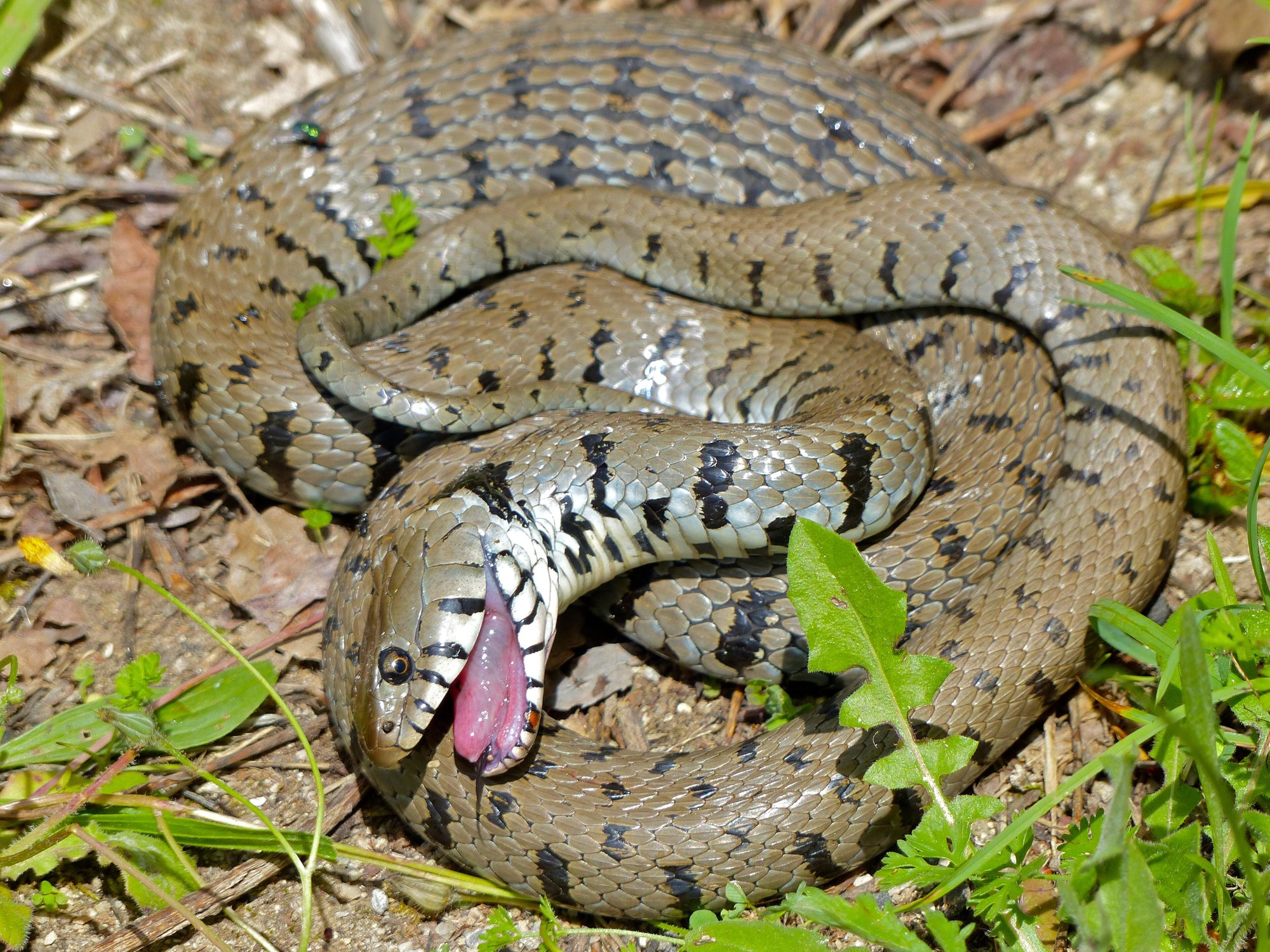
Barred grass snake (Natrix helvetica)
Snakes · Difficulty: Intermediate
Key facts and care guidance for Barred grass snake (Natrix helvetica) (origin: Western and southwestern Europe: England, France, Benelux, Switzerland, Italy, northern Spain; in Germany west and south of the Rhine). Adult size around usually 80–120 cm total length; females noticeably larger and more robust, males rarely over 140 cm. A maximum length of just under 2 m has been recorded.. Life expectancy 15–25 years. The values below are carefully researched guidance.
Short answers
Barred grass snake: How big does the enclosure need to be?
From 150×60×60 cm (minimum size per the 1997 expert report, Eurasian water snakes); an aqua-terrarium.
Barred grass snake: What temperature does it need?
Daytime 20–27 °C, basking spot 32 °C, at night 12–17 °C.
Barred grass snake: Does it need UVB lighting?
UVB: Essential (UVB 5.0).
Barred grass snake: How long do they live?
Life expectancy: 15–25 years.
Barred grass snake: Is it suitable for beginners?
Rather not – it is considered an intermediate species (difficulty: Intermediate).
Climate
- Daytime temperature
- 20–27 °C
- Night temperature
- 12–17 °C
- Basking spot
- 32 °C
- Humidity
- 55–70 %
- UVB
- Essential (UVB 5.0)
Enclosure
- Minimum size
- from 150×60×60 cm (minimum size per the 1997 expert report, Eurasian water snakes); an aqua-terrarium
- Substrate
- Bark mulch with leaf litter, a cork hide, a large water section
Feeding
- Food
- Fish, amphibian substitute food, earthworms
- Feeding interval
- 2×/week
Key facts
- Adult size
- usually 80–120 cm total length; females noticeably larger and more robust, males rarely over 140 cm. A maximum length of just under 2 m has been recorded.
- Life expectancy
- 15–25 years
- Origin
- Western and southwestern Europe: England, France, Benelux, Switzerland, Italy, northern Spain; in Germany west and south of the Rhine
- Protection status
- Specially protected (German Federal Species Protection Ordinance) – taking from the wild is prohibited, keeping it only with legal proof of origin
- Brumation
- A winter rest of 12–16 weeks at 4–8 °C
- Cohabitation
- A group is possible. Water and garter snakes are the exception among colubrids: they lie together willingly and can be kept in groups. But the feeding accident remains the risk here too — so always feed them singly, ideally in separate boxes, and only house animals of roughly the same size together.
Notes
Split from Natrix natrix in 2017 – the western grass snake, with strong dark cross bars. Native and strictly regulated: documented captive-bred animals only, and taking it from the wild is a criminal offence.
Do you keep this species?
Add your animal to Reptoria – Reptoria reminds you about feeding and shedding. Add your animal for free →
Look for Barred grass snake (Natrix helvetica) in the marketplace →
Related species
- Grass snake (Natrix natrix) – Intermediate
- Viperine water snake (Natrix maura) – Intermediate
- Dice snake (Natrix tessellata) – Expert
- Ahumada's alpine garter snake (Thamnophis ahumadai) – Expert
- Northern water snake (Nerodia sipedon) – Intermediate
- Bogert's garter snake (Thamnophis bogerti) – Expert
- Dekay's brown snake (Storeria dekayi) – Intermediate
- Butler's garter snake (Thamnophis butleri) – Intermediate
What you need to start
To keep Barred grass snake (Natrix helvetica) you typically need: a suitable enclosure (from 150×60×60 cm (minimum size per the 1997 expert report, Eurasian water snakes); an aqua-terrarium), substrate (Bark mulch with leaf litter, a cork hide, a large water section), a heat source with a thermostat, UVB lighting, thermometer and hygrometer, a water dish and hides. You will find equipment in the Reptoria marketplace.
The complete, interactive care database is in the Reptoria app.
Last updated: 2 November 2026 · Editor: Reptoria editorial team · Sources include: Wikipedia DE, reptile-database.reptarium.cz, eu_annex.txt (lokal, VO (EU) 2026/1383), gutachten.txt (BML 1997, lokal), herpetofauna-bw.de
All values are non-binding guidance and do not replace expert advice. Research thoroughly from several sources before acquiring and keeping an animal, and observe the applicable law (species and animal protection in particular).