Blackbelly garter snake (Thamnophis melanogaster)
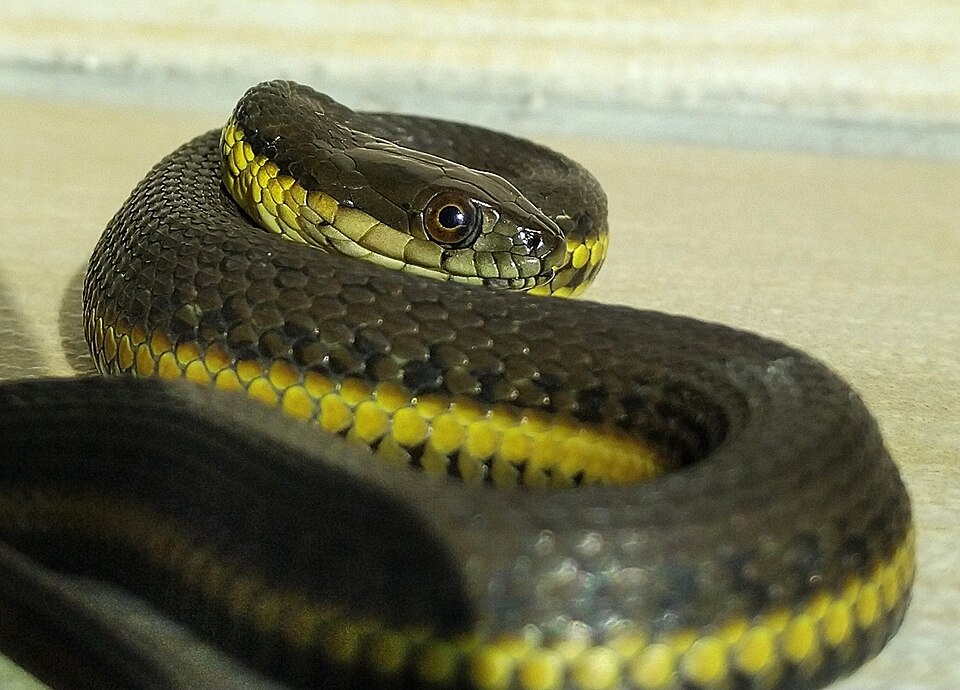
Snakes · Difficulty: Intermediate
Key facts and care guidance for Blackbelly garter snake (Thamnophis melanogaster) (origin: Mexico: the central plateau (including Jalisco, Michoacán, Guanajuato, the State of Mexico and Durango) at 1,150–2,550 m, at lakes such as Chapala and Cuitzeo, canals and streams). Adult size around 45–70 cm (usually 50–60 cm, record 86 cm). Life expectancy 8–12 years. The values below are carefully researched guidance.
Short answers
Blackbelly garter snake: How big does the enclosure need to be?
From 90×55×35 cm (minimum size per the 1997 expert report, garter snakes; about a fifth more floor space for each additional animal).
Blackbelly garter snake: What temperature does it need?
Daytime 22–28 °C, basking spot Basking spot 30–33 °C, at night 15–19 °C.
Blackbelly garter snake: Does it need UVB lighting?
UVB: Recommended.
Blackbelly garter snake: How long do they live?
Life expectancy: 8–12 years.
Blackbelly garter snake: Is it suitable for beginners?
Rather not – it is considered an intermediate species (difficulty: Intermediate).
Climate
- Daytime temperature
- 22–28 °C
- Night temperature
- 15–19 °C
- Basking spot
- Basking spot 30–33 °C
- Humidity
- 50–70 % (keep the land area dry)
- UVB
- Recommended
Enclosure
- Minimum size
- from 90×55×35 cm (minimum size per the 1997 expert report, garter snakes; about a fifth more floor space for each additional animal)
- Substrate
- Aqua-terrarium with a large water section (up to half the floor) and a smaller, dry, heated land area of coco humus or a soil-sand mix; branches above the water for basking, dense hides
Feeding
- Food
- A pronounced aquatic hunter that feeds only underwater: in the wild fish, tadpoles, frogs, leeches, earthworms and, as the only known garter snake, freshly moulted crayfish. In captivity low-thiaminase fish (dead or live) and earthworms; mice are rarely taken
- Feeding interval
- adults 2×/week, juveniles more often
Key facts
- Adult size
- 45–70 cm (usually 50–60 cm, record 86 cm)
- Life expectancy
- 8–12 years
- Origin
- Mexico: the central plateau (including Jalisco, Michoacán, Guanajuato, the State of Mexico and Durango) at 1,150–2,550 m, at lakes such as Chapala and Cuitzeo, canals and streams
- Protection status
- Not listed under CITES
- Brumation
- A short rest period of 8–12 weeks at 12–16 °C with shorter lighting; a true winter rest is not necessary, and refusing food in winter is normal
- Cohabitation
- Group keeping is possible (similarly sized animals, a large water section, enough basking spots); experienced keepers also house them together with the Mexican garter snake (T. eques). They strike quickly at feeding time: always feed them singly, ideally in separate boxes.
Notes
Little keeping experience overall, but bred by specialist keepers for years. Very shy at first, calmer over time and then basks openly. A highland species: keep it clearly cooler at night. When feeding fish, choose low-thiaminase species.
Do you keep this species?
Add your animal to Reptoria – Reptoria reminds you about feeding and shedding. Add your animal for free →
Look for Blackbelly garter snake (Thamnophis melanogaster) in the marketplace →
Related species
- Ahumada's alpine garter snake (Thamnophis ahumadai) – Expert
- Bogert's garter snake (Thamnophis bogerti) – Expert
- Butler's garter snake (Thamnophis butleri) – Intermediate
- Cope's mountain meadow snake (Thamnophis copei) – Expert
- Fox's mountain meadow snake (Thamnophis foxi) – Expert
- Yellow-throated garter snake (Thamnophis pulchrilatus) – Expert
- Common garter snake (Thamnophis sirtalis) – Beginner
- Godman's garter snake (Thamnophis godmani) – Expert
What you need to start
To keep Blackbelly garter snake (Thamnophis melanogaster) you typically need: a suitable enclosure (from 90×55×35 cm (minimum size per the 1997 expert report, garter snakes; about a fifth more floor space for each additional animal)), substrate (Aqua-terrarium with a large water section (up to half the floor) and a smaller, dry, heated land area of coco humus or a soil-sand mix; branches above the water for basking, dense hides), a heat source with a thermostat, UVB lighting, thermometer and hygrometer, a water dish and hides. You will find equipment in the Reptoria marketplace.
The complete, interactive care database is in the Reptoria app.
Last updated: 27 October 2026 · Editor: Reptoria editorial team · Sources include: Steven Bol Garter Snakes: Thamnophis melanogaster canescens – meist 50–60 cm, Maximum 86,4 cm – https://stevenbolgartersnakes.com/species-2/melanogaster-canescens/, DGHT AG Schlangen, Merkblatt 4 Wassernattern (2004) – Thiaminase in karpfenartigen Fischen, Haltung richtet sich nach Herkunft – https://schlangen.dght.de/files/Merkblatt-Wassernattern.pdf, gartersnake.co.uk Maintenance (Gattung) – Futterunfälle, trächtige Weibchen einzeln – https://www.gartersnake.co.uk/maintenance/, Steven Bol Garter Snakes: T. m. canescens – Gruppen im Aquaterrarium, zusammen mit T. eques, Mindestmaß für ein Paar 70×50×50 cm – https://stevenbolgartersnakes.com/species-2/melanogaster-canescens/, Wikipedia EN: Blackbelly garter snake – frisst nur unter Wasser, Fisch, Frösche, Kaulquappen, Egel, Regenwürmer, weichhäutige Flusskrebse – https://en.wikipedia.org/wiki/Thamnophis_melanogaster
All values are non-binding guidance and do not replace expert advice. Research thoroughly from several sources before acquiring and keeping an animal, and observe the applicable law (species and animal protection in particular).