Blue-ring centipede (Ethmostigmus trigonopodus)
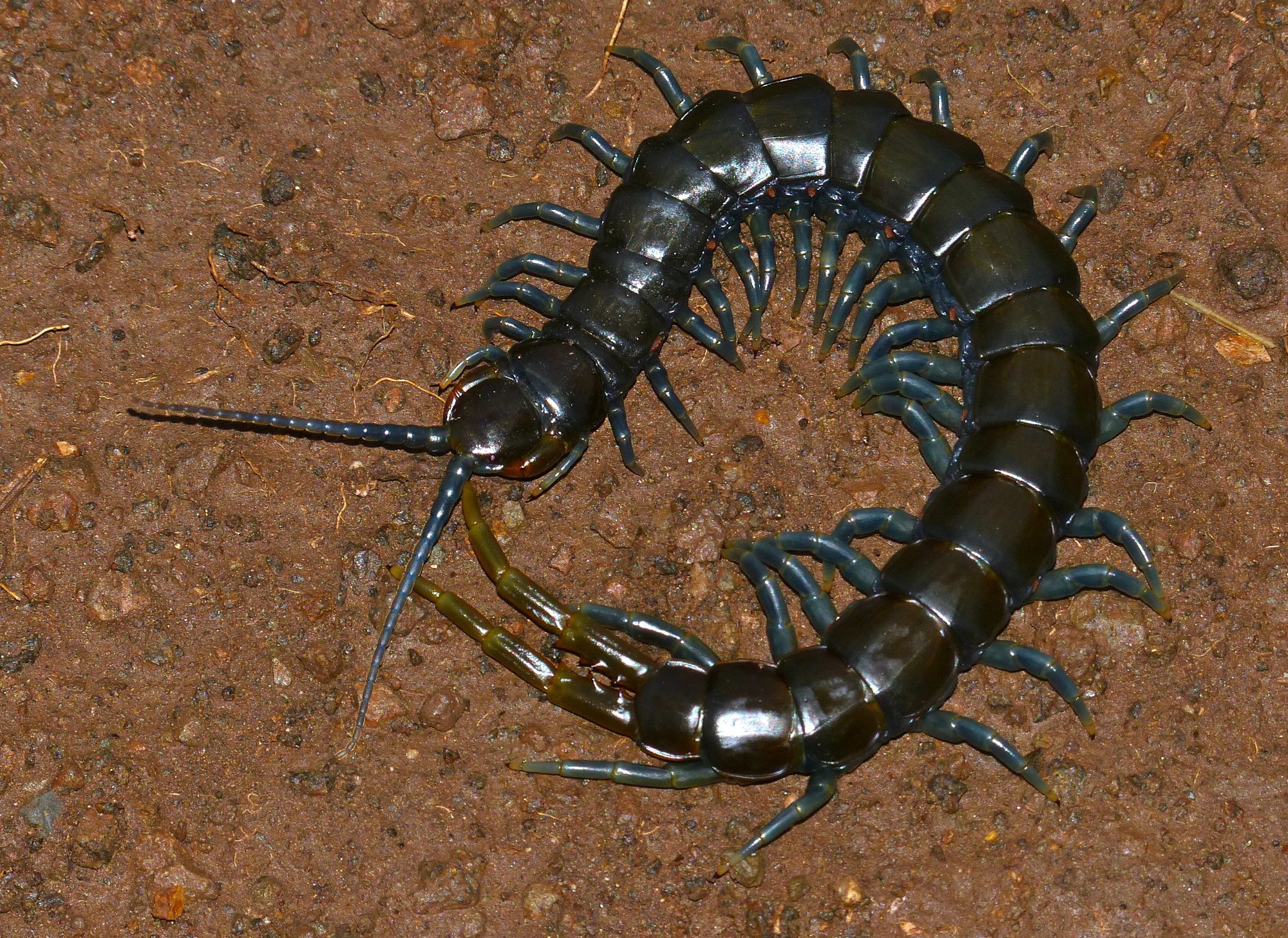
Invertebrates · Difficulty: Intermediate
Key facts and care guidance for Blue-ring centipede (Ethmostigmus trigonopodus) (origin: Large parts of Africa, from Algeria through Ethiopia to South Africa; animals in the trade are mostly from Tanzania, Congo and Sudan). Adult size around approx. 15–18 cm. Life expectancy approx. 5–7 years. The values below are carefully researched guidance.
Short answers
Blue-ring centipede: How big does the enclosure need to be?
40×30×30 cm kept singly, closed escape-proof.
Blue-ring centipede: What temperature does it need?
Daytime 24–28 °C, basking spot no warm spot needed, at night 22 °C.
Blue-ring centipede: Does it need UVB lighting?
UVB: No UVB needed.
Blue-ring centipede: How long do they live?
Life expectancy: approx. 5–7 years.
Blue-ring centipede: Is it suitable for beginners?
Rather not – it is considered an intermediate species (difficulty: Intermediate).
Climate
- Daytime temperature
- 24–28 °C
- Night temperature
- 22 °C
- Basking spot
- no warm spot needed
- Humidity
- 65–80 %
- UVB
- No UVB needed
Enclosure
- Minimum size
- 40×30×30 cm kept singly, closed escape-proof
- Substrate
- Coco humus with forest humus, 10–15 cm deep for digging; cork bark
Feeding
- Food
- Crickets, roaches, locusts; occasionally superworms
- Feeding interval
- 1–2× a week
Key facts
- Adult size
- approx. 15–18 cm
- Life expectancy
- approx. 5–7 years
- Origin
- Large parts of Africa, from Algeria through Ethiopia to South Africa; animals in the trade are mostly from Tanzania, Congo and Sudan
- Protection status
- Not protected
- Brumation
- None
- Cohabitation
- Strictly singly. Centipedes are cannibalistic towards each other. The reason is not fighting but feeding: these animals take anything that fits in the mouth, and a second animal in the enclosure counts.
Notes
A VENOMOUS ANIMAL: the bite is not life-threatening to healthy adults, but very painful and it can cause swelling. Do not pick it up, and work only with forceps. Very keen to escape — an enclosure without a tightly closing lid is not an enclosure. Not one for beginners, and not for households with children.
Do you keep this species?
Add your animal to Reptoria – Reptoria reminds you about feeding and shedding. Add your animal for free →
Look for Blue-ring centipede (Ethmostigmus trigonopodus) in the marketplace →
Related species
- Giant centipede (Ethmostigmus rubripes) – Expert
- Amazonian giant centipede (Scolopendra gigantea) – Intermediate to expert
- Chinese red-headed centipede (Scolopendra subspinipes) – Expert
- Chinese red-headed centipede (Scolopendra mutilans) – Expert
- Tanzanian blue ringleg centipede (Scolopendra morsitans) – Intermediate
- Indian tiger centipede (Scolopendra hardwickei) – Expert
- Caribbean giant centipede (Scolopendra alternans) – Expert
- Mediterranean banded centipede (Scolopendra cingulata) – Intermediate
What you need to start
To keep Blue-ring centipede (Ethmostigmus trigonopodus) you typically need: a suitable enclosure (40×30×30 cm kept singly, closed escape-proof), substrate (Coco humus with forest humus, 10–15 cm deep for digging; cork bark), a heat source with a thermostat, UVB lighting, thermometer and hygrometer, a water dish and hides. You will find equipment in the Reptoria marketplace.
The complete, interactive care database is in the Reptoria app.
Last updated: 9 October 2026 · Editor: Reptoria editorial team · Sources include: Wikipedia DE, exotic-pets.co.uk, Wikipedia EN, eu_annex.txt (lokal), geckonia.eu
All values are non-binding guidance and do not replace expert advice. Research thoroughly from several sources before acquiring and keeping an animal, and observe the applicable law (species and animal protection in particular).