Carpet chameleon (Furcifer lateralis)
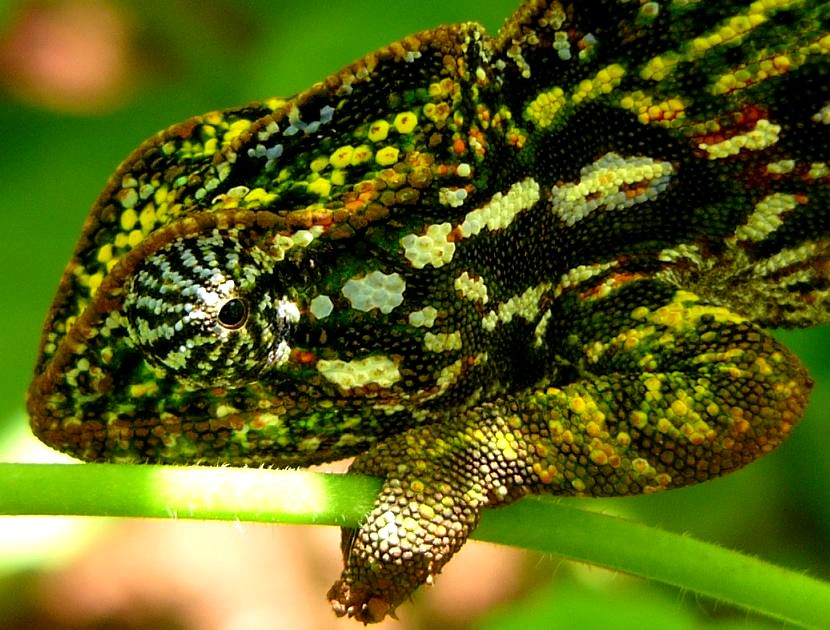
Chameleons · Difficulty: Intermediate
Key facts and care guidance for Carpet chameleon (Furcifer lateralis) (origin: Endemic to Madagascar (the highlands / central Madagascar, widespread)). Adult size around approx. 17–25 cm total length (a small species). Life expectancy approx. 2–4 years (short-lived, females worn down by egg-laying). The values below are carefully researched guidance.
Short answers
Carpet chameleon: How big does the enclosure need to be?
60×50×80 cm for one adult animal (at least 40×40×70 cm is quoted; larger is better).
Carpet chameleon: What temperature does it need?
Daytime 24–28 °C, basking spot 30–33 °C, at night 15–18 °C (cooler in winter).
Carpet chameleon: Does it need UVB lighting?
UVB: UVB needed (Ferguson zone 2–3, UV index 3).
Carpet chameleon: How long do they live?
Life expectancy: approx. 2–4 years (short-lived, females worn down by egg-laying).
Carpet chameleon: Is it suitable for beginners?
Rather not – it is considered an intermediate species (difficulty: Intermediate).
Climate
- Daytime temperature
- 24–28 °C
- Night temperature
- 15–18 °C (cooler in winter)
- Basking spot
- 30–33 °C
- Humidity
- 60–80 % during the day, up to ~100 % at night
- UVB
- UVB needed (Ferguson zone 2–3, UV index 3)
Enclosure
- Minimum size
- 60×50×80 cm for one adult animal (at least 40×40×70 cm is quoted; larger is better)
- Substrate
- A humus soil or forest floor, densely planted (ficus, schefflera), plenty of fine climbing branches; gauze on two sides against stale air
Feeding
- Food
- Insects: house crickets, small crickets, flies, roaches, locusts; dusted with calcium and vitamins
- Feeding interval
- adults 2–3×/week, juveniles daily
Key facts
- Adult size
- approx. 17–25 cm total length (a small species)
- Life expectancy
- approx. 2–4 years (short-lived, females worn down by egg-laying)
- Origin
- Endemic to Madagascar (the highlands / central Madagascar, widespread)
- Protection status
- CITES Appendix II / EU Regulation Annex B – specially protected: proof of origin plus registration required; export quotas from Madagascar
- Brumation
- No real winter rest; a cooler, drier winter spell with a stronger night-time drop is recommended (it encourages reproduction)
- Cohabitation
- Single keeping. Males are aggressive towards each other and strongly territorial, females stress easily, and pairs can seriously injure each other. Keep adults singly; only hatchlings can be kept briefly in groups and are separated by size as they mature. Mating only briefly and under supervision, then separate again.
Notes
Small and adaptable, but very sensitive to climate mistakes; it dehydrates easily (fresh drinking water or droplets are needed). Common mistakes: too warm, too dry, and stuffy air. Not for beginners.
Do you keep this species?
Add your animal to Reptoria – Reptoria reminds you about feeding and shedding. Add your animal for free →
Look for Carpet chameleon (Furcifer lateralis) in the marketplace →
Related species
- Angel's chameleon (Furcifer angeli) – Expert
- Antimena chameleon (Furcifer antimena) – Intermediate to expert
- Campan's chameleon (Furcifer campani) – Expert
- Unicorn chameleon (Furcifer monoceras) – Expert
- Forked chameleon (Furcifer bifidus) – Expert
- Belted chameleon (Furcifer balteatus) – Expert
- Minor chameleon (Furcifer minor) – Expert
- Labord's chameleon (Furcifer labordi) – Expert
What you need to start
To keep Carpet chameleon (Furcifer lateralis) you typically need: a suitable enclosure (60×50×80 cm for one adult animal (at least 40×40×70 cm is quoted; larger is better)), substrate (A humus soil or forest floor, densely planted (ficus, schefflera), plenty of fine climbing branches; gauze on two sides against stale air), a heat source with a thermostat, UVB lighting, thermometer and hygrometer, a water dish and hides. You will find equipment in the Reptoria marketplace.
The complete, interactive care database is in the Reptoria app.
Last updated: 7 November 2026 · Editor: Reptoria editorial team · Sources include: Wikipedia Carpet chameleon (Furcifer lateralis): Eier bei konstant 24°C, Schlupf nach ca. einem halben Jahr, Gelege 8-23 Eier, bis 3x/Jahr – https://en.wikipedia.org/wiki/Carpet_chameleon, Reptile Database: Furcifer lateralis, oviparous – https://reptile-database.reptarium.cz/species?genus=Furcifer&species=lateralis, https://de.wikipedia.org/wiki/Furcifer_lateralis, https://en.wikipedia.org/wiki/Furcifer_lateralis, https://reptile-database.reptarium.cz/species?genus=Furcifer&species=lateralis
All values are non-binding guidance and do not replace expert advice. Research thoroughly from several sources before acquiring and keeping an animal, and observe the applicable law (species and animal protection in particular).