Central bearded dragon (Pogona vitticeps)
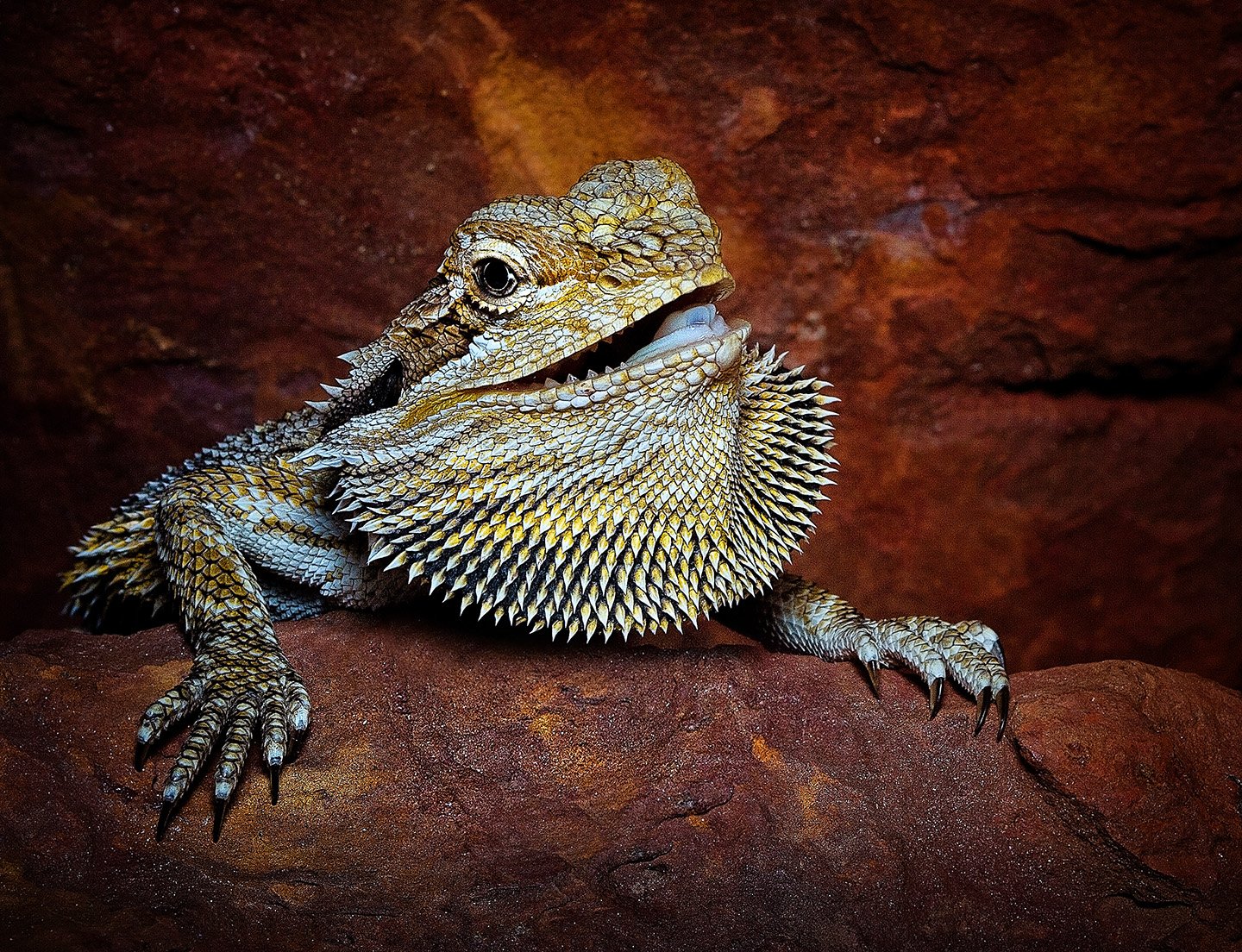
Agamas · Difficulty: Beginner to intermediate
Key facts and care guidance for Central bearded dragon (Pogona vitticeps) (origin: Australia). Adult size around 40–55 cm. Life expectancy 12–18 years. The values below are carefully researched guidance.
Short answers
Central bearded dragon: How big does the enclosure need to be?
From 150×100×80 cm for one animal.
Central bearded dragon: What temperature does it need?
Daytime 28–30 °C, basking spot 40–45 °C at the basking spot (up to 50 °C directly under the lamp), at night 18–22 °C.
Central bearded dragon: Does it need UVB lighting?
UVB: Essential (strong desert-grade UVB, T5 10–12 %).
Central bearded dragon: How long do they live?
Life expectancy: 12–18 years.
Central bearded dragon: Is it suitable for beginners?
Partly – manageable with some prior knowledge (difficulty: Beginner to intermediate).
Climate
- Daytime temperature
- 28–30 °C
- Night temperature
- 18–22 °C
- Basking spot
- 40–45 °C at the basking spot (up to 50 °C directly under the lamp)
- Humidity
- 30–40 %
- UVB
- Essential (strong desert-grade UVB, T5 10–12 %)
Enclosure
- Minimum size
- from 150×100×80 cm for one animal
- Substrate
- A sand-loam mix
Feeding
- Food
- Plenty of insects when young, more vegetables and herbs as adults
- Feeding interval
- Adults insects 2–3×/week, plants daily
Key facts
- Adult size
- 40–55 cm
- Life expectancy
- 12–18 years
- Origin
- Australia
- Protection status
- —
- Brumation
- Recommended: 2–3 months at 12–15 °C, in January/February. Ramp down temperature and lighting slowly over about a month, and withhold food for two weeks beforehand. Without a rest period breeding won't happen, and many keepers observe a shorter lifespan.
- Cohabitation
- Single housing (especially males). The reason is territory: two animals will not voluntarily share a basking spot or a hiding place. They fight until one is seriously injured or permanently confined to a corner — and that second animal then eats worse, without showing any visible wound.
Notes
Very hungry for light: strong UVB plus a hot basking spot are essential. A common beginner's mistake is too little light and warmth.
Do you keep this species?
Add your animal to Reptoria – Reptoria reminds you about feeding and shedding. Add your animal for free →
Central bearded dragon (Pogona vitticeps) currently offered
- 0.1 Hypo Translucent Dark Red LB Bartagame – Hypo Translucent Dark Red Leatherback · Penig · 240 €
- 0.1 Hypo Red Bartagame – Hypo Red Leatherback · Penig · 180 €
- 1.0 Coral Bartagame Nachzuchten 2026 – Coral Translucent Red Orange · Penig · 220 €
- 0.1 Coral Bartagame – Hypo Translucent Dark Red Orange · Penig · 200 €
- 0.1 Red Orange LB Bartagame Pogona Vitticeps – Red Orange Leatherback · Penig · 170 €
- 0.1 Dark Red LB Bartagame Pogona Vitticeps – Dark Red Leatherback · Penig · 190 €
Related species
- Eastern bearded dragon (Pogona barbata) – Intermediate
- Kimberley bearded dragon (Pogona microlepidota) – Intermediate
- Mitchell's bearded dragon (Pogona mitchelli) – Intermediate
- Nullarbor bearded dragon (Pogona nullarbor) – Intermediate
- Rankin's bearded dragon (Pogona rankini) – Beginner
- Western bearded dragon (Pogona minor) – Intermediate
- Rankin's dragon (Pogona henrylawsoni) – Beginner to intermediate
- Egyptian spiny-tailed lizard (Uromastyx aegyptia) – Intermediate to expert
What you need to start
To keep Central bearded dragon (Pogona vitticeps) you typically need: a suitable enclosure (from 150×100×80 cm for one animal), substrate (A sand-loam mix), a heat source with a thermostat, UVB lighting, thermometer and hygrometer, a water dish and hides. You will find equipment in the Reptoria marketplace.
The complete, interactive care database is in the Reptoria app.
Last updated: 9 October 2026 · Editor: Reptoria editorial team · Sources include: bartagamenhaltung.de, Gutachten 1997, dahmstierleben.de, drta-archiv.de, einrichtungsbeispiele.de
All values are non-binding guidance and do not replace expert advice. Research thoroughly from several sources before acquiring and keeping an animal, and observe the applicable law (species and animal protection in particular).