Centralian blue-tongued skink (Tiliqua multifasciata)
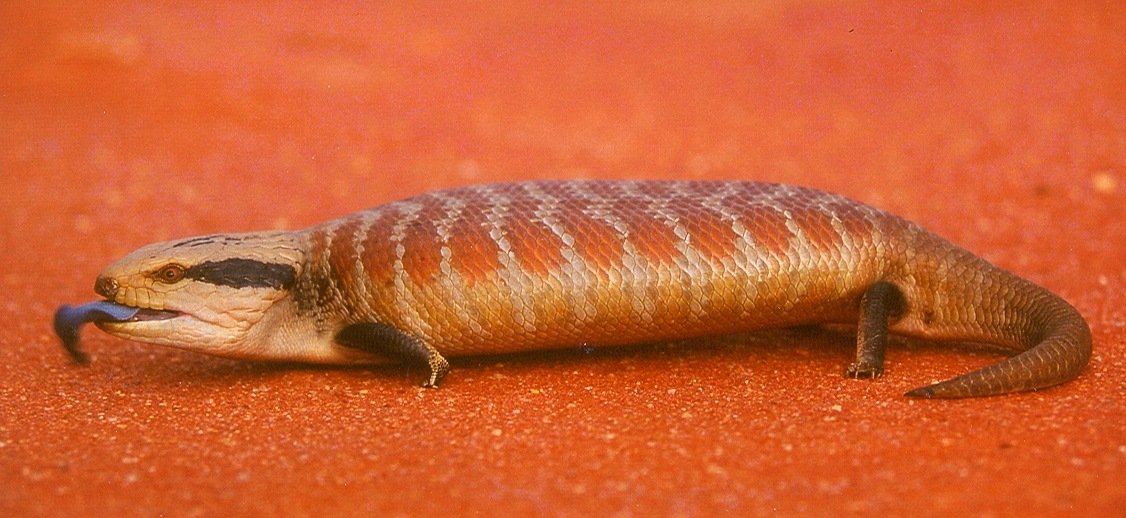
Skinks · Difficulty: Intermediate
Key facts and care guidance for Centralian blue-tongued skink (Tiliqua multifasciata) (origin: Arid and semi-arid areas of central and western Australia: spinifex sand plains, stony hills, red sandy soils (WA, NT, SA, western QLD, the far northwest of NSW)). Adult size around 40–50 cm. Life expectancy 20–30 years, individual animals considerably older. The values below are carefully researched guidance.
Short answers
Centralian blue-tongued skink: How big does the enclosure need to be?
180 × 120 × 90 cm for an adult animal.
Centralian blue-tongued skink: What temperature does it need?
Daytime cool side 21–26 °C, warm side 28–32 °C, basking spot 40–45 °C, at night 18–24 °C.
Centralian blue-tongued skink: Does it need UVB lighting?
UVB: Yes, UV index 3–4 at the basking spot (e.g. a 12% T5 fluorescent tube), replace the lamp annually.
Centralian blue-tongued skink: How long do they live?
Life expectancy: 20–30 years, individual animals considerably older.
Centralian blue-tongued skink: Is it suitable for beginners?
Rather not – it is considered an intermediate species (difficulty: Intermediate).
Climate
- Daytime temperature
- cool side 21–26 °C, warm side 28–32 °C
- Night temperature
- 18–24 °C
- Basking spot
- 40–45 °C
- Humidity
- 30–50 % (arid; offer a humid hide)
- UVB
- Yes, UV index 3–4 at the basking spot (e.g. a 12% T5 fluorescent tube), replace the lamp annually
Enclosure
- Minimum size
- 180 × 120 × 90 cm for an adult animal
- Substrate
- A sand-loam mix, a humid hide box
Feeding
- Food
- Omnivorous – insects, snails, vegetables and fruit, flowers
- Feeding interval
- Adults 1–2×/week, juveniles 3×/week, babies daily.
Key facts
- Adult size
- 40–50 cm
- Life expectancy
- 20–30 years, individual animals considerably older
- Origin
- Arid and semi-arid areas of central and western Australia: spinifex sand plains, stony hills, red sandy soils (WA, NT, SA, western QLD, the far northwest of NSW)
- Protection status
- —
- Brumation
- A slight winter rest of ~6–8 weeks is recommended
- Cohabitation
- Single housing; territorial. The reason is territory: two animals will not voluntarily share a basking spot or a hiding place. They fight until one is seriously injured or permanently confined to a corner — and that second animal then eats worse, without showing any visible wound.
Notes
A desert species – low ambient humidity, but a damp hide is needed; do NOT keep it humid like tropical T. gigas. A high UVB and warmth requirement.
Do you keep this species?
Add your animal to Reptoria – Reptoria reminds you about feeding and shedding. Add your animal for free →
Look for Centralian blue-tongued skink (Tiliqua multifasciata) in the marketplace →
Related species
- Common blue-tongued skink (Tiliqua scincoides) – Beginner
- Halmahera blue-tongued skink (Tiliqua gigas gigas) – Intermediate
- Indonesian blue-tongued skink (Tiliqua gigas) – Beginner to intermediate
- Irian Jaya blue-tongued skink (Tiliqua sp. „Irian Jaya") – Intermediate
- Kei Island blue-tongued skink (Tiliqua gigas keyensis) – Intermediate
- Shingleback skink (Tiliqua rugosa) – Intermediate
- Merauke blue-tongued skink (Tiliqua gigas evanescens) – Intermediate
- Northern blue-tongued skink (Tiliqua scincoides intermedia) – Beginner
What you need to start
To keep Centralian blue-tongued skink (Tiliqua multifasciata) you typically need: a suitable enclosure (180 × 120 × 90 cm for an adult animal), substrate (A sand-loam mix, a humid hide box), a heat source with a thermostat, UVB lighting, thermometer and hygrometer, a water dish and hides. You will find equipment in the Reptoria marketplace.
The complete, interactive care database is in the Reptoria app.
Last updated: 9 October 2026 · Editor: Reptoria editorial team · Sources include: arod.com.au, Wikipedia EN, reptifiles.com, dubiaroaches.com, reptile-database.reptarium.cz
All values are non-binding guidance and do not replace expert advice. Research thoroughly from several sources before acquiring and keeping an animal, and observe the applicable law (species and animal protection in particular).