Shingleback skink (Tiliqua rugosa)
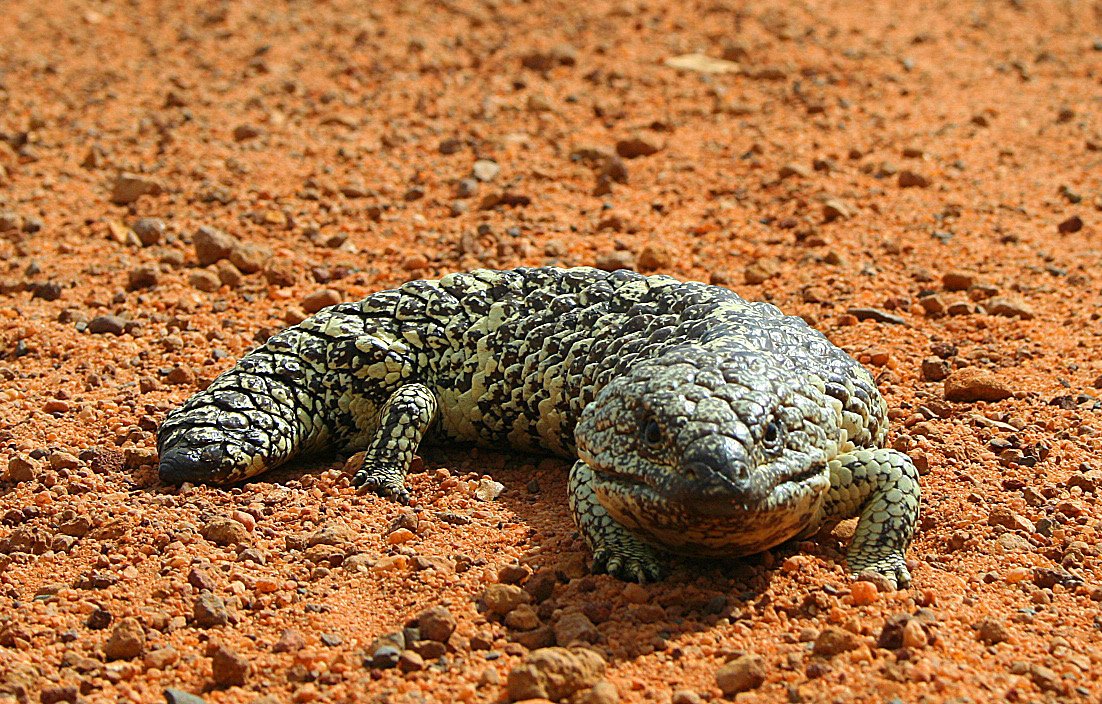
Skinks · Difficulty: Intermediate
Key facts and care guidance for Shingleback skink (Tiliqua rugosa) (origin: Southern and Western Australia (arid areas)). Adult size around approx. 30–40 cm. Life expectancy very long-lived, 30–50+ years. The values below are carefully researched guidance.
Short answers
Shingleback skink: How big does the enclosure need to be?
150 × 80 × 80 cm (a pair), from 250 × 100 × 100 cm for groups.
Shingleback skink: What temperature does it need?
Daytime 23–30 °C, basking spot 35–40 °C, at night 15–20 °C.
Shingleback skink: Does it need UVB lighting?
UVB: Essential (10–12 % UVB).
Shingleback skink: How long do they live?
Life expectancy: very long-lived, 30–50+ years.
Shingleback skink: Is it suitable for beginners?
Rather not – it is considered an intermediate species (difficulty: Intermediate).
Climate
- Daytime temperature
- 23–30 °C
- Night temperature
- 15–20 °C
- Basking spot
- 35–40 °C
- Humidity
- 40–60 %
- UVB
- Essential (10–12 % UVB)
Enclosure
- Minimum size
- 150 × 80 × 80 cm (a pair), from 250 × 100 × 100 cm for groups
- Substrate
- A sand and soil mix, stone slabs, bark, cork tubes
Feeding
- Food
- Mostly plant-based (~80 %: leaves, flowers, vegetables, fruit), ~20 % animal food (snails, insects)
- Feeding interval
- 2–3× a week
Key facts
- Adult size
- approx. 30–40 cm
- Life expectancy
- very long-lived, 30–50+ years
- Origin
- Southern and Western Australia (arid areas)
- Protection status
- Not listed under CITES; an Australian export ban (captive-bred animals only)
- Brumation
- A winter rest or cooling of ~2–3 months at ~10–15 °C (compulsory for breeding)
- Cohabitation
- A pair is closest to natural behaviour: shingleback skinks are among the few monogamous reptiles and form stable partnerships over years, reuniting at breeding time. Outside the bond they are territorial – several males fight over territory and basking spots until one is injured. Females usually get along but need their own warm spots and hides.
Notes
The shingleback: live-bearing with 1–2 very large young, monogamous and extremely long-lived. A cool overwintering and a mainly plant-based diet are essential.
Do you keep this species?
Add your animal to Reptoria – Reptoria reminds you about feeding and shedding. Add your animal for free →
Look for Shingleback skink (Tiliqua rugosa) in the marketplace →
Related species
- Centralian blue-tongued skink (Tiliqua multifasciata) – Intermediate
- Common blue-tongued skink (Tiliqua scincoides) – Beginner
- Halmahera blue-tongued skink (Tiliqua gigas gigas) – Intermediate
- Indonesian blue-tongued skink (Tiliqua gigas) – Beginner to intermediate
- Irian Jaya blue-tongued skink (Tiliqua sp. „Irian Jaya") – Intermediate
- Kei Island blue-tongued skink (Tiliqua gigas keyensis) – Intermediate
- Merauke blue-tongued skink (Tiliqua gigas evanescens) – Intermediate
- Northern blue-tongued skink (Tiliqua scincoides intermedia) – Beginner
What you need to start
To keep Shingleback skink (Tiliqua rugosa) you typically need: a suitable enclosure (150 × 80 × 80 cm (a pair), from 250 × 100 × 100 cm for groups), substrate (A sand and soil mix, stone slabs, bark, cork tubes), a heat source with a thermostat, UVB lighting, thermometer and hygrometer, a water dish and hides. You will find equipment in the Reptoria marketplace.
The complete, interactive care database is in the Reptoria app.
Last updated: 30 October 2026 · Editor: Reptoria editorial team · Sources include: https://en.wikipedia.org/wiki/Shingleback, https://reptile-database.reptarium.cz/species?genus=Tiliqua&species=rugosa
All values are non-binding guidance and do not replace expert advice. Research thoroughly from several sources before acquiring and keeping an animal, and observe the applicable law (species and animal protection in particular).