Merauke blue-tongued skink (Tiliqua gigas evanescens)
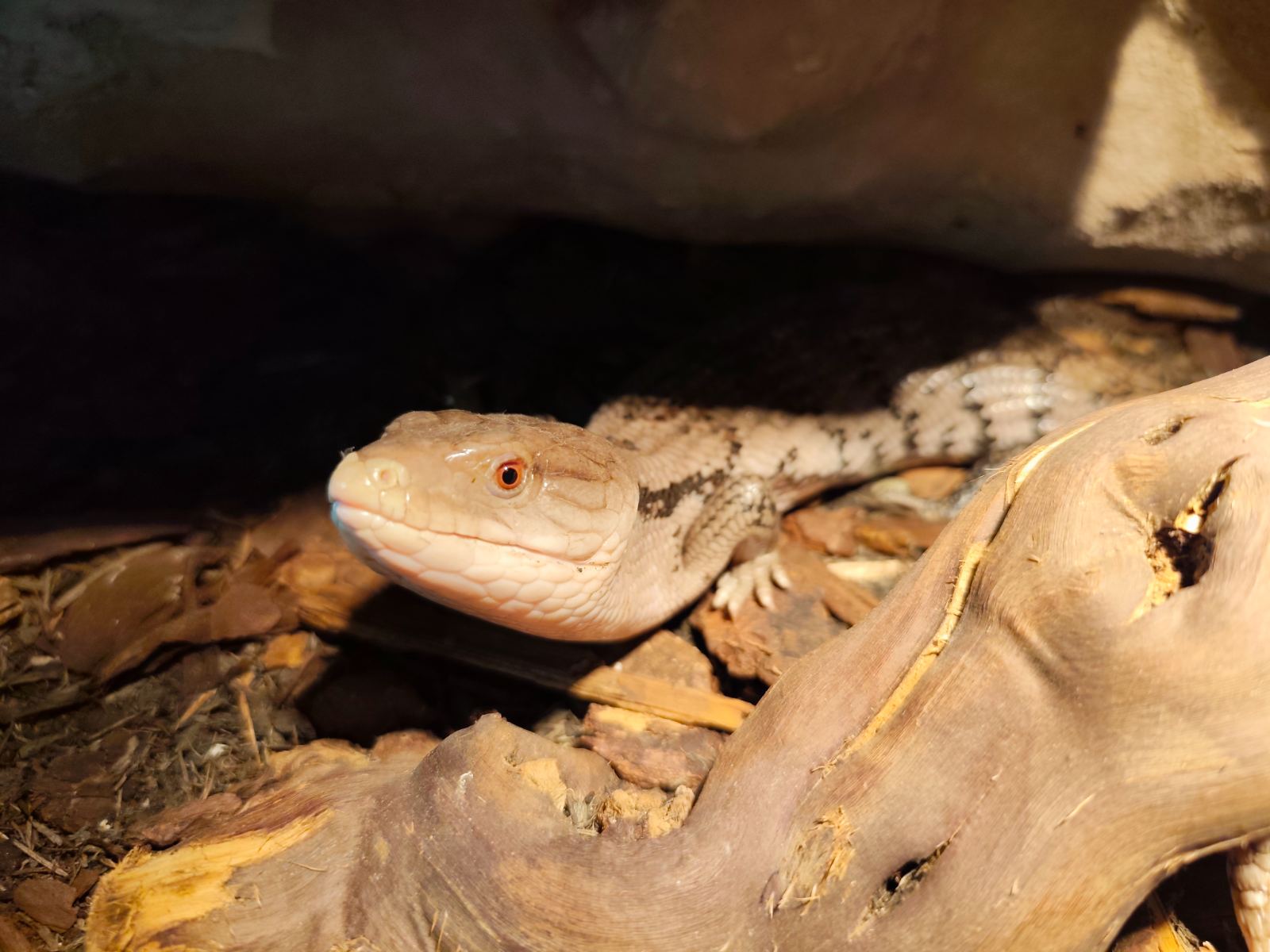
Skinks · Difficulty: Intermediate
Key facts and care guidance for Merauke blue-tongued skink (Tiliqua gigas evanescens) (origin: Southern New Guinea (Merauke)). Adult size around 55–75 cm total length (the longest of all blue-tongued skink forms; tail makes up about half, snout–vent length 30–35 cm). Life expectancy 15–20 years on average, over 30 years with good care. The values below are carefully researched guidance.
Short answers
Merauke blue-tongued skink: How big does the enclosure need to be?
180×80×80 cm for a single animal, more is better (Swiss recommendation: 7× snout–vent length in length, 4× in width, 3× in height).
Merauke blue-tongued skink: What temperature does it need?
Daytime 26–32 °C, basking spot 38 °C, at night 22–24 °C.
Merauke blue-tongued skink: Does it need UVB lighting?
UVB: Essential (UVB 6–10 %).
Merauke blue-tongued skink: How long do they live?
Life expectancy: 15–20 years on average, over 30 years with good care.
Merauke blue-tongued skink: Is it suitable for beginners?
Rather not – it is considered an intermediate species (difficulty: Intermediate).
Climate
- Daytime temperature
- 26–32 °C
- Night temperature
- 22–24 °C
- Basking spot
- 38 °C
- Humidity
- 60–80 %
- UVB
- Essential (UVB 6–10 %)
Enclosure
- Minimum size
- 180×80×80 cm for a single animal, more is better (Swiss recommendation: 7× snout–vent length in length, 4× in width, 3× in height)
- Substrate
- Damp coco humus or bark mulch, hides
Feeding
- Food
- Mixed diet: roughly half plant-based (leafy greens, vegetables, little fruit), half animal-based (insects, snails, high-quality wet food, boiled egg)
- Feeding interval
- adults 1–2×/week, subadults 3×/week, juveniles daily
Key facts
- Adult size
- 55–75 cm total length (the longest of all blue-tongued skink forms; tail makes up about half, snout–vent length 30–35 cm)
- Life expectancy
- 15–20 years on average, over 30 years with good care
- Origin
- Southern New Guinea (Merauke)
- Protection status
- Not listed under CITES
- Brumation
- None
- Cohabitation
- Keep them strictly singly. Territorial: males in particular fight in earnest and injure their heads and limbs in the process. For breeding, put them together under supervision and separate them again afterwards.
Notes
The longest blue-tongue form, with a long tail. It needs more humidity than the Australian relatives.
Do you keep this species?
Add your animal to Reptoria – Reptoria reminds you about feeding and shedding. Add your animal for free →
Merauke blue-tongued skink (Tiliqua gigas evanescens) currently offered
- Blauzungenskink evanescens – Bad Kreuznach · 199 €
Related species
- Centralian blue-tongued skink (Tiliqua multifasciata) – Intermediate
- Common blue-tongued skink (Tiliqua scincoides) – Beginner
- Halmahera blue-tongued skink (Tiliqua gigas gigas) – Intermediate
- Indonesian blue-tongued skink (Tiliqua gigas) – Beginner to intermediate
- Irian Jaya blue-tongued skink (Tiliqua sp. „Irian Jaya") – Intermediate
- Kei Island blue-tongued skink (Tiliqua gigas keyensis) – Intermediate
- Shingleback skink (Tiliqua rugosa) – Intermediate
- Northern blue-tongued skink (Tiliqua scincoides intermedia) – Beginner
What you need to start
To keep Merauke blue-tongued skink (Tiliqua gigas evanescens) you typically need: a suitable enclosure (180×80×80 cm for a single animal, more is better (Swiss recommendation: 7× snout–vent length in length, 4× in width, 3× in height)), substrate (Damp coco humus or bark mulch, hides), a heat source with a thermostat, UVB lighting, thermometer and hygrometer, a water dish and hides. You will find equipment in the Reptoria marketplace.
The complete, interactive care database is in the Reptoria app.
Last updated: 2 November 2026 · Editor: Reptoria editorial team · Sources include: thebiodude.com, reptifiles.com, cites.org, einrichtungsbeispiele.de, reptilienkosmos.de
All values are non-binding guidance and do not replace expert advice. Research thoroughly from several sources before acquiring and keeping an animal, and observe the applicable law (species and animal protection in particular).