Condamine earless dragon (Tympanocryptis condaminensis)
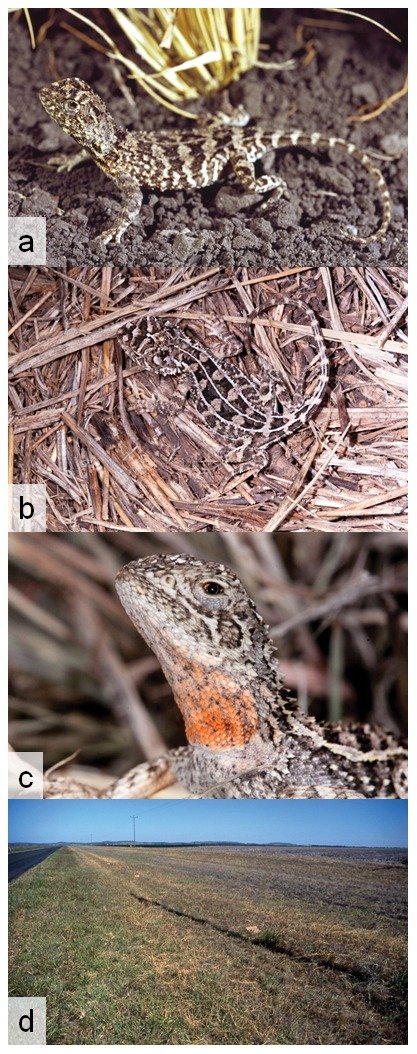
Agamas · Difficulty: Expert
Key facts and care guidance for Condamine earless dragon (Tympanocryptis condaminensis) (origin: Endemic to south-eastern Queensland, Australia (the Darling Downs, the Condamine floodplain, black-soil natural grassland and farmland)). Adult size around small: SVL ~5–7 cm, total length ~12–15 cm with the tail. Life expectancy Not documented for this species; related earless dragons reach 4–7 years in the terrarium, and 9 years or more under good conditions. The values below are carefully researched guidance.
Short answers
Condamine earless dragon: How big does the enclosure need to be?
~80×50×50 cm for one animal (ground-oriented and terrestrial); theoretical only – see the notes.
Condamine earless dragon: What temperature does it need?
Daytime 26–32 °C (dry grassland, warm by day), basking spot Basking spot 36–40 °C (close to the floor, on stone), at night 16–20 °C.
Condamine earless dragon: Does it need UVB lighting?
UVB: UVB needed (open grassland, a sun species, Ferguson zone 3–4, a high UV index).
Condamine earless dragon: How long do they live?
Life expectancy: Not documented for this species; related earless dragons reach 4–7 years in the terrarium, and 9 years or more under good conditions.
Condamine earless dragon: Is it suitable for beginners?
No – better suited to experienced keepers (difficulty: Expert).
Climate
- Daytime temperature
- 26–32 °C (dry grassland, warm by day)
- Night temperature
- 16–20 °C
- Basking spot
- Basking spot 36–40 °C (close to the floor, on stone)
- Humidity
- 30–50 % (dry; a small humid area or burrow)
- UVB
- UVB needed (open grassland, a sun species, Ferguson zone 3–4, a high UV index)
Enclosure
- Minimum size
- ~80×50×50 cm for one animal (ground-oriented and terrestrial); theoretical only – see the notes
- Substrate
- A loamy or clay-rich floor (black soil), a sand-loam mix with cracks, stones and tussocks of grass, diggable
Feeding
- Food
- Insectivorous: ants, termites, small crickets or house crickets, roaches and small arthropods; calcium and D3
- Feeding interval
- adults every other day, juveniles daily (small prey)
Key facts
- Adult size
- small: SVL ~5–7 cm, total length ~12–15 cm with the tail
- Life expectancy
- Not documented for this species; related earless dragons reach 4–7 years in the terrarium, and 9 years or more under good conditions
- Origin
- Endemic to south-eastern Queensland, Australia (the Darling Downs, the Condamine floodplain, black-soil natural grassland and farmland)
- Protection status
- STRICTLY PROTECTED: IUCN "Endangered"; protected under Australian law (the Queensland Nature Conservation Act and the EPBC Act), with export from Australia prohibited. NO legal wild collection, and no legal keeping in Germany without proof; practically absent from the terrarium trade
- Brumation
- A seasonal cool rest in winter (cooler and drier, nights ~10–15 °C, with a shortened photoperiod) – matched to the climate they come from
- Cohabitation
- Single housing or a pair (1.1); avoid keeping several males together, they fight over territory and the basking spot. Ground-dwelling dwarf grassland dragon that uses soil cracks as hiding places. The species itself is not kept in captivity; this information is based on related earless dragons.
Notes
IMPORTANT: a threatened Australian endemic and NOT a terrarium species – Australia bans wildlife export and the species is endangered. The climate and food figures are derived from the genus (T. tetraporophora, T. pinguicolla) and its habitat, NOT from keeping practice. If listed in the app context: mark it as protected and not keepable.
Do you keep this species?
Add your animal to Reptoria – Reptoria reminds you about feeding and shedding. Add your animal for free →
Look for Condamine earless dragon (Tympanocryptis condaminensis) in the marketplace →
Related species
- Inland earless dragon (Tympanocryptis intima) – Expert
- Even-scaled earless dragon (Tympanocryptis uniformis) – Expert
- Long-tailed earless dragon (Tympanocryptis tetraporophora) – Intermediate
- Pebble-mimic dragon (Tympanocryptis cephalus) – Expert
- Fortescue earless dragon (Tympanocryptis fortescuensis) – Expert
- Lined earless dragon (Tympanocryptis lineata) – Expert
- Smooth-snouted earless dragon (Tympanocryptis parviceps) – Expert
- Grassland earless dragon (Tympanocryptis pinguicolla) – Expert
What you need to start
To keep Condamine earless dragon (Tympanocryptis condaminensis) you typically need: a suitable enclosure (~80×50×50 cm for one animal (ground-oriented and terrestrial); theoretical only – see the notes), substrate (A loamy or clay-rich floor (black soil), a sand-loam mix with cracks, stones and tussocks of grass, diggable), a heat source with a thermostat, UVB lighting, thermometer and hygrometer, a water dish and hides. You will find equipment in the Reptoria marketplace.
The complete, interactive care database is in the Reptoria app.
Last updated: 30 October 2026 · Editor: Reptoria editorial team · Sources include: Wikipedia EN, arod.com.au, bmleh.de (Gutachten Reptilien 1997), dragonzoo.de, eur-lex.europa.eu
All values are non-binding guidance and do not replace expert advice. Research thoroughly from several sources before acquiring and keeping an animal, and observe the applicable law (species and animal protection in particular).