Lined earless dragon (Tympanocryptis lineata)
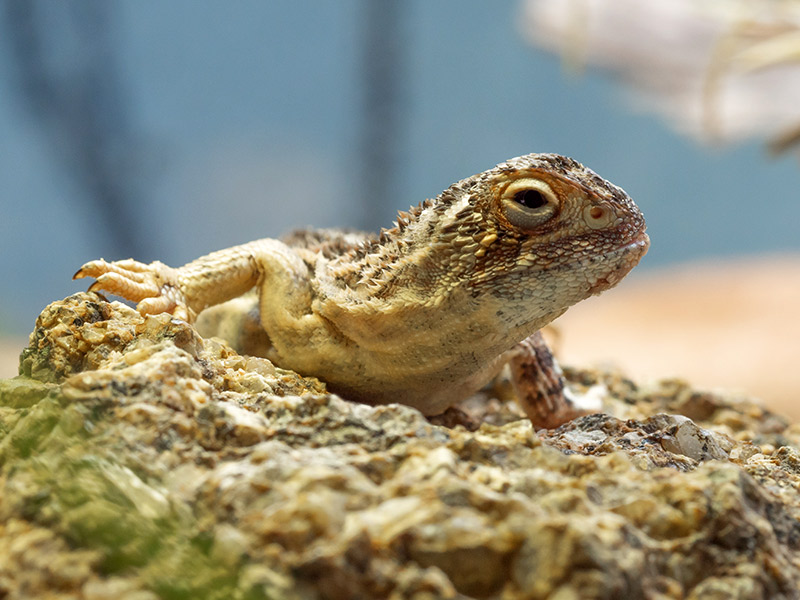
Agamas · Difficulty: Expert
Key facts and care guidance for Lined earless dragon (Tympanocryptis lineata) (origin: The natural temperate grassland around Canberra (ACT) and adjoining NSW; a very restricted range. Confirmed as a separate species in 2019 (Melville et al.)). Adult size around approx. 12–15 cm total length (SVL 5–7 cm). Life expectancy short-lived in the wild (often under 3–4 years); captivity barely documented. The values below are carefully researched guidance.
Short answers
Lined earless dragon: How big does the enclosure need to be?
80×40×40 cm with dense tussocks of grass and invertebrate earth tubes.
Lined earless dragon: What temperature does it need?
Daytime 24–30 °C (temperate grassland), basking spot 36–42 °C, at night 12–18 °C.
Lined earless dragon: Does it need UVB lighting?
UVB: UVB needed (Ferguson zone 3–4, UV index 4–6; open grassland).
Lined earless dragon: How long do they live?
Life expectancy: short-lived in the wild (often under 3–4 years); captivity barely documented.
Lined earless dragon: Is it suitable for beginners?
No – better suited to experienced keepers (difficulty: Expert).
Climate
- Daytime temperature
- 24–30 °C (temperate grassland)
- Night temperature
- 12–18 °C
- Basking spot
- 36–42 °C
- Humidity
- 40–60 %
- UVB
- UVB needed (Ferguson zone 3–4, UV index 4–6; open grassland)
Enclosure
- Minimum size
- 80×40×40 cm with dense tussocks of grass and invertebrate earth tubes
- Substrate
- A loamy floor with tussocks of grass, flat stones and open cracks or spider and cricket burrows as hides
Feeding
- Food
- Small insects: ants, small crickets, beetles, spiders
- Feeding interval
- adults every 1–2 days, juveniles daily
Key facts
- Adult size
- approx. 12–15 cm total length (SVL 5–7 cm)
- Life expectancy
- short-lived in the wild (often under 3–4 years); captivity barely documented
- Origin
- The natural temperate grassland around Canberra (ACT) and adjoining NSW; a very restricted range. Confirmed as a separate species in 2019 (Melville et al.)
- Protection status
- Nationally listed as threatened or endangered (EPBC Act); Australian native wildlife, export prohibited – NOT in the trade, only in a conservation context; registration required
- Brumation
- A winter rest (brumation) of several weeks at about 8–14 °C is needed (a temperate highland)
- Cohabitation
- Keep them singly. Territorial; NEVER keep males together. Put them together only within controlled breeding programmes.
Notes
A badly endangered grassland species, effectively relevant only in conservation breeding and field protection, not in private keeping. It uses burrows dug by arthropods as a key hide. The figures are derived conservatively from its habitat.
Do you keep this species?
Add your animal to Reptoria – Reptoria reminds you about feeding and shedding. Add your animal for free →
Look for Lined earless dragon (Tympanocryptis lineata) in the marketplace →
Related species
- Inland earless dragon (Tympanocryptis intima) – Expert
- Condamine earless dragon (Tympanocryptis condaminensis) – Expert
- Even-scaled earless dragon (Tympanocryptis uniformis) – Expert
- Long-tailed earless dragon (Tympanocryptis tetraporophora) – Intermediate
- Pebble-mimic dragon (Tympanocryptis cephalus) – Expert
- Fortescue earless dragon (Tympanocryptis fortescuensis) – Expert
- Smooth-snouted earless dragon (Tympanocryptis parviceps) – Expert
- Grassland earless dragon (Tympanocryptis pinguicolla) – Expert
What you need to start
To keep Lined earless dragon (Tympanocryptis lineata) you typically need: a suitable enclosure (80×40×40 cm with dense tussocks of grass and invertebrate earth tubes), substrate (A loamy floor with tussocks of grass, flat stones and open cracks or spider and cricket burrows as hides), a heat source with a thermostat, UVB lighting, thermometer and hygrometer, a water dish and hides. You will find equipment in the Reptoria marketplace.
The complete, interactive care database is in the Reptoria app.
Last updated: 9 October 2026 · Editor: Reptoria editorial team · Sources include: https://en.wikipedia.org/wiki/Tympanocryptis, https://en.wikipedia.org/wiki/Tympanocryptis_lineata
All values are non-binding guidance and do not replace expert advice. Research thoroughly from several sources before acquiring and keeping an animal, and observe the applicable law (species and animal protection in particular).