Grassland earless dragon (Tympanocryptis pinguicolla)
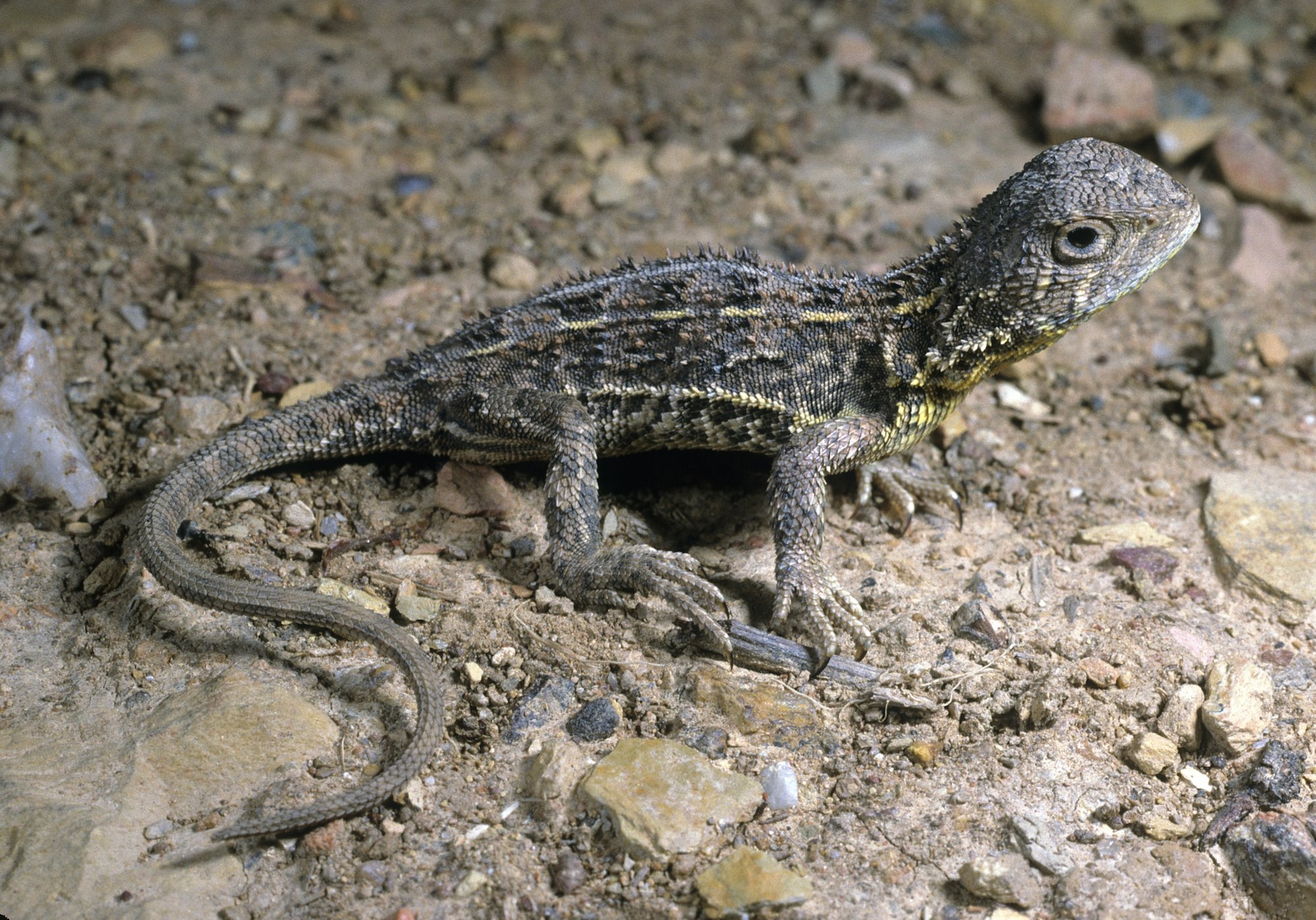
Agamas · Difficulty: Expert
Key facts and care guidance for Grassland earless dragon (Tympanocryptis pinguicolla) (origin: The natural temperate grassland of Victoria (south-eastern Australia); long thought possibly extinct, and rediscovered in 2023). Adult size around approx. 12–15 cm total length; snout–vent length 4.5–6.2 cm. Life expectancy Short-lived in the wild: many animals reach sexual maturity in their hatching year and reproduce only once; for earless dragons in general, the BML expert report states 4–7 years. The values below are carefully researched guidance.
Short answers
Grassland earless dragon: How big does the enclosure need to be?
80×40×40 cm with dense tussocks of grass and earth tubes.
Grassland earless dragon: What temperature does it need?
Daytime 24–30 °C (temperate grassland of Victoria), basking spot 36–42 °C, at night 10–16 °C.
Grassland earless dragon: Does it need UVB lighting?
UVB: UVB needed (Ferguson zone 3–4, UV index 4–6).
Grassland earless dragon: How long do they live?
Life expectancy: Short-lived in the wild: many animals reach sexual maturity in their hatching year and reproduce only once; for earless dragons in general, the BML expert report states 4–7 years.
Grassland earless dragon: Is it suitable for beginners?
No – better suited to experienced keepers (difficulty: Expert).
Climate
- Daytime temperature
- 24–30 °C (temperate grassland of Victoria)
- Night temperature
- 10–16 °C
- Basking spot
- 36–42 °C
- Humidity
- 40–60 %
- UVB
- UVB needed (Ferguson zone 3–4, UV index 4–6)
Enclosure
- Minimum size
- 80×40×40 cm with dense tussocks of grass and earth tubes
- Substrate
- A loam floor with tussocks of grass (Themeda), flat stones and invertebrate-dug burrows as essential hides
Feeding
- Food
- Small insects: ants, small crickets, beetles, spiders
- Feeding interval
- adults every 1–2 days, juveniles daily
Key facts
- Adult size
- approx. 12–15 cm total length; snout–vent length 4.5–6.2 cm
- Life expectancy
- Short-lived in the wild: many animals reach sexual maturity in their hatching year and reproduce only once; for earless dragons in general, the BML expert report states 4–7 years
- Origin
- The natural temperate grassland of Victoria (south-eastern Australia); long thought possibly extinct, and rediscovered in 2023
- Protection status
- Critically endangered (nationally threatened or critical); Australian native wildlife, with export strictly prohibited. NOT in the trade – it exists in captivity only within a conservation breeding programme (including Melbourne Zoo, with the first captive breeding at the end of 2023)
- Brumation
- A winter rest (brumation) of several weeks at about 6–12 °C is needed (a cool temperate climate)
- Cohabitation
- Keep them singly. Territorial; NEVER keep males together. Put them together only in controlled zoo conservation breeding.
Notes
One of Australia's most threatened reptile species, effectively only in a conservation and zoo context, with no private keeping at all. Arthropod burrows are vital to its survival. The figures are derived from field biology and the breeding programme.
Do you keep this species?
Add your animal to Reptoria – Reptoria reminds you about feeding and shedding. Add your animal for free →
Look for Grassland earless dragon (Tympanocryptis pinguicolla) in the marketplace →
Related species
- Inland earless dragon (Tympanocryptis intima) – Expert
- Condamine earless dragon (Tympanocryptis condaminensis) – Expert
- Even-scaled earless dragon (Tympanocryptis uniformis) – Expert
- Long-tailed earless dragon (Tympanocryptis tetraporophora) – Intermediate
- Pebble-mimic dragon (Tympanocryptis cephalus) – Expert
- Fortescue earless dragon (Tympanocryptis fortescuensis) – Expert
- Lined earless dragon (Tympanocryptis lineata) – Expert
- Smooth-snouted earless dragon (Tympanocryptis parviceps) – Expert
What you need to start
To keep Grassland earless dragon (Tympanocryptis pinguicolla) you typically need: a suitable enclosure (80×40×40 cm with dense tussocks of grass and earth tubes), substrate (A loam floor with tussocks of grass (Themeda), flat stones and invertebrate-dug burrows as essential hides), a heat source with a thermostat, UVB lighting, thermometer and hygrometer, a water dish and hides. You will find equipment in the Reptoria marketplace.
The complete, interactive care database is in the Reptoria app.
Last updated: 30 October 2026 · Editor: Reptoria editorial team · Sources include: Wikipedia EN, aussiepythons.com, bmleh.de, colossalfoundation.org, eur-lex.europa.eu
All values are non-binding guidance and do not replace expert advice. Research thoroughly from several sources before acquiring and keeping an animal, and observe the applicable law (species and animal protection in particular).