Flat rock scorpion (Hadogenes troglodytes)
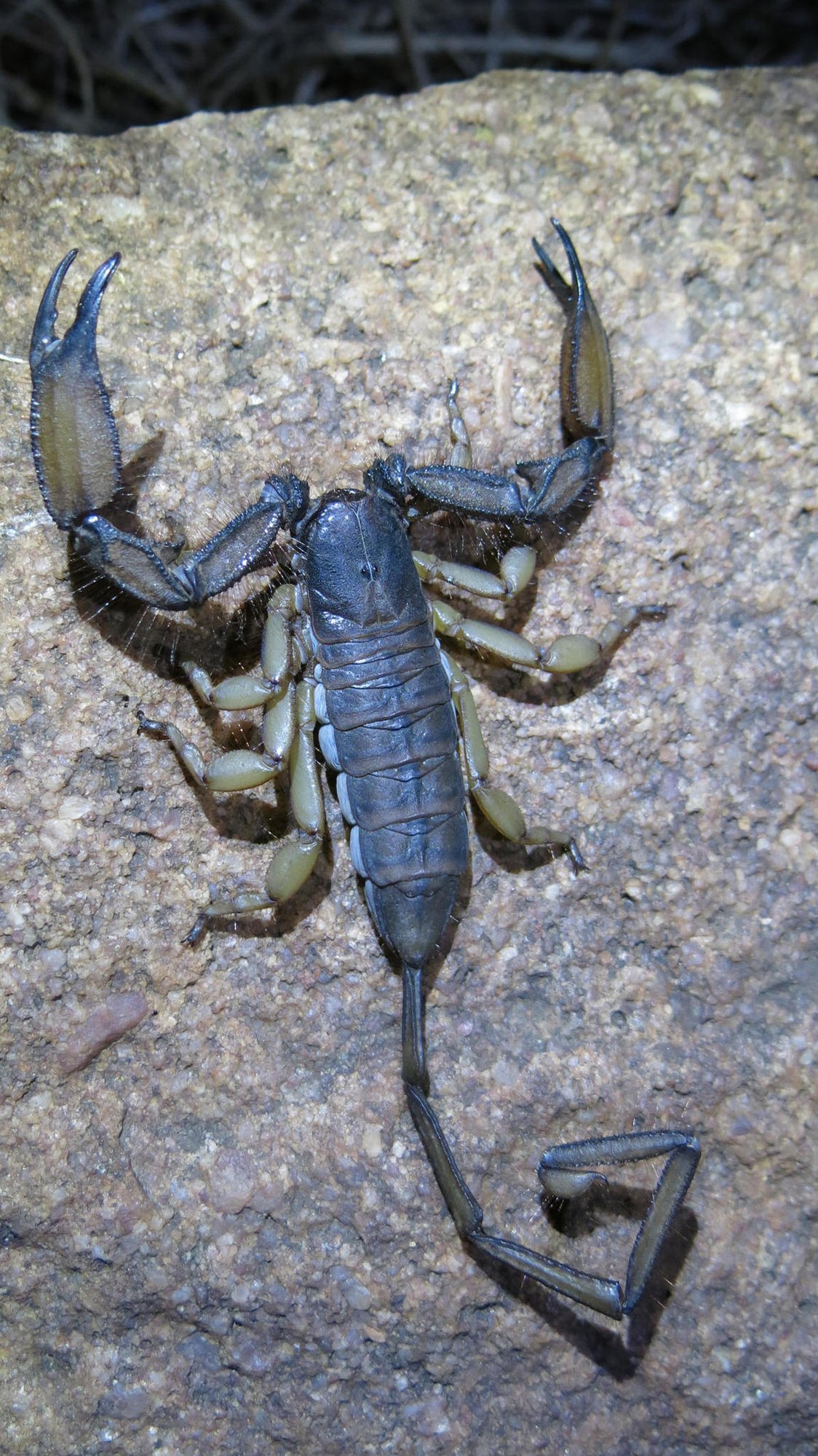
Invertebrates · Difficulty: Intermediate
Key facts and care guidance for Flat rock scorpion (Hadogenes troglodytes) (origin: Southern Africa (South Africa, Zimbabwe, Mozambique, Botswana)). Adult size around Up to ~20–21 cm (males); elongated and very flat. Life expectancy Up to ~25–30 years (the longest-lived scorpion species); sexual maturity only at 8–10 years. The values below are carefully researched guidance.
Short answers
Flat rock scorpion: How big does the enclosure need to be?
From ~30×30×20 cm (a single animal); flat, with an extensive rock structure.
Flat rock scorpion: What temperature does it need?
Daytime 25–32 °C, at night 20–24 °C.
Flat rock scorpion: Does it need UVB lighting?
UVB: No UVB needed (nocturnal); avoid bright light.
Flat rock scorpion: How long do they live?
Life expectancy: Up to ~25–30 years (the longest-lived scorpion species); sexual maturity only at 8–10 years.
Flat rock scorpion: Is it suitable for beginners?
Rather not – it is considered an intermediate species (difficulty: Intermediate).
Climate
- Daytime temperature
- 25–32 °C
- Night temperature
- 20–24 °C
- Basking spot
- —
- Humidity
- 40–60 % (mostly dry)
- UVB
- No UVB needed (nocturnal); avoid bright light
Enclosure
- Minimum size
- from ~30×30×20 cm (a single animal); flat, with an extensive rock structure
- Substrate
- A shallow layer of dry sand or soil plus stacked stone slabs (slate) with narrow crevices; good ventilation
Feeding
- Food
- Live insects: house crickets, crickets, roaches, mealworms, locusts
- Feeding interval
- Adults 1×/week to every 2 weeks; juveniles 2–3×/week; remove leftovers
Key facts
- Adult size
- Up to ~20–21 cm (males); elongated and very flat
- Life expectancy
- Up to ~25–30 years (the longest-lived scorpion species); sexual maturity only at 8–10 years
- Origin
- Southern Africa (South Africa, Zimbabwe, Mozambique, Botswana)
- Protection status
- No CITES; may be kept freely.
- Brumation
- None.
- Cohabitation
- Keep singly – strictly solitary and cannibalistic, tolerates no conspecifics; Wikipedia describes it as highly territorial, fighting to the death if housed together. Never house males together.
Notes
Very slow-growing and extremely long-lived – barely bred in captivity, and imports are usually wild-caught. It needs rock crevices rather than digging substrate. Too high a humidity or poor ventilation → fungal infection (the main mistake; an early source gave 70 %, reputable care sheets 40–60 %). Low in venom and very peaceable, but no touching. Unsuitable for breeding because of how slowly it grows.
Do you keep this species?
Add your animal to Reptoria – Reptoria reminds you about feeding and shedding. Add your animal for free →
Look for Flat rock scorpion (Hadogenes troglodytes) in the marketplace →
Related species
- Giant desert hairy scorpion (Hadrurus arizonensis) – Beginner with some knowledge
- Asian giant forest scorpion (Heterometrus longimanus) – Beginner
- Asian black scorpion (Heterometrus petersii) – Beginner
- Asian forest scorpion (Heterometrus spinifer) – Intermediate
- Brazilian yellow scorpion (Tityus serrulatus) – Expert
- Dictator scorpion (Pandinus dictator) – Intermediate
- Italian scorpion (Euscorpius italicus) – Beginner
- Yellow-legged burrowing scorpion (Opistophthalmus glabrifrons) – Intermediate
What you need to start
To keep Flat rock scorpion (Hadogenes troglodytes) you typically need: a suitable enclosure (from ~30×30×20 cm (a single animal); flat, with an extensive rock structure), substrate (A shallow layer of dry sand or soil plus stacked stone slabs (slate) with narrow crevices; good ventilation), a heat source with a thermostat, UVB lighting, thermometer and hygrometer, a water dish and hides. You will find equipment in the Reptoria marketplace.
The complete, interactive care database is in the Reptoria app.
Last updated: 30 October 2026 · Editor: Reptoria editorial team · Sources include: https://davethebugguy.org/2026/02/18/the-flat-rock-scorpion-a-deep-dive-into-hadogenes-troglodytes/, https://en.wikipedia.org/wiki/Hadogenes_troglodytes
All values are non-binding guidance and do not replace expert advice. Research thoroughly from several sources before acquiring and keeping an animal, and observe the applicable law (species and animal protection in particular).