Giant desert hairy scorpion (Hadrurus arizonensis)
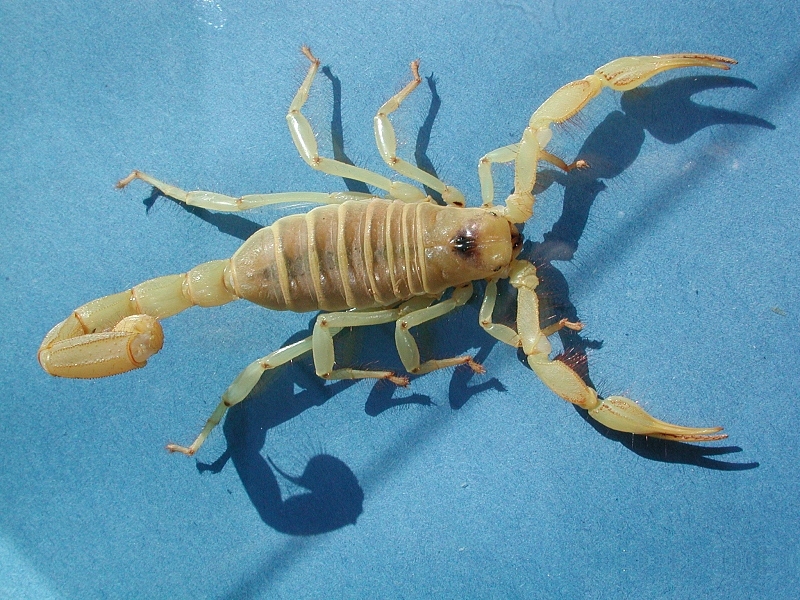
Invertebrates · Difficulty: Beginner with some knowledge
Key facts and care guidance for Giant desert hairy scorpion (Hadrurus arizonensis) (origin: The deserts of the south-western USA (Arizona, Nevada, California, Utah) and northern Mexico). Adult size around approx. 11–15 cm total length (the largest scorpion species in North America). Life expectancy females 15–20 years, individual animals over 25 years; males only a few years after their maturity moult. The values below are carefully researched guidance.
Short answers
Giant desert hairy scorpion: How big does the enclosure need to be?
From 40×30 cm floor space for a single animal; choose the height so that 15–25 cm of substrate fits in with air space above it (i.e. from about 40 cm total height). Otherwise height is of no importance for this ground dweller.
Giant desert hairy scorpion: What temperature does it need?
Daytime 28–32 °C (warm side up to ~35 °C), at night 20–24 °C.
Giant desert hairy scorpion: Does it need UVB lighting?
UVB: Not needed (nocturnal). A spot lamp is only for heat, not lighting; avoid bright light all day.
Giant desert hairy scorpion: How long do they live?
Life expectancy: females 15–20 years, individual animals over 25 years; males only a few years after their maturity moult.
Giant desert hairy scorpion: Is it suitable for beginners?
Partly – manageable with some prior knowledge (difficulty: Beginner with some knowledge).
Climate
- Daytime temperature
- 28–32 °C (warm side up to ~35 °C)
- Night temperature
- 20–24 °C
- Basking spot
- —
- Humidity
- 30–50 % (dry); a shallow water dish
- UVB
- Not needed (nocturnal). A spot lamp is only for heat, not lighting; avoid bright light all day.
Enclosure
- Minimum size
- From 40×30 cm floor space for a single animal; choose the height so that 15–25 cm of substrate fits in with air space above it (i.e. from about 40 cm total height). Otherwise height is of no importance for this ground dweller.
- Substrate
- Dry, diggable sand-clay mix, filled 15–25 cm deep and lightly moistened and compacted so the burrow holds its shape; only the bottom layer in one corner kept damp. Flat stones and pieces of bark as hides.
Feeding
- Food
- Live insects: house crickets, crickets, roaches, locusts
- Feeding interval
- Adults every 10–14 days; juveniles weekly; remove leftovers after 24 h
Key facts
- Adult size
- approx. 11–15 cm total length (the largest scorpion species in North America)
- Life expectancy
- females 15–20 years, individual animals over 25 years; males only a few years after their maturity moult
- Origin
- The deserts of the south-western USA (Arizona, Nevada, California, Utah) and northern Mexico
- Protection status
- No CITES; may be kept freely.
- Brumation
- Not mandatory. German husbandry reports recommend two to three months at 5–10 °C without food to prepare for breeding; English-language care guides keep the animals at room temperature year-round. Anyone not breeding can skip this.
- Cohabitation
- Keep them strictly singly – territorial and cannibalistic. Never keep them together.
Notes
The commonest keeping mistake: too humid or poorly ventilated → fungal infection and death. Venomous (mildly, but painfully) and very defensive – do not touch it. It needs dry, deeply diggable substrate.
Do you keep this species?
Add your animal to Reptoria – Reptoria reminds you about feeding and shedding. Add your animal for free →
Look for Giant desert hairy scorpion (Hadrurus arizonensis) in the marketplace →
Related species
- Black hairy scorpion (Hadrurus spadix) – Intermediate
- Asian giant forest scorpion (Heterometrus longimanus) – Beginner
- Asian black scorpion (Heterometrus petersii) – Beginner
- Asian forest scorpion (Heterometrus spinifer) – Intermediate
- Brazilian yellow scorpion (Tityus serrulatus) – Expert
- Dictator scorpion (Pandinus dictator) – Intermediate
- Italian scorpion (Euscorpius italicus) – Beginner
- Flat rock scorpion (Hadogenes troglodytes) – Intermediate
What you need to start
To keep Giant desert hairy scorpion (Hadrurus arizonensis) you typically need: a suitable enclosure (From 40×30 cm floor space for a single animal; choose the height so that 15–25 cm of substrate fits in with air space above it (i.e. from about 40 cm total height). Otherwise height is of no importance for this ground dweller.), substrate (Dry, diggable sand-clay mix, filled 15–25 cm deep and lightly moistened and compacted so the burrow holds its shape; only the bottom layer in one corner kept damp. Flat stones and pieces of bark as hides.), a heat source with a thermostat, thermometer and hygrometer, a water dish and hides. You will find equipment in the Reptoria marketplace.
The complete, interactive care database is in the Reptoria app.
Last updated: 2 November 2026 · Editor: Reptoria editorial team · Sources include: tropic-shop.de, thebiodude.com, Wikipedia EN, einrichtungsbeispiele.de, eu_annex.txt (lokal)
All values are non-binding guidance and do not replace expert advice. Research thoroughly from several sources before acquiring and keeping an animal, and observe the applicable law (species and animal protection in particular).