Black hairy scorpion (Hadrurus spadix)
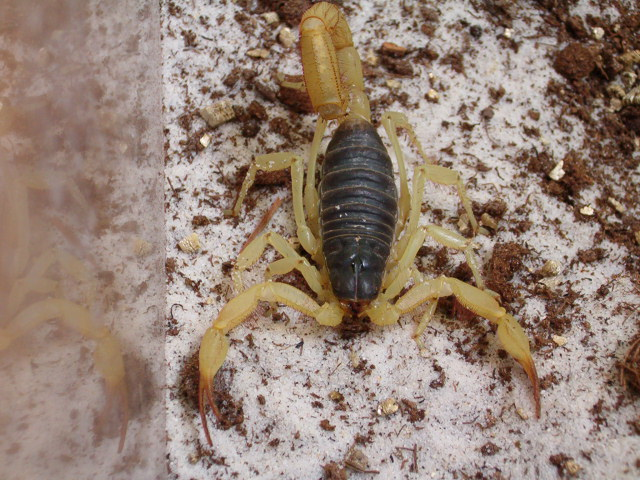
Invertebrates · Difficulty: Intermediate
Key facts and care guidance for Black hairy scorpion (Hadrurus spadix) (origin: North America (the Great Basin and desert regions of the USA)). Adult size around approx. 11–14 cm. Life expectancy approx. 10–20 years (long-lived). The values below are carefully researched guidance.
Short answers
Black hairy scorpion: How big does the enclosure need to be?
40×30×30 cm, plenty of floor area, deep stable digging substrate.
Black hairy scorpion: What temperature does it need?
Daytime 30–35 °C, at night 20 °C (clear night-time drop).
Black hairy scorpion: Does it need UVB lighting?
UVB: No UVB needed (nocturnal).
Black hairy scorpion: How long do they live?
Life expectancy: approx. 10–20 years (long-lived).
Black hairy scorpion: Is it suitable for beginners?
Rather not – it is considered an intermediate species (difficulty: Intermediate).
Climate
- Daytime temperature
- 30–35 °C
- Night temperature
- 20 °C (clear night-time drop)
- Basking spot
- —
- Humidity
- 30 % (very dry, very good ventilation – otherwise there is a risk of fungal infection)
- UVB
- No UVB needed (nocturnal)
Enclosure
- Minimum size
- 40×30×30 cm, plenty of floor area, deep stable digging substrate
- Substrate
- A sand and peat mix (mostly sand), deep and diggable; a stone or bark to burrow under
Feeding
- Food
- House crickets, crickets, roaches
- Feeding interval
- adults 1×/week
Key facts
- Adult size
- approx. 11–14 cm
- Life expectancy
- approx. 10–20 years (long-lived)
- Origin
- North America (the Great Basin and desert regions of the USA)
- Protection status
- Not listed under CITES
- Brumation
- Not essential; optionally a cooler, dry rest period in winter
- Cohabitation
- Kept singly; solitary and cannibalistic. The reason is not territorial conflict but diet: desert hairy scorpions eat anything that fits in their mouths, including a conspecific. Only pair briefly and under supervision for controlled breeding.
Notes
The venom is fairly mild (like a bee sting), but it is very sensitive to high humidity and poor ventilation → the commonest cause of death is mycosis (fungus). A deep burrow and good ventilation matter more than the exact humidity. Long-lived.
Do you keep this species?
Add your animal to Reptoria – Reptoria reminds you about feeding and shedding. Add your animal for free →
Look for Black hairy scorpion (Hadrurus spadix) in the marketplace →
Related species
- Giant desert hairy scorpion (Hadrurus arizonensis) – Beginner with some knowledge
- Asian giant forest scorpion (Heterometrus longimanus) – Beginner
- Asian black scorpion (Heterometrus petersii) – Beginner
- Asian forest scorpion (Heterometrus spinifer) – Intermediate
- Brazilian yellow scorpion (Tityus serrulatus) – Expert
- Dictator scorpion (Pandinus dictator) – Intermediate
- Italian scorpion (Euscorpius italicus) – Beginner
- Flat rock scorpion (Hadogenes troglodytes) – Intermediate
What you need to start
To keep Black hairy scorpion (Hadrurus spadix) you typically need: a suitable enclosure (40×30×30 cm, plenty of floor area, deep stable digging substrate), substrate (A sand and peat mix (mostly sand), deep and diggable; a stone or bark to burrow under), a heat source with a thermostat, UVB lighting, thermometer and hygrometer, a water dish and hides. You will find equipment in the Reptoria marketplace.
The complete, interactive care database is in the Reptoria app.
Last updated: 9 October 2026 · Editor: Reptoria editorial team · Sources include: https://en.wikipedia.org/wiki/Hadrurus, https://en.wikipedia.org/wiki/Hadrurus_spadix
All values are non-binding guidance and do not replace expert advice. Research thoroughly from several sources before acquiring and keeping an animal, and observe the applicable law (species and animal protection in particular).