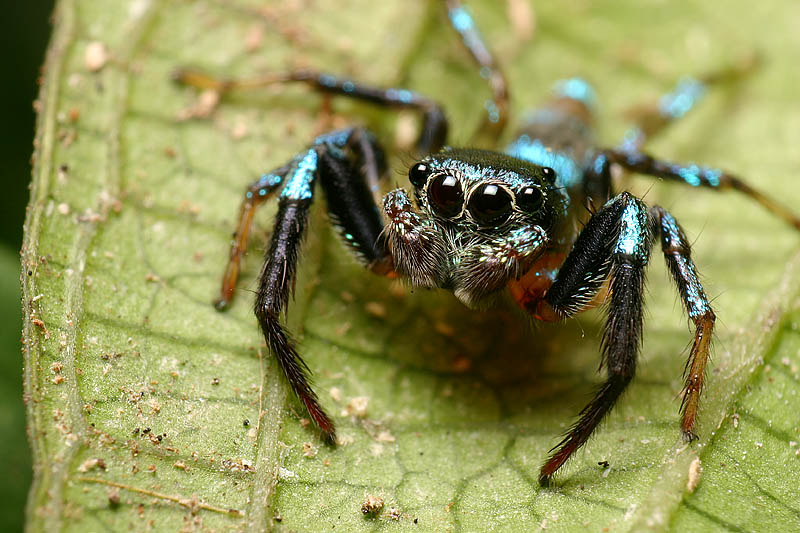
Green jumping spider (Thiania bhamoensis)
Invertebrates · Difficulty: Intermediate
Key facts and care guidance for Green jumping spider (Thiania bhamoensis) (origin: South-East Asia (Singapore, Malaysia, Thailand, Myanmar, Indonesia) – tropical, arboreal). Adult size around approx. 9–12 mm body length. Life expectancy females approx. 1–1.5 years, males shorter (in captivity). The values below are carefully researched guidance.
Short answers
Green jumping spider: How big does the enclosure need to be?
15×15×25 cm (tall, well ventilated, planted).
Green jumping spider: What temperature does it need?
Daytime 24–28 °C, at night 20–23 °C.
Green jumping spider: Does it need UVB lighting?
UVB: No UVB needed; bright daytime lighting (plant lighting) recommended.
Green jumping spider: How long do they live?
Life expectancy: females approx. 1–1.5 years, males shorter (in captivity).
Green jumping spider: Is it suitable for beginners?
Rather not – it is considered an intermediate species (difficulty: Intermediate).
Climate
- Daytime temperature
- 24–28 °C
- Night temperature
- 20–23 °C
- Basking spot
- —
- Humidity
- 70–80 %
- UVB
- No UVB needed; bright daytime lighting (plant lighting) recommended
Enclosure
- Minimum size
- 15×15×25 cm (tall, well ventilated, planted)
- Substrate
- Coco humus or potting soil with sphagnum moss, slightly damp; dense planting with broad leaves
Feeding
- Food
- Fruit flies (Drosophila), micro crickets, small flies and midges; house flies as adults too
- Feeding interval
- adults approx. every 3–4 days, juveniles once a day to every other day
Key facts
- Adult size
- approx. 9–12 mm body length
- Life expectancy
- females approx. 1–1.5 years, males shorter (in captivity)
- Origin
- South-East Asia (Singapore, Malaysia, Thailand, Myanmar, Indonesia) – tropical, arboreal
- Protection status
- No CITES or German protection; mostly wild-caught or imported – look for a reputable source
- Brumation
- None (a tropical species, warm all year)
- Cohabitation
- Keep them singly. Known as the "fighting spider" – the males are strongly territorial and fight to the death, with cannibalism. Strictly solitary, so no pairs or groups.
Notes
It builds a silk retreat from two leaves spun together (untypical for jumping spiders) – offer broad-leaved plants. It needs higher humidity than temperate species, but good ventilation against mould and waterlogging. A common mistake: too dry or too wet. Iridescent green-blue; the females greener, the males bluer.
Do you keep this species?
Add your animal to Reptoria – Reptoria reminds you about feeding and shedding. Add your animal for free →
Look for Green jumping spider (Thiania bhamoensis) in the marketplace →
Related species
- Algerian jumping spider (Cyrba algerina) – Intermediate
- Arched jumping spider (Evarcha arcuata) – Intermediate
- Bronze jumping spider (Hyllus semicupreus) – Beginner
- Peacock jumping spider (Saitis barbipes) – Intermediate
- Diard's jumping spider (Hyllus diardi) – Beginner
- Three-spotted jumping spider (Pellenes tripunctatus) – Intermediate
- Canopy jumping spider (Phidippus otiosus) – Beginner
- Fringed jumping spider (Portia fimbriata) – Expert
What you need to start
To keep Green jumping spider (Thiania bhamoensis) you typically need: a suitable enclosure (15×15×25 cm (tall, well ventilated, planted)), substrate (Coco humus or potting soil with sphagnum moss, slightly damp; dense planting with broad leaves), a heat source with a thermostat, UVB lighting, thermometer and hygrometer, a water dish and hides. You will find equipment in the Reptoria marketplace.
The complete, interactive care database is in the Reptoria app.
Last updated: 30 October 2026 · Editor: Reptoria editorial team · Sources include: https://en.wikipedia.org/wiki/Thiania_bhamoensis, https://m.singapore.biodiversity.online/taxo4254/mainSpace/Thiania%20bhamoensis.html
All values are non-binding guidance and do not replace expert advice. Research thoroughly from several sources before acquiring and keeping an animal, and observe the applicable law (species and animal protection in particular).