Grey wall jumping spider (Menemerus bivittatus)
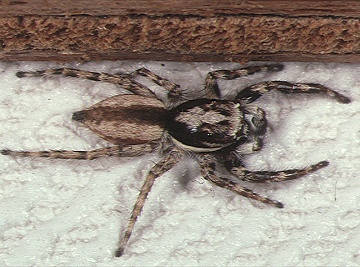
Invertebrates · Difficulty: Beginner
Key facts and care guidance for Grey wall jumping spider (Menemerus bivittatus) (origin: Pantropical, originally African; found in warm regions worldwide (synanthropic, on house walls and tree trunks)). Adult size around females 6–9 mm, males 5–7 mm (body length). Life expectancy approx. 1–2 years. The values below are carefully researched guidance.
Short answers
Grey wall jumping spider: How big does the enclosure need to be?
20×20×30 cm (tall format, vertical surfaces of cork or bark to climb).
Grey wall jumping spider: What temperature does it need?
Daytime 25–28 °C, at night 20–22 °C.
Grey wall jumping spider: How long do they live?
Life expectancy: approx. 1–2 years.
Grey wall jumping spider: Is it suitable for beginners?
Yes – it is considered suitable for beginners (difficulty: Beginner).
Grey wall jumping spider: Can several be kept together?
Keeping them singly is essential – solitary and cannibalistic; NEVER keep males together.
Climate
- Daytime temperature
- 25–28 °C
- Night temperature
- 20–22 °C
- Basking spot
- —
- Humidity
- 50–65 %
Enclosure
- Minimum size
- 20×20×30 cm (tall format, vertical surfaces of cork or bark to climb)
- Substrate
- Coco humus or terrarium soil, cork and bark surfaces; mostly dry, with one damp corner
Feeding
- Food
- Fruit flies (juveniles), house flies, small house crickets or crickets, small roaches, moths
- Feeding interval
- adults 2–3×/week, juveniles every 1–2 days
Key facts
- Adult size
- females 6–9 mm, males 5–7 mm (body length)
- Life expectancy
- approx. 1–2 years
- Origin
- Pantropical, originally African; found in warm regions worldwide (synanthropic, on house walls and tree trunks)
- Protection status
- Not listed under CITES; no special protection
- Brumation
- None (a tropical, heat-loving species)
- Cohabitation
- Keeping them singly is essential – solitary and cannibalistic; NEVER keep males together. Mate them only briefly and under supervision.
Notes
A robust species adapted to walls and vertical surfaces that follows human settlement; it avoids wet and takes drier, warmer conditions. Suitable as a beginner's species. Vertical climbing surfaces matter. Good ventilation, and no stagnant air.
Do you keep this species?
Add your animal to Reptoria – Reptoria reminds you about feeding and shedding. Add your animal for free →
Look for Grey wall jumping spider (Menemerus bivittatus) in the marketplace →
Related species
- Algerian jumping spider (Cyrba algerina) – Intermediate
- Arched jumping spider (Evarcha arcuata) – Intermediate
- Bronze jumping spider (Hyllus semicupreus) – Beginner
- Peacock jumping spider (Saitis barbipes) – Intermediate
- Diard's jumping spider (Hyllus diardi) – Beginner
- Three-spotted jumping spider (Pellenes tripunctatus) – Intermediate
- Canopy jumping spider (Phidippus otiosus) – Beginner
- Fringed jumping spider (Portia fimbriata) – Expert
What you need to start
To keep Grey wall jumping spider (Menemerus bivittatus) you typically need: a suitable enclosure (20×20×30 cm (tall format, vertical surfaces of cork or bark to climb)), substrate (Coco humus or terrarium soil, cork and bark surfaces; mostly dry, with one damp corner), a heat source with a thermostat, thermometer and hygrometer, a water dish and hides. You will find equipment in the Reptoria marketplace.
The complete, interactive care database is in the Reptoria app.
Last updated: 9 October 2026 · Editor: Reptoria editorial team · Sources include: https://en.wikipedia.org/wiki/Menemerus, https://en.wikipedia.org/wiki/Menemerus_bivittatus
All values are non-binding guidance and do not replace expert advice. Research thoroughly from several sources before acquiring and keeping an animal, and observe the applicable law (species and animal protection in particular).