House jumping spider (Pseudeuophrys lanigera)
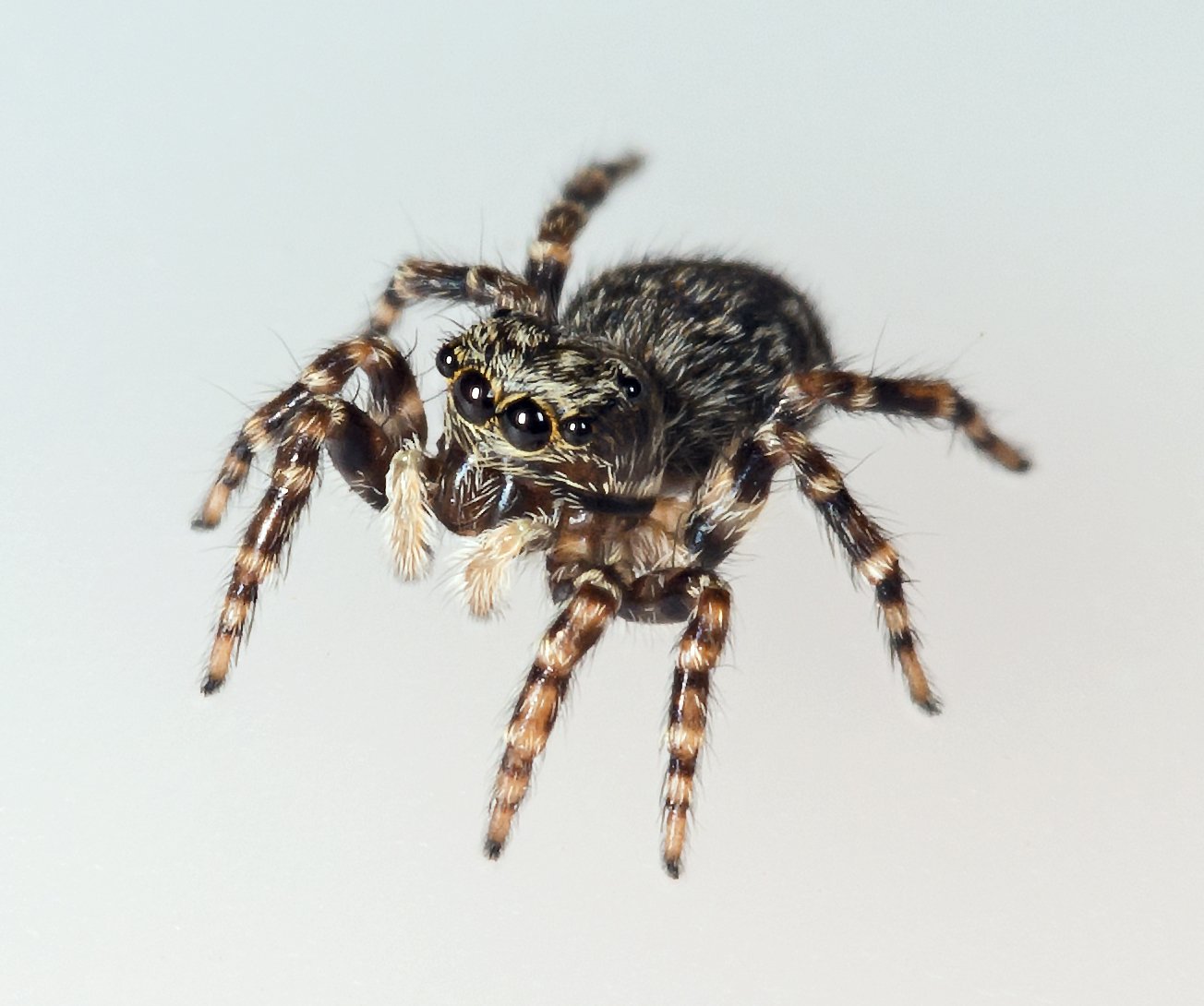
Invertebrates · Difficulty: Intermediate
Key facts and care guidance for House jumping spider (Pseudeuophrys lanigera) (origin: Originally southern Europe, established in central Europe since about the 1950s; synanthropic – it lives on and in buildings (house walls, flats)). Adult size around females approx. 4–5 mm, males approx. 3–4 mm body length. Life expectancy approx. 1 year (short-lived). The values below are carefully researched guidance.
Short answers
House jumping spider: How big does the enclosure need to be?
10×10×15 cm (a very small species).
House jumping spider: What temperature does it need?
Daytime 20–24 °C (room temperature), at night 16–20 °C.
House jumping spider: Does it need UVB lighting?
UVB: No UVB needed; bright daytime lighting is enough.
House jumping spider: How long do they live?
Life expectancy: approx. 1 year (short-lived).
House jumping spider: Is it suitable for beginners?
Rather not – it is considered an intermediate species (difficulty: Intermediate).
Climate
- Daytime temperature
- 20–24 °C (room temperature)
- Night temperature
- 16–20 °C
- Basking spot
- —
- Humidity
- 40–60 %
- UVB
- No UVB needed; bright daytime lighting is enough
Enclosure
- Minimum size
- 10×10×15 cm (a very small species)
- Substrate
- Dry, e.g. coco humus and sand with bark and stone structures as hides
Feeding
- Food
- Fruit flies (Drosophila), springtails, very small flies
- Feeding interval
- adults 2–3×/week, juveniles more often
Key facts
- Adult size
- females approx. 4–5 mm, males approx. 3–4 mm body length
- Life expectancy
- approx. 1 year (short-lived)
- Origin
- Originally southern Europe, established in central Europe since about the 1950s; synanthropic – it lives on and in buildings (house walls, flats)
- Protection status
- A native species, not specially protected; no CITES listing. Taking from the wild is guided by conservation ethics – handle them gently, and no commercial breeding is established
- Brumation
- No deliberate winter rest is needed; in the wild it overwinters hidden on or in buildings. Kept indoors it is active all year.
- Cohabitation
- Keep them singly. A solitary, territorial small jumping spider – a risk of cannibalism, so no group keeping.
Notes
A tiny native "wall jumping spider", barely kept as a hobby animal – species-specific husbandry data are sparse; the figures are derived from general jumping spider care and its biology. Warmth-loving, and fond of basking on walls. Field and record data from arages.de and natur-in-nrw.de.
Do you keep this species?
Add your animal to Reptoria – Reptoria reminds you about feeding and shedding. Add your animal for free →
Look for House jumping spider (Pseudeuophrys lanigera) in the marketplace →
Related species
- Algerian jumping spider (Cyrba algerina) – Intermediate
- Arched jumping spider (Evarcha arcuata) – Intermediate
- Bronze jumping spider (Hyllus semicupreus) – Beginner
- Peacock jumping spider (Saitis barbipes) – Intermediate
- Diard's jumping spider (Hyllus diardi) – Beginner
- Three-spotted jumping spider (Pellenes tripunctatus) – Intermediate
- Canopy jumping spider (Phidippus otiosus) – Beginner
- Fringed jumping spider (Portia fimbriata) – Expert
What you need to start
To keep House jumping spider (Pseudeuophrys lanigera) you typically need: a suitable enclosure (10×10×15 cm (a very small species)), substrate (Dry, e.g. coco humus and sand with bark and stone structures as hides), a heat source with a thermostat, UVB lighting, thermometer and hygrometer, a water dish and hides. You will find equipment in the Reptoria marketplace.
The complete, interactive care database is in the Reptoria app.
Last updated: 30 October 2026 · Editor: Reptoria editorial team · Sources include: https://en.wikipedia.org/wiki/Pseudeuophrys_lanigera, https://www.naturespot.org/species/pseudeuophrys-lanigera
All values are non-binding guidance and do not replace expert advice. Research thoroughly from several sources before acquiring and keeping an animal, and observe the applicable law (species and animal protection in particular).