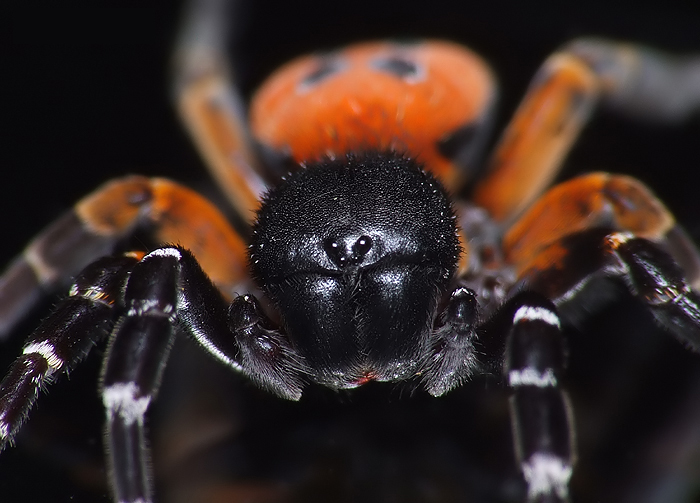
Ladybird spider (Eresus kollari)
Invertebrates · Difficulty: Expert
Key facts and care guidance for Ladybird spider (Eresus kollari) (origin: Central and southern Europe; in Germany local (the Rhine and Nahe valleys, the Lüneburg Heath, Brandenburg), xerothermic dry grassland and heath). Adult size around females 10–16 mm (up to 20 mm in the south), males 8–11 mm. Life expectancy females live several years (approx. 3–4+ years, maturing late), males ~1 year. The values below are carefully researched guidance.
Short answers
Ladybird spider: How big does the enclosure need to be?
~20×20×25 cm, deep dry substrate for the sloping burrow tube, in a sun-exposed position.
Ladybird spider: What temperature does it need?
Daytime 24–30 °C (sunny, warm slopes), basking spot locally 30–38 °C (sunlit spot above the tube), at night 12–18 °C.
Ladybird spider: Does it need UVB lighting?
UVB: UVA/UVB is beneficial (a xerothermic, sun-exposed species) – simulate a basking spot.
Ladybird spider: How long do they live?
Life expectancy: females live several years (approx. 3–4+ years, maturing late), males ~1 year.
Ladybird spider: Is it suitable for beginners?
No – better suited to experienced keepers (difficulty: Expert).
Climate
- Daytime temperature
- 24–30 °C (sunny, warm slopes)
- Night temperature
- 12–18 °C
- Basking spot
- locally 30–38 °C (sunlit spot above the tube)
- Humidity
- 40–55 % (dry, good ventilation; the tube somewhat more humid)
- UVB
- UVA/UVB is beneficial (a xerothermic, sun-exposed species) – simulate a basking spot
Enclosure
- Minimum size
- ~20×20×25 cm, deep dry substrate for the sloping burrow tube, in a sun-exposed position
- Substrate
- Sandy, loamy dry substrate they can dig in (a burrow 5–10 cm deep), stones
Feeding
- Food
- Insects, mainly beetles, also locusts and crickets (robust prey)
- Feeding interval
- 1×/week to every 10–14 days
Key facts
- Adult size
- females 10–16 mm (up to 20 mm in the south), males 8–11 mm
- Life expectancy
- females live several years (approx. 3–4+ years, maturing late), males ~1 year
- Origin
- Central and southern Europe; in Germany local (the Rhine and Nahe valleys, the Lüneburg Heath, Brandenburg), xerothermic dry grassland and heath
- Protection status
- Native, German Red List "Endangered"; specially protected (Federal Species Protection Ordinance) → taking from the wild is prohibited, and keeping it requires legal origin or a permit
- Brumation
- Yes – a cool, dry overwintering (about 2–10 °C) following the annual cycle
- Cohabitation
- Keep singly. Adults are solitary and territorial, each living in its own burrow. A notable exception: after hatching, spiderlings initially stay in the mother's burrow and feed on her after she dies from brood care (matriphagy) - but always keep adults separately.
Notes
The male mimics a ladybird (red with black dots, the "ladybird spider"); a burrow dweller of xerothermic sites; a protected native species, demanding to keep and legally tricky.
Do you keep this species?
Add your animal to Reptoria – Reptoria reminds you about feeding and shedding. Add your animal for free →
Look for Ladybird spider (Eresus kollari) in the marketplace →
Related species
- Woodlouse spider (Dysdera crocata) – Intermediate
- Huntsman spider (Heteropoda venatoria) – Beginner
- Brown recluse spider (Loxosceles reclusa) – Expert
- David Bowie huntsman spider (Heteropoda davidbowie) – Intermediate
- Tube-web spider (Segestria florentina) – Intermediate
- Raft spider (Dolomedes fimbriatus) – Expert
- Segmented spider (Liphistius sp.) – Expert
- Great raft spider (Dolomedes plantarius) – Expert
What you need to start
To keep Ladybird spider (Eresus kollari) you typically need: a suitable enclosure (~20×20×25 cm, deep dry substrate for the sloping burrow tube, in a sun-exposed position), substrate (Sandy, loamy dry substrate they can dig in (a burrow 5–10 cm deep), stones), a heat source with a thermostat, UVB lighting, thermometer and hygrometer, a water dish and hides. You will find equipment in the Reptoria marketplace.
The complete, interactive care database is in the Reptoria app.
Last updated: 9 October 2026 · Editor: Reptoria editorial team · Sources include: https://de.wikipedia.org/wiki/Rote_R%C3%B6hrenspinne, https://en.wikipedia.org/wiki/Eresus_kollari
All values are non-binding guidance and do not replace expert advice. Research thoroughly from several sources before acquiring and keeping an animal, and observe the applicable law (species and animal protection in particular).