Raft spider (Dolomedes fimbriatus)
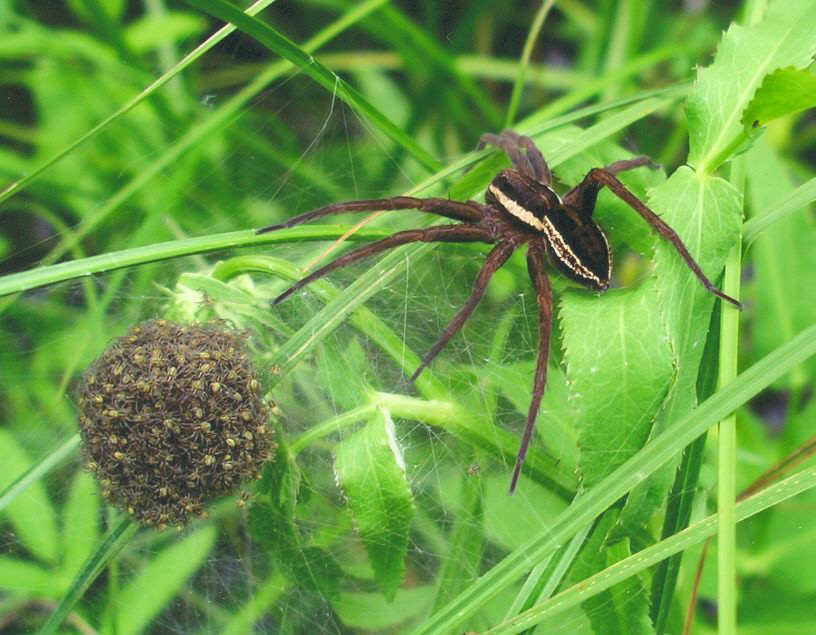
Invertebrates · Difficulty: Expert
Key facts and care guidance for Raft spider (Dolomedes fimbriatus) (origin: Europe and northern Asia; bogs, nutrient-poor banks, wet meadows). Adult size around females up to ~22 mm, males ~9–13 mm body length (leg span up to ~7 cm). Life expectancy approx. 2–3 years (females live several years). The values below are carefully researched guidance.
Short answers
Raft spider: How big does the enclosure need to be?
An aqua-terrarium or paludarium ~40×30×40 cm with a large water surface and emergent plants.
Raft spider: What temperature does it need?
Daytime 18–24 °C, at night 12–18 °C.
Raft spider: Does it need UVB lighting?
UVB: UVB not essential; a clear day/night rhythm.
Raft spider: How long do they live?
Life expectancy: approx. 2–3 years (females live several years).
Raft spider: Is it suitable for beginners?
No – better suited to experienced keepers (difficulty: Expert).
Climate
- Daytime temperature
- 18–24 °C
- Night temperature
- 12–18 °C
- Basking spot
- —
- Humidity
- 80–95 % (bank/wetland biotope with open water)
- UVB
- UVB not essential; a clear day/night rhythm
Enclosure
- Minimum size
- an aqua-terrarium or paludarium ~40×30×40 cm with a large water surface and emergent plants
- Substrate
- A bank zone (moss, peat) plus open water, floating and climbing plants
Feeding
- Food
- Insects, and small aquatic animals too (tadpoles, small fish); it hunts at and on the water surface
- Feeding interval
- 1–2×/week
Key facts
- Adult size
- females up to ~22 mm, males ~9–13 mm body length (leg span up to ~7 cm)
- Life expectancy
- approx. 2–3 years (females live several years)
- Origin
- Europe and northern Asia; bogs, nutrient-poor banks, wet meadows
- Protection status
- Native; regionally threatened or near threatened on the Red List; listed as specially protected under German species and nature conservation law → NO taking from the wild, only a legal source (check your state and the supplier)
- Brumation
- Yes – a cool overwintering (about 2–8 °C) following the native annual cycle
- Cohabitation
- Keep them singly – a solitary, cannibalistic huntress. The reason is not fighting but feeding: these animals take anything that fits in the mouth, and a second animal in the enclosure counts.
Notes
Semi-aquatic; it runs on the water surface and dives; it needs clean water plus high humidity. A native protected species – keep it only with a legal origin. Spider of the Year 2020.
Do you keep this species?
Add your animal to Reptoria – Reptoria reminds you about feeding and shedding. Add your animal for free →
Look for Raft spider (Dolomedes fimbriatus) in the marketplace →
Related species
- Great raft spider (Dolomedes plantarius) – Expert
- Woodlouse spider (Dysdera crocata) – Intermediate
- Huntsman spider (Heteropoda venatoria) – Beginner
- Brown recluse spider (Loxosceles reclusa) – Expert
- David Bowie huntsman spider (Heteropoda davidbowie) – Intermediate
- Tube-web spider (Segestria florentina) – Intermediate
- Segmented spider (Liphistius sp.) – Expert
- Domestic house spider (Tegenaria domestica) – Beginner
What you need to start
To keep Raft spider (Dolomedes fimbriatus) you typically need: a suitable enclosure (an aqua-terrarium or paludarium ~40×30×40 cm with a large water surface and emergent plants), substrate (A bank zone (moss, peat) plus open water, floating and climbing plants), a heat source with a thermostat, UVB lighting, thermometer and hygrometer, a water dish and hides. You will find equipment in the Reptoria marketplace.
The complete, interactive care database is in the Reptoria app.
Last updated: 9 October 2026 · Editor: Reptoria editorial team · Sources include: https://de.wikipedia.org/wiki/Gerandete_Jagdspinne, https://en.wikipedia.org/wiki/Dolomedes_fimbriatus
All values are non-binding guidance and do not replace expert advice. Research thoroughly from several sources before acquiring and keeping an animal, and observe the applicable law (species and animal protection in particular).