Leopard tortoise (Stigmochelys pardalis)
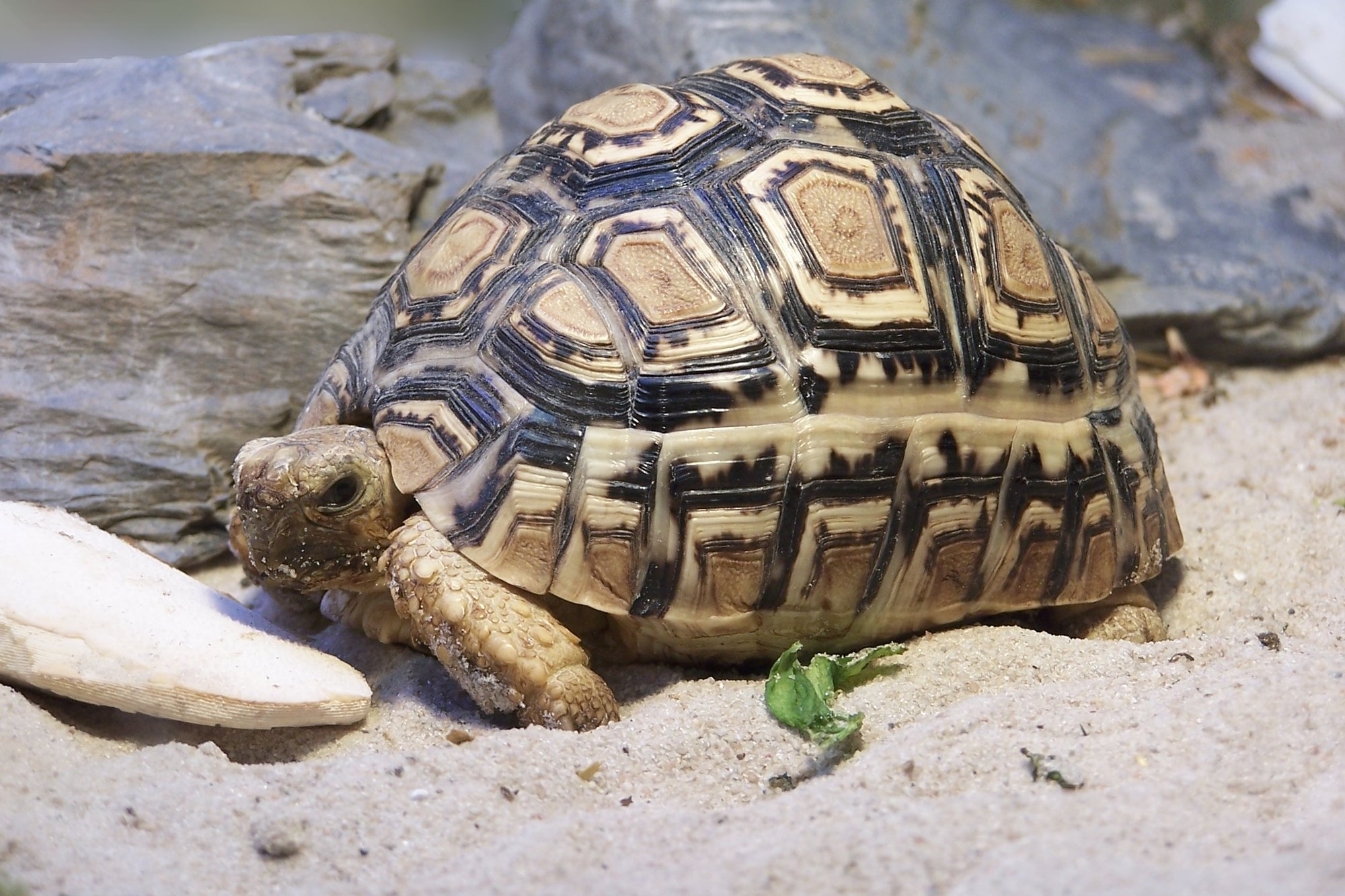
Turtles & tortoises · Difficulty: Intermediate
Key facts and care guidance for Leopard tortoise (Stigmochelys pardalis) (origin: Eastern and southern Africa (savannah)). Adult size around 30–45 cm, often up to 60–70 cm and 20–40 kg. Life expectancy approx. 50–60 years, individual animals older. The values below are carefully researched guidance.
Short answers
Leopard tortoise: How big does the enclosure need to be?
An outdoor setup of at least 50 m² (100 m² from the eighth year of life) plus a year-round heatable indoor enclosure or greenhouse of at least 10 m²; a purely indoor room enclosure is only for juveniles.
Leopard tortoise: What temperature does it need?
Daytime 28–32 °C, basking spot 35–40 °C, at night 18–22 °C.
Leopard tortoise: Does it need UVB lighting?
UVB: Essential (strong steppe-grade UVB).
Leopard tortoise: How long do they live?
Life expectancy: approx. 50–60 years, individual animals older.
Leopard tortoise: Is it suitable for beginners?
Rather not – it is considered an intermediate species (difficulty: Intermediate).
Climate
- Daytime temperature
- 28–32 °C
- Night temperature
- 18–22 °C
- Basking spot
- 35–40 °C
- Humidity
- juveniles humid (microclimate 60–80 %), adults 40–60 %
- UVB
- Essential (strong steppe-grade UVB)
Enclosure
- Minimum size
- An outdoor setup of at least 50 m² (100 m² from the eighth year of life) plus a year-round heatable indoor enclosure or greenhouse of at least 10 m²; a purely indoor room enclosure is only for juveniles
- Substrate
- A soil and sand mix, hay; keep juveniles damper
Feeding
- Food
- Herbivorous: fibre-rich wild herbs, grasses, hay; NO fruit and no animal protein
- Feeding interval
- Plant food daily, high in fibre (grass and hay ad libitum)
Key facts
- Adult size
- 30–45 cm, often up to 60–70 cm and 20–40 kg
- Life expectancy
- approx. 50–60 years, individual animals older
- Origin
- Eastern and southern Africa (savannah)
- Protection status
- CITES Appendix II / EU Annex B – registration and proof of origin required
- Brumation
- None (no brumation; at most a cooler rest period)
- Cohabitation
- Tolerant, and groups are possible given plenty of space. Two males harass each other and the females; under constant courtship a female visibly loses condition. One male to several females, and plan for a way to separate them.
Notes
A pure grass eater – high in fibre, no fruit or protein (otherwise pyramiding and kidney damage). Rear the young damp; it grows very large.
Do you keep this species?
Add your animal to Reptoria – Reptoria reminds you about feeding and shedding. Add your animal for free →
Look for Leopard tortoise (Stigmochelys pardalis) in the marketplace →
Related species
- Ploughshare tortoise (Astrochelys yniphora) – Expert
- Speckled padloper (Homopus areolatus) – Expert
- Serrated tent tortoise (Psammobates oculifer) – Expert
- Bell's hinge-back tortoise (Kinixys belliana) – Intermediate
- Speckled padloper tortoise (Chersobius signatus) – Expert
- Angulate tortoise (Chersina angulata) – Intermediate
- Home's hinge-back tortoise (Kinixys homeana) – Expert
- Natal hinge-back tortoise (Kinixys natalensis) – Intermediate
What you need to start
To keep Leopard tortoise (Stigmochelys pardalis) you typically need: a suitable enclosure (An outdoor setup of at least 50 m² (100 m² from the eighth year of life) plus a year-round heatable indoor enclosure or greenhouse of at least 10 m²; a purely indoor room enclosure is only for juveniles), substrate (A soil and sand mix, hay; keep juveniles damper), a heat source with a thermostat, UVB lighting, thermometer and hygrometer, a water dish and hides. You will find equipment in the Reptoria marketplace.
The complete, interactive care database is in the Reptoria app.
Last updated: 9 October 2026 · Editor: Reptoria editorial team · Sources include: bmleh.de, megazoo-nord.de, schildkroeten-schutz.de, tropic-shop.de, Wikipedia: Leopard tortoise – Inkubation 8–15 Monate je nach Temperatur – https://en.wikipedia.org/wiki/Leopard_tortoise
All values are non-binding guidance and do not replace expert advice. Research thoroughly from several sources before acquiring and keeping an animal, and observe the applicable law (species and animal protection in particular).