Speckled padloper (Homopus areolatus)
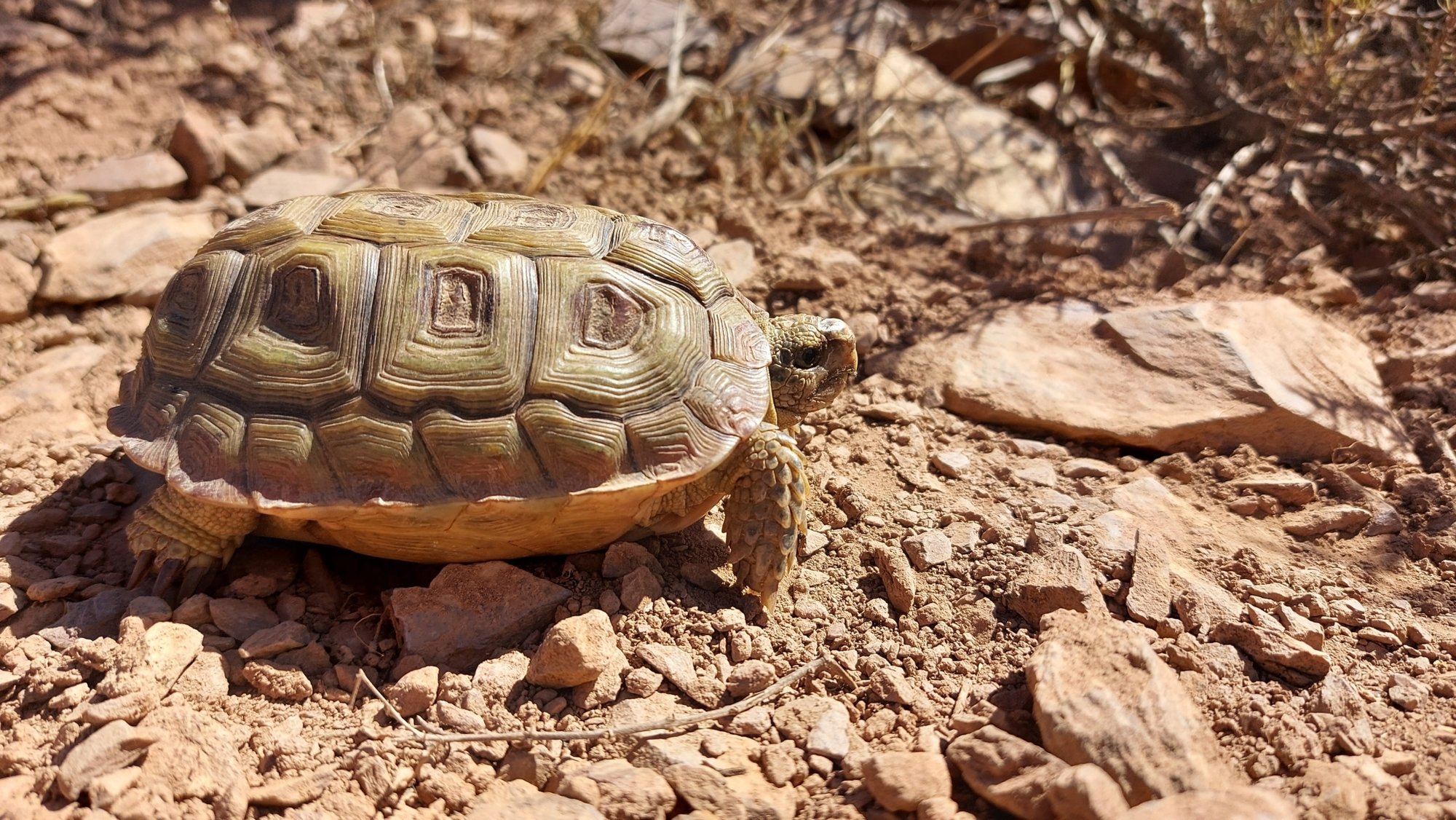
Turtles & tortoises · Difficulty: Expert
Key facts and care guidance for Speckled padloper (Homopus areolatus) (origin: The southern and south-western Cape, South Africa (fynbos, strandveld, coastal lowlands)). Adult size around ~10–11 cm (females larger, up to ~14 cm). Life expectancy 20–30+ years. The values below are carefully researched guidance.
Short answers
Speckled padloper: How big does the enclosure need to be?
From 100×50 cm floor area for one animal; around 1 m² (for example 100×100 cm) for up to three adult animals, with males kept separately.
Speckled padloper: What temperature does it need?
Daytime 22–28 °C, basking spot 40–45 °C at the basking spot, at night 12–16 °C.
Speckled padloper: Does it need UVB lighting?
UVB: UVB needed (open, sunny fynbos; Ferguson zone 3, UV index 3–4).
Speckled padloper: How long do they live?
Life expectancy: 20–30+ years.
Speckled padloper: Is it suitable for beginners?
No – better suited to experienced keepers (difficulty: Expert).
Climate
- Daytime temperature
- 22–28 °C
- Night temperature
- 12–16 °C
- Basking spot
- 40–45 °C at the basking spot
- Humidity
- 40–60 % (dry, well ventilated) plus a humid hide
- UVB
- UVB needed (open, sunny fynbos; Ferguson zone 3, UV index 3–4)
Enclosure
- Minimum size
- from 100×50 cm floor area for one animal; around 1 m² (for example 100×100 cm) for up to three adult animals, with males kept separately
- Substrate
- Sandy loam, rather dry, with stones and crevices as hides
Feeding
- Food
- Greens such as dandelion, plantain, endive and chicory, plus a fibre-rich component (soaked hay pellets or dried herbs); dusted with calcium and vitamins at every feeding. Occasionally slow-moving insects as a protein source. No fruit. Always offer food in a dish or on a flat stone slab, never on the substrate
- Feeding interval
- 3–4×/week in small portions
Key facts
- Adult size
- ~10–11 cm (females larger, up to ~14 cm)
- Life expectancy
- 20–30+ years
- Origin
- The southern and south-western Cape, South Africa (fynbos, strandveld, coastal lowlands)
- Protection status
- CITES Appendix II, EU Regulation Annex B; collecting and trade are strictly prohibited in South Africa and Namibia → hardly available legally
- Brumation
- No true winter dormancy; a mild coastal climate, active all year; a slight winter cooling is possible
- Cohabitation
- Group of one male with several females: they can be kept together year-round; about 1 m² of floor space is enough for up to three adults. Two males do not work — they are aggressive towards each other all year, not just in the breeding season, and must be housed separately. Plenty of hides and several basking spots are essential.
Notes
Difficult: a specialised diet and sensitivity to permanently high humidity (the cause of many keeping problems). An escape artist. For specialists only; usually with the problems of wild-caught animals. The temperature figures are derived from its climate and habitat (fine values are thin in the care sheets).
Do you keep this species?
Add your animal to Reptoria – Reptoria reminds you about feeding and shedding. Add your animal for free →
Look for Speckled padloper (Homopus areolatus) in the marketplace →
Related species
- Ploughshare tortoise (Astrochelys yniphora) – Expert
- Serrated tent tortoise (Psammobates oculifer) – Expert
- Bell's hinge-back tortoise (Kinixys belliana) – Intermediate
- Speckled padloper tortoise (Chersobius signatus) – Expert
- Angulate tortoise (Chersina angulata) – Intermediate
- Home's hinge-back tortoise (Kinixys homeana) – Expert
- Natal hinge-back tortoise (Kinixys natalensis) – Intermediate
- Leopard tortoise (Stigmochelys pardalis) – Intermediate
What you need to start
To keep Speckled padloper (Homopus areolatus) you typically need: a suitable enclosure (from 100×50 cm floor area for one animal; around 1 m² (for example 100×100 cm) for up to three adult animals, with males kept separately), substrate (Sandy loam, rather dry, with stones and crevices as hides), a heat source with a thermostat, UVB lighting, thermometer and hygrometer, a water dish and hides. You will find equipment in the Reptoria marketplace.
The complete, interactive care database is in the Reptoria app.
Last updated: 9 October 2026 · Editor: Reptoria editorial team · Sources include: dwarftortoises.org (Zuchtbuch-Haltungsempfehlung, PDF), en.wikipedia.org, eu_annex.txt (lokal, VO (EU) 2026/1383), genomics.senescence.info (AnAge), gesetze-im-internet.de (BArtSchV § 7)
All values are non-binding guidance and do not replace expert advice. Research thoroughly from several sources before acquiring and keeping an animal, and observe the applicable law (species and animal protection in particular).