Longtail alpine garter snake (Thamnophis scalaris)
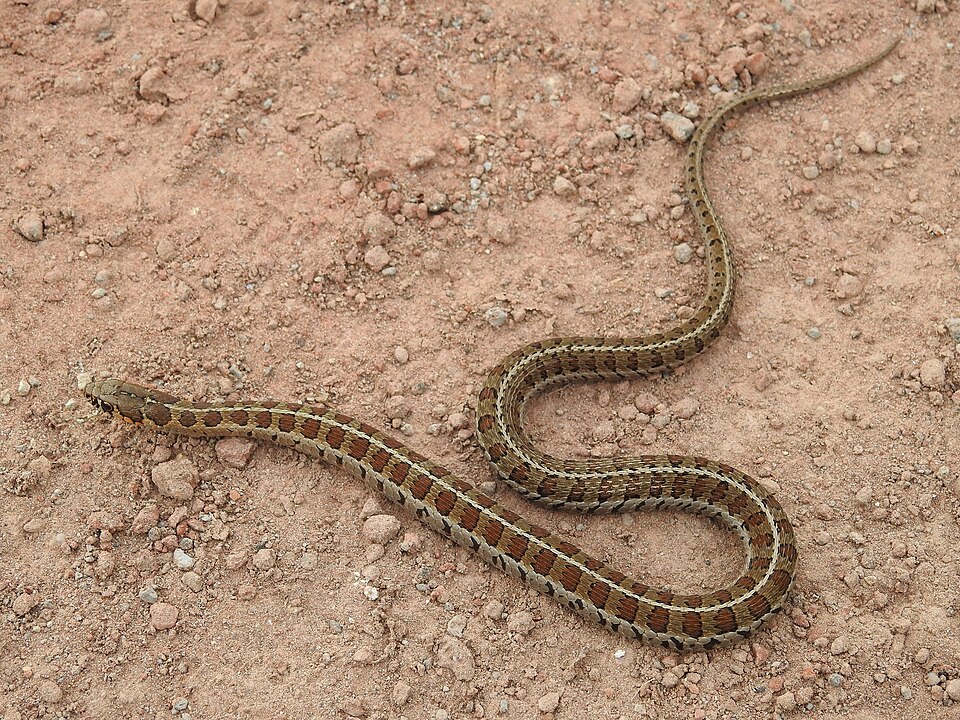
Snakes · Difficulty: Expert
Key facts and care guidance for Longtail alpine garter snake (Thamnophis scalaris) (origin: The highlands of central Mexico (from Jalisco to Veracruz), about 2100–4270 m). Adult size around 45–70 cm (females clearly larger, rarely up to about 75 cm). Life expectancy 8–10 years (estimate, species-specific data are lacking). The values below are carefully researched guidance.
Short answers
Longtail alpine garter snake: How big does the enclosure need to be?
From 90×55×35 cm (minimum size per the 1997 expert report, garter snakes; large females are better kept singly).
Longtail alpine garter snake: What temperature does it need?
Daytime 20–28 °C, basking spot Basking spot 30–32 °C, at night 14–20 °C.
Longtail alpine garter snake: Does it need UVB lighting?
UVB: Recommended (UVB tube above the basking spot, the species basks a lot).
Longtail alpine garter snake: How long do they live?
Life expectancy: 8–10 years (estimate, species-specific data are lacking).
Longtail alpine garter snake: Is it suitable for beginners?
No – better suited to experienced keepers (difficulty: Expert).
Climate
- Daytime temperature
- 20–28 °C
- Night temperature
- 14–20 °C
- Basking spot
- Basking spot 30–32 °C
- Humidity
- 50–70 % (one slightly moist corner for burrowing)
- UVB
- Recommended (UVB tube above the basking spot, the species basks a lot)
Enclosure
- Minimum size
- from 90×55×35 cm (minimum size per the 1997 expert report, garter snakes; large females are better kept singly)
- Substrate
- Warm side dry with coarse wood chips, cool side slightly moist coco humus or unfertilised soil for burrowing; rocks, bark and leaf litter as hides, a shallow water bowl
Feeding
- Food
- Earthworms (Lumbricus), thawed pinkie mice, occasionally low-thiaminase fish (often refused); in the wild mainly earthworms, large animals also lizards and small snakes
- Feeding interval
- adults 1×/week, juveniles more often
Key facts
- Adult size
- 45–70 cm (females clearly larger, rarely up to about 75 cm)
- Life expectancy
- 8–10 years (estimate, species-specific data are lacking)
- Origin
- The highlands of central Mexico (from Jalisco to Veracruz), about 2100–4270 m
- Protection status
- Not listed under CITES
- Brumation
- Short rest period of 6–8 weeks at 15–18 °C (brief basking during the day; a cold winter rest at 5–10 °C has cost animals their lives in captivity)
- Cohabitation
- Keeping them singly is the safer choice, especially for large females: in captivity, females have eaten smaller cage mates, usually males. A small group of roughly equal-sized animals is possible but needs clearly more space than the minimum and constant observation. Always feed singly, ideally in separate boxes.
Notes
Very little captive experience; the values come mainly from the reports of a Dutch garter snake keeper and from the natural habitat. A highland species: copes poorly with heat, but does not need a cold winter rest either.
Do you keep this species?
Add your animal to Reptoria – Reptoria reminds you about feeding and shedding. Add your animal for free →
Look for Longtail alpine garter snake (Thamnophis scalaris) in the marketplace →
Related species
- Ahumada's alpine garter snake (Thamnophis ahumadai) – Expert
- Bogert's garter snake (Thamnophis bogerti) – Expert
- Butler's garter snake (Thamnophis butleri) – Intermediate
- Cope's mountain meadow snake (Thamnophis copei) – Expert
- Fox's mountain meadow snake (Thamnophis foxi) – Expert
- Yellow-throated garter snake (Thamnophis pulchrilatus) – Expert
- Common garter snake (Thamnophis sirtalis) – Beginner
- Godman's garter snake (Thamnophis godmani) – Expert
What you need to start
To keep Longtail alpine garter snake (Thamnophis scalaris) you typically need: a suitable enclosure (from 90×55×35 cm (minimum size per the 1997 expert report, garter snakes; large females are better kept singly)), substrate (Warm side dry with coarse wood chips, cool side slightly moist coco humus or unfertilised soil for burrowing; rocks, bark and leaf litter as hides, a shallow water bowl), a heat source with a thermostat, UVB lighting, thermometer and hygrometer, a water dish and hides. You will find equipment in the Reptoria marketplace.
The complete, interactive care database is in the Reptoria app.
Last updated: 27 October 2026 · Editor: Reptoria editorial team · Sources include: Barrera Sánchez 2019 (UNAM-Tesis) – KRL Weibchen bis 60,8 cm, Schwanz Männchen ca. 15 cm – https://ru.dgb.unam.mx/bitstream/20.500.14330/TES01000825030/3/0825030.pdf, S. Bol: Observations … Thamnophis scalaris – Weibchen 52–60 cm Gesamtlänge, Männchen 42,5–49,8 cm, max. KRL 601 mm – https://stevenbolgartersnakes.com/publications-2/observations-in-the-wild-and-in-captivity-on-the-mexican-alpine-blotched-garter-snake-thamnophis-scalaris-cope-1861a/, S. Bol: Observations … Thamnophis scalaris – zwei große Weibchen fraßen kleinere Mitbewohner – https://stevenbolgartersnakes.com/publications-2/observations-in-the-wild-and-in-captivity-on-the-mexican-alpine-blotched-garter-snake-thamnophis-scalaris-cope-1861a/, Barrera Sánchez 2019 (UNAM-Tesis) – Würmer, Frösche, Salamander, Echsen, kleine Nager – https://ru.dgb.unam.mx/bitstream/20.500.14330/TES01000825030/3/0825030.pdf, S. Bol: Observations … Thamnophis scalaris – Freiland 81 % Regenwürmer, große Tiere Wirbeltiere; Haltung Babymäuse, Würmer, Stint – https://stevenbolgartersnakes.com/publications-2/observations-in-the-wild-and-in-captivity-on-the-mexican-alpine-blotched-garter-snake-thamnophis-scalaris-cope-1861a/
All values are non-binding guidance and do not replace expert advice. Research thoroughly from several sources before acquiring and keeping an animal, and observe the applicable law (species and animal protection in particular).