Mexican beaded lizard (Heloderma horridum)
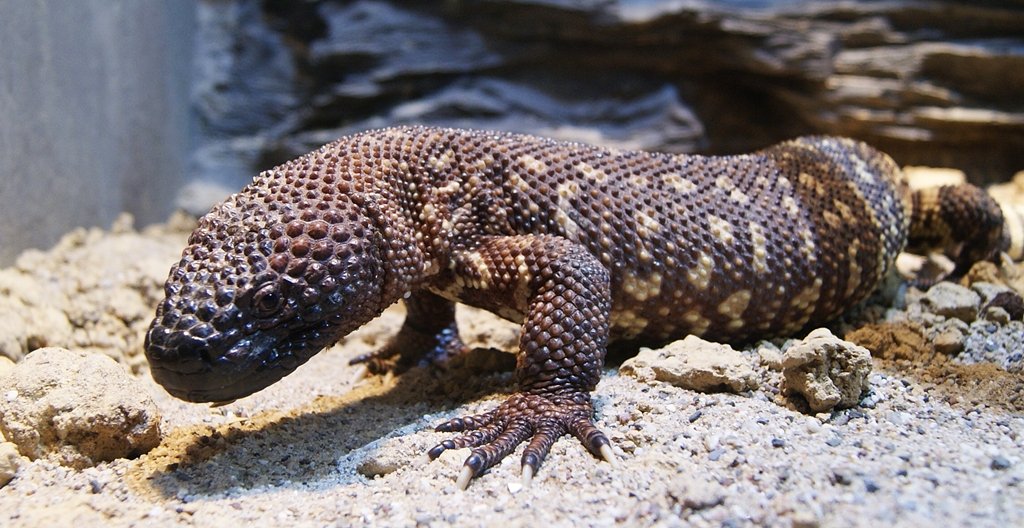
Lizards · Difficulty: Expert
Key facts and care guidance for Mexican beaded lizard (Heloderma horridum) (origin: Western and central Mexico (the Pacific side); dry thorn scrub and deciduous forest, rocky areas). Adult size around 60–90 cm total length (larger and more slender than the Gila monster). Life expectancy approx. 25–30 years. The values below are carefully researched guidance.
Short answers
Mexican beaded lizard: How big does the enclosure need to be?
150×80×80 cm for one animal (larger is better for this big species).
Mexican beaded lizard: What temperature does it need?
Daytime 26–32 °C, basking spot 35–38 °C (basking spot), at night 18–22 °C.
Mexican beaded lizard: Does it need UVB lighting?
UVB: UVB recommended (Ferguson zone 1–2, UV index 1–3).
Mexican beaded lizard: How long do they live?
Life expectancy: approx. 25–30 years.
Mexican beaded lizard: Is it suitable for beginners?
No – better suited to experienced keepers (difficulty: Expert).
Climate
- Daytime temperature
- 26–32 °C
- Night temperature
- 18–22 °C
- Basking spot
- 35–38 °C (basking spot)
- Humidity
- 50–70 % (with a humid floor zone or hide)
- UVB
- UVB recommended (Ferguson zone 1–2, UV index 1–3)
Enclosure
- Minimum size
- 150×80×80 cm for one animal (larger is better for this big species)
- Substrate
- A sand and soil mix they can dig in, with stone slabs, roots, cork tubes and damp retreats
Feeding
- Food
- Carnivorous: mice or rats, chicks, quail and other bird eggs, occasionally insects
- Feeding interval
- adults sparingly, approx. 1×/week or every 5–10 days (avoid obesity)
Key facts
- Adult size
- 60–90 cm total length (larger and more slender than the Gila monster)
- Life expectancy
- approx. 25–30 years
- Origin
- Western and central Mexico (the Pacific side); dry thorn scrub and deciduous forest, rocky areas
- Protection status
- VENOMOUS. CITES Appendix II / EU Annex B – a commercial-use permit and proof of origin are needed. Keeping venomous animals: notification, a permit and proof of expertise are required depending on the German state
- Brumation
- A rest period matching the dry season: cooler and drier, about 13–18 °C for a few weeks to months (November to March)
- Cohabitation
- Keeping them singly is the standard. 1.1 only for experienced keepers, in a very large enclosure and under supervision. NEVER keep males together (ritual fights); rear the young separately
Notes
A venomous lizard – handle it only with experience and protection, and keep an emergency plan ready. Slightly higher humidity than the Gila monster (thorn scrub). It runs to obesity – feed sparingly. Not for beginners.
Do you keep this species?
Add your animal to Reptoria – Reptoria reminds you about feeding and shedding. Add your animal for free →
Look for Mexican beaded lizard (Heloderma horridum) in the marketplace →
Related species
- Chiapan beaded lizard (Heloderma alvarezi) – Expert
- Gila monster (Heloderma suspectum) – Expert
- Guatemalan beaded lizard (Heloderma charlesbogerti) – Expert
- Rio Fuerte beaded lizard (Heloderma exasperatum) – Expert
- Aeolian wall lizard (Podarcis raffonei) – Expert
- Anzueto's arboreal alligator lizard (Abronia anzuetoi) – Expert
- Aran rock lizard (Iberolacerta aranica) – Expert
- Aurelio's rock lizard (Iberolacerta aurelioi) – Expert
What you need to start
To keep Mexican beaded lizard (Heloderma horridum) you typically need: a suitable enclosure (150×80×80 cm for one animal (larger is better for this big species)), substrate (A sand and soil mix they can dig in, with stone slabs, roots, cork tubes and damp retreats), a heat source with a thermostat, UVB lighting, thermometer and hygrometer, a water dish and hides. You will find equipment in the Reptoria marketplace.
The complete, interactive care database is in the Reptoria app.
Last updated: 8 November 2026 · Editor: Reptoria editorial team · Sources include: Heloderma suspectum Inkubation 114-152 Tage bei 26-29°C (Royal Society) als Gattungswert – https://royalsocietypublishing.org/rspb/article/285/1879/20180632/78940/Evidence-for-atypical-nest-overwintering-by, Gila Monster Egg Incubation - DocSeward.com (Gattungswert Heloderma) – https://www.docseward.com/incubation.htm, https://de.wikipedia.org/wiki/Skorpion-Krustenechse, https://en.wikipedia.org/wiki/Heloderma, https://en.wikipedia.org/wiki/Mexican_beaded_lizard
All values are non-binding guidance and do not replace expert advice. Research thoroughly from several sources before acquiring and keeping an animal, and observe the applicable law (species and animal protection in particular).