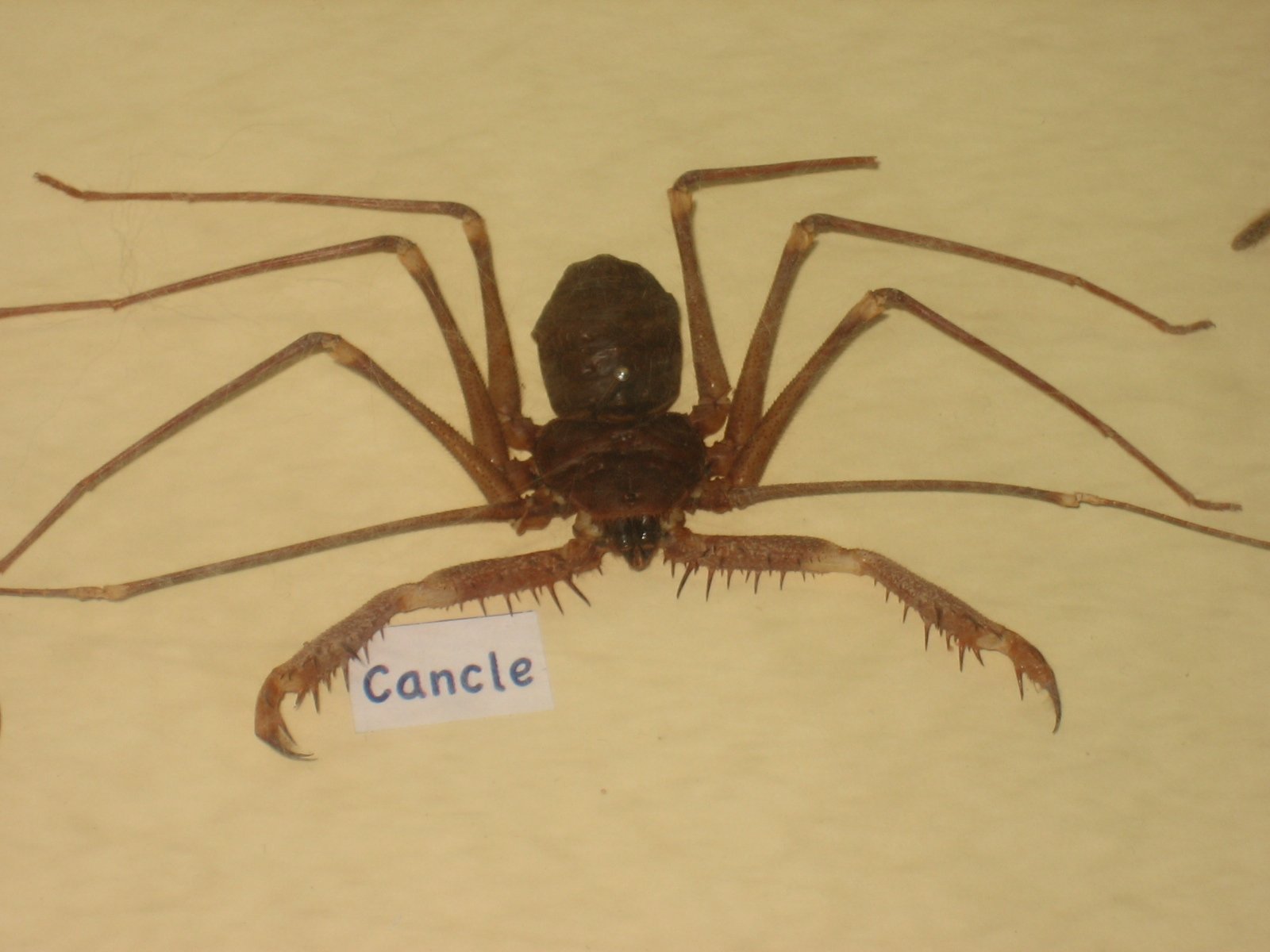
Mexican whip spider (Acanthophrynus coronatus)
Invertebrates · Difficulty: Intermediate
Key facts and care guidance for Mexican whip spider (Acanthophrynus coronatus) (origin: Mexico (Jalisco, Baja California among others), drier forests). Adult size around leg span up to approx. 18 cm, body up to approx. 4 cm wide (a giant species). Life expectancy approx. 7 years. The values below are carefully researched guidance.
Short answers
Mexican whip spider: How big does the enclosure need to be?
40×40×60 cm (large and tall – one of the largest species).
Mexican whip spider: What temperature does it need?
Daytime 24–28 °C, at night 20–23 °C.
Mexican whip spider: Does it need UVB lighting?
UVB: No UVB needed (nocturnal).
Mexican whip spider: How long do they live?
Life expectancy: approx. 7 years.
Mexican whip spider: Is it suitable for beginners?
Rather not – it is considered an intermediate species (difficulty: Intermediate).
Climate
- Daytime temperature
- 24–28 °C
- Night temperature
- 20–23 °C
- Basking spot
- —
- Humidity
- 70–80 % (tolerates drier air briefly; damp substrate)
- UVB
- No UVB needed (nocturnal)
Enclosure
- Minimum size
- 40×40×60 cm (large and tall – one of the largest species)
- Substrate
- Coco humus or soil, 5–10 cm, moisture-retaining
Feeding
- Food
- Large crickets, roaches, locusts; matched to their size
- Feeding interval
- 1×/week for adults; juveniles somewhat more often
Key facts
- Adult size
- leg span up to approx. 18 cm, body up to approx. 4 cm wide (a giant species)
- Life expectancy
- approx. 7 years
- Origin
- Mexico (Jalisco, Baja California among others), drier forests
- Protection status
- No known CITES or German protection; freely tradable
- Brumation
- None (tropical / subtropical)
- Cohabitation
- Keep it singly. The species is large and predatory; it is best kept alone. Only siblings from the same egg sac get along. A pair can be together for a few days, but this is risky, so only briefly and supervised; never keep males together.
Notes
The largest whip spider of the New World. An escape artist – a securely closing lid is essential. Non-venomous, without silk glands. Moulting needs plenty of free height. Nocturnal, and in its hide by day.
Do you keep this species?
Add your animal to Reptoria – Reptoria reminds you about feeding and shedding. Add your animal for free →
Look for Mexican whip spider (Acanthophrynus coronatus) in the marketplace →
Related species
- African whip spider (Euphrynichus amanica) – Beginner to intermediate
- Amazonian whip spider (Heterophrynus elaphus) – Intermediate
- Tailless whip scorpion (Phrynus marginemaculatus) – Intermediate
- Israeli whip spider (Charinus israelensis) – Expert
- Johnston's whip spider (Damon johnstonii) – Intermediate
- Small whip spider (Phrynus parvulus) – Intermediate
- East African whip spider (Damon variegatus) – Intermediate
- Tanzanian whip spider (Damon diadema) – Beginner
What you need to start
To keep Mexican whip spider (Acanthophrynus coronatus) you typically need: a suitable enclosure (40×40×60 cm (large and tall – one of the largest species)), substrate (Coco humus or soil, 5–10 cm, moisture-retaining), a heat source with a thermostat, UVB lighting, thermometer and hygrometer, a water dish and hides. You will find equipment in the Reptoria marketplace.
The complete, interactive care database is in the Reptoria app.
Last updated: 7 November 2026 · Editor: Reptoria editorial team · Sources include: Wikipedia (EN) Amblypygi - Eggs hatch after 3 to 5.5 months – https://en.wikipedia.org/wiki/Amblypygi, Wikipedia Geisselspinnen - Fortpflanzung allgemein – https://de.wikipedia.org/wiki/Gei%C3%9Felspinnen, https://arachnoboards.com/threads/acanthophrynus-coronatus-care.352139/, https://en.wikipedia.org/wiki/Acanthophrynus, https://en.wikipedia.org/wiki/Acanthophrynus_coronatus
All values are non-binding guidance and do not replace expert advice. Research thoroughly from several sources before acquiring and keeping an animal, and observe the applicable law (species and animal protection in particular).