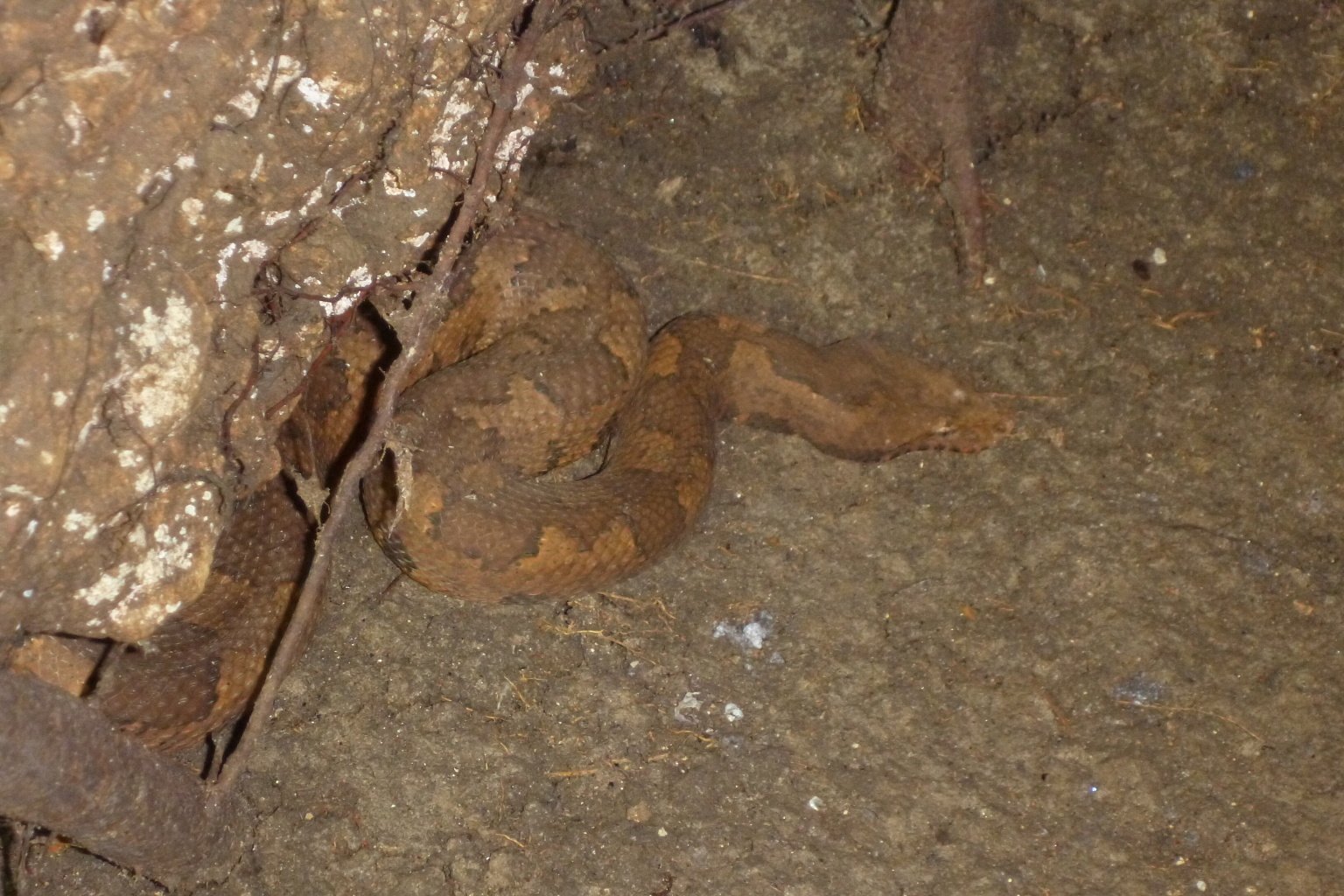
New Guinea ground boa (Candoia aspera)
Snakes · Difficulty: Intermediate
Key facts and care guidance for New Guinea ground boa (Candoia aspera) (origin: Eastern Indonesia, New Guinea). Adult size around 40–70 cm (short and very heavily built). Life expectancy approx. 20 years. The values below are carefully researched guidance.
Short answers
New Guinea ground boa: How big does the enclosure need to be?
From 80×45×55 cm (minimum size according to the 1997 expert report, Pacific boas); terrestrial, floor area is what counts.
New Guinea ground boa: What temperature does it need?
Daytime 26–28 °C, basking spot 30–32 °C, at night 24 °C.
New Guinea ground boa: Does it need UVB lighting?
UVB: UVB not essential (nocturnal), weak UVB is tolerated.
New Guinea ground boa: How long do they live?
Life expectancy: approx. 20 years.
New Guinea ground boa: Is it suitable for beginners?
Rather not – it is considered an intermediate species (difficulty: Intermediate).
Climate
- Daytime temperature
- 26–28 °C
- Night temperature
- 24 °C
- Basking spot
- 30–32 °C
- Humidity
- 60–80 % (higher at night)
- UVB
- UVB not essential (nocturnal), weak UVB is tolerated
Enclosure
- Minimum size
- from 80×45×55 cm (minimum size according to the 1997 expert report, Pacific boas); terrestrial, floor area is what counts
- Substrate
- Coco soil or coco chips at least 8 cm deep (it likes to dig), moisture-retaining; a large water basin for bathing
Feeding
- Food
- Rodents (mice or young rats); occasionally small lizards
- Feeding interval
- neonates and subadults weekly, adults every 2 weeks
Key facts
- Adult size
- 40–70 cm (short and very heavily built)
- Life expectancy
- approx. 20 years
- Origin
- Eastern Indonesia, New Guinea
- Protection status
- Protected: CITES Appendix II, EU Annex B - proof of origin required at purchase and resale. Predominantly wild-caught - check for legal proof of origin.
- Brumation
- None (tropical)
- Cohabitation
- Keep them singly – solitary and territorial; put them together only briefly for supervised breeding, and never keep males together
Notes
A ground-dwelling, stocky "viper boa". Common mistakes: wild-caught animals with a high parasite load, food refusal, and conditions that are too dry. It usually defecates in the water – change the water regularly.
Do you keep this species?
Add your animal to Reptoria – Reptoria reminds you about feeding and shedding. Add your animal for free →
Look for New Guinea ground boa (Candoia aspera) in the marketplace →
Related species
- Bibron's bevel-nosed boa (Candoia bibroni) – Intermediate
- Solomon Islands ground boa (Candoia paulsoni) – Intermediate
- Viper boa (Candoia carinata) – Intermediate
- Amazon tree boa (Corallus batesii) – Expert
- Argentine boa (Boa constrictor occidentalis) – Intermediate
- True red-tailed boa – Guyana (Boa constrictor constrictor) – Intermediate
- True red-tailed boa – Peru (Boa constrictor constrictor) – Intermediate
- True red-tailed boa – Suriname (Boa constrictor constrictor) – Intermediate
What you need to start
To keep New Guinea ground boa (Candoia aspera) you typically need: a suitable enclosure (from 80×45×55 cm (minimum size according to the 1997 expert report, Pacific boas); terrestrial, floor area is what counts), substrate (Coco soil or coco chips at least 8 cm deep (it likes to dig), moisture-retaining; a large water basin for bathing), a heat source with a thermostat, UVB lighting, thermometer and hygrometer, a water dish and hides. You will find equipment in the Reptoria marketplace.
The complete, interactive care database is in the Reptoria app.
Last updated: 9 October 2026 · Editor: Reptoria editorial team · Sources include: http://www.kingsnake.com/candoia/husbandry.html, https://de.wikipedia.org/wiki/Neuguinea-Boa, https://reptile-database.reptarium.cz/species?genus=Candoia&species=aspera
All values are non-binding guidance and do not replace expert advice. Research thoroughly from several sources before acquiring and keeping an animal, and observe the applicable law (species and animal protection in particular).