Ocellated skink (Chalcides ocellatus)
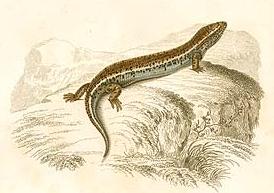
Skinks · Difficulty: Intermediate
Key facts and care guidance for Ocellated skink (Chalcides ocellatus) (origin: Southern Europe (Sardinia, Sicily, Malta, Greece, Cyprus, Turkey), North Africa, the Near and Middle East to Pakistan and Sri Lanka; introduced to California). Adult size around 20–30 cm total length (SVL up to ~8–12 cm). Life expectancy 10–15 years. The values below are carefully researched guidance.
Short answers
Ocellated skink: How big does the enclosure need to be?
From 80×40×40 cm for one animal; for a pair from 90×40×40 cm (15 % more floor space per additional animal, as in the 1997 expert report).
Ocellated skink: What temperature does it need?
Daytime 25–30 °C, basking spot 32–35 °C, at night 20–23 °C.
Ocellated skink: Does it need UVB lighting?
UVB: UVB needed (for D3 and colour; roughly Ferguson zone 2–3, UV index 3–4).
Ocellated skink: How long do they live?
Life expectancy: 10–15 years.
Ocellated skink: Is it suitable for beginners?
Rather not – it is considered an intermediate species (difficulty: Intermediate).
Climate
- Daytime temperature
- 25–30 °C
- Night temperature
- 20–23 °C
- Basking spot
- 32–35 °C
- Humidity
- 40–60 % with a humid retreat corner (a generalist that tolerates humidity, but never permanently wet)
- UVB
- UVB needed (for D3 and colour; roughly Ferguson zone 2–3, UV index 3–4)
Enclosure
- Minimum size
- from 80×40×40 cm for one animal; for a pair from 90×40×40 cm (15 % more floor space per additional animal, as in the 1997 expert report)
- Substrate
- Substrate they can dig in (sand-loam or sand and coco), ~10 cm deep, plus cork, leaf litter and hides
Feeding
- Food
- Insectivorous (house crickets, crickets, locusts, wax worms), occasionally small invertebrates or a little sweet fruit; dust with vitamin and mineral powder
- Feeding interval
- adults approx. 2–3×/week
Key facts
- Adult size
- 20–30 cm total length (SVL up to ~8–12 cm)
- Life expectancy
- 10–15 years
- Origin
- Southern Europe (Sardinia, Sicily, Malta, Greece, Cyprus, Turkey), North Africa, the Near and Middle East to Pakistan and Sri Lanka; introduced to California
- Protection status
- Not listed under CITES; IUCN "Least Concern"; no registration duty in Germany. Note: some dealer profiles wrongly claim "WA II / registration required" – according to CITES and the Reptile Database this is not the case
- Brumation
- A winter rest of ~2–3 months (cooler, ~12–18 °C) encourages reproduction; important for breeding
- Cohabitation
- Keeping them singly is the least stressful and safest choice. A group of one male with several females (1,x) is possible but needs a lot of space and many hides; males never get on with each other and typically show bite marks on the tail. Juveniles must be separated from adults due to documented cannibalism.
Notes
Live-bearing (ovoviviparous, about 2–10 and rarely up to 20 young); the tail is readily autotomised; shy, burrowing, and a robust generalist. Common mistakes: substrate that is too shallow, too tall a terrarium, males kept together, and leaving the young with the adults. The humidity is set conservatively at 40–60 % (one vendor source gives 60–90 %, which is too high as a permanent value).
Do you keep this species?
Add your animal to Reptoria – Reptoria reminds you about feeding and shedding. Add your animal for free →
Look for Ocellated skink (Chalcides ocellatus) in the marketplace →
Related species
- Italian three-toed skink (Chalcides chalcides) – Beginner
- Gran Canaria skink (Chalcides sexlineatus) – Intermediate
- African five-lined skink (Trachylepis quinquetaeniata) – Intermediate
- Algerian skink (Eumeces algeriensis) – Intermediate
- Berber skink (Eumeces schneideri) – Beginner to intermediate
- Berdmore's water skink (Tropidophorus berdmorei) – Beginner with some knowledge
- Mountain skink (Plestiodon callicephalus) – Beginner with some knowledge
- Pacific blue-tailed skink (Emoia caeruleocauda) – Beginner with some knowledge
What you need to start
To keep Ocellated skink (Chalcides ocellatus) you typically need: a suitable enclosure (from 80×40×40 cm for one animal; for a pair from 90×40×40 cm (15 % more floor space per additional animal, as in the 1997 expert report)), substrate (Substrate they can dig in (sand-loam or sand and coco), ~10 cm deep, plus cork, leaf litter and hides), a heat source with a thermostat, UVB lighting, thermometer and hygrometer, a water dish and hides. You will find equipment in the Reptoria marketplace.
The complete, interactive care database is in the Reptoria app.
Last updated: 9 October 2026 · Editor: Reptoria editorial team · Sources include: https://de.wikipedia.org/wiki/Gefleckter_Walzenskink, https://reptile-database.reptarium.cz/species?genus=Chalcides&species=ocellatus
All values are non-binding guidance and do not replace expert advice. Research thoroughly from several sources before acquiring and keeping an animal, and observe the applicable law (species and animal protection in particular).