Pacific coast aquatic garter snake (Thamnophis atratus)
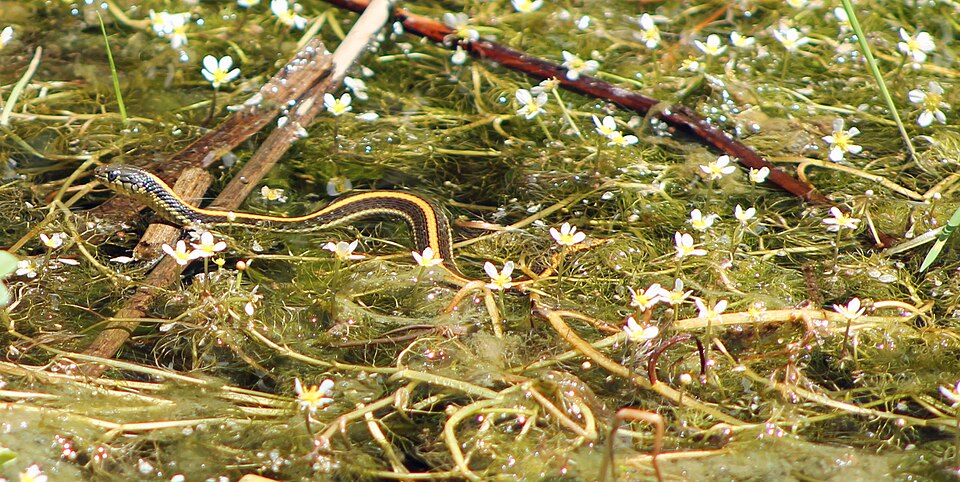
Snakes · Difficulty: Intermediate
Key facts and care guidance for Pacific coast aquatic garter snake (Thamnophis atratus) (origin: Pacific coast of the USA: coastal California from Santa Barbara to northern California and south-western Oregon). Adult size around 45–75 cm (rarely up to 102 cm). Life expectancy 8–12 years. The values below are carefully researched guidance.
Short answers
Pacific coast aquatic garter snake: How big does the enclosure need to be?
From 95×55×40 cm (minimum size per the 1997 expert report, garter snakes; considerably more floor space for each additional animal).
Pacific coast aquatic garter snake: What temperature does it need?
Daytime 22–27 °C, basking spot Basking spot 30–32 °C, at night 15–19 °C.
Pacific coast aquatic garter snake: Does it need UVB lighting?
UVB: Recommended (UV index around 2–3 at the basking spot).
Pacific coast aquatic garter snake: How long do they live?
Life expectancy: 8–12 years.
Pacific coast aquatic garter snake: Is it suitable for beginners?
Rather not – it is considered an intermediate species (difficulty: Intermediate).
Climate
- Daytime temperature
- 22–27 °C
- Night temperature
- 15–19 °C
- Basking spot
- Basking spot 30–32 °C
- Humidity
- 50–65 % (land area dry, humidity from the water basin)
- UVB
- Recommended (UV index around 2–3 at the basking spot)
Enclosure
- Minimum size
- from 95×55×40 cm (minimum size per the 1997 expert report, garter snakes; considerably more floor space for each additional animal)
- Substrate
- Soil-sand mix with a pebble and stone area, a large shallow water basin with stones (creek-bank style), basking spot on a flat stone, several hides
Feeding
- Food
- In the wild mainly amphibians and their larvae (treefrogs, toads, newts), plus small fish, leeches, slugs and occasionally rodents. In captivity fish (low in thiaminase; avoid e.g. smelt and goldfish), earthworms and frozen-thawed mice or mouse fillet, scented with fish if needed. Do not feed amphibians.
- Feeding interval
- adults 2×/week, juveniles more often
Key facts
- Adult size
- 45–75 cm (rarely up to 102 cm)
- Life expectancy
- 8–12 years
- Origin
- Pacific coast of the USA: coastal California from Santa Barbara to northern California and south-western Oregon
- Protection status
- Not listed under CITES
- Brumation
- A winter rest of 6–10 weeks at 8–12 °C
- Cohabitation
- Can be kept in pairs or as a small group of similarly sized animals, with considerably more space and several basking spots. If you want to avoid stress completely, keep them singly. Always feed them separately – fish in a shared basin quickly leads to a feeding accident in which one snake grabs the other.
Notes
Little captive experience in Europe; the care values are derived from the mild, cool coastal climate of California and from close relatives (T. couchii, T. elegans). Very variable in colour, from grey with blotches to almost black with a yellow dorsal stripe. Three subspecies: atratus, hydrophilus, zaxanthus.
Do you keep this species?
Add your animal to Reptoria – Reptoria reminds you about feeding and shedding. Add your animal for free →
Look for Pacific coast aquatic garter snake (Thamnophis atratus) in the marketplace →
Related species
- Ahumada's alpine garter snake (Thamnophis ahumadai) – Expert
- Bogert's garter snake (Thamnophis bogerti) – Expert
- Butler's garter snake (Thamnophis butleri) – Intermediate
- Cope's mountain meadow snake (Thamnophis copei) – Expert
- Fox's mountain meadow snake (Thamnophis foxi) – Expert
- Yellow-throated garter snake (Thamnophis pulchrilatus) – Expert
- Common garter snake (Thamnophis sirtalis) – Beginner
- Godman's garter snake (Thamnophis godmani) – Expert
What you need to start
To keep Pacific coast aquatic garter snake (Thamnophis atratus) you typically need: a suitable enclosure (from 95×55×40 cm (minimum size per the 1997 expert report, garter snakes; considerably more floor space for each additional animal)), substrate (Soil-sand mix with a pebble and stone area, a large shallow water basin with stones (creek-bank style), basking spot on a flat stone, several hides), a heat source with a thermostat, UVB lighting, thermometer and hygrometer, a water dish and hides. You will find equipment in the Reptoria marketplace.
The complete, interactive care database is in the Reptoria app.
Last updated: 27 October 2026 · Editor: Reptoria editorial team · Sources include: CaliforniaHerps, Santa Cruz Gartersnake – 46–102 cm, meist 46–71 cm, Jungtiere 18–25 cm – https://californiaherps.com/snakes/pages/t.a.atratus.html, ReptiFiles Garter Snake Care Sheet (PDF) – getrennt füttern, Gruppen brauchen mehr Platz – https://reptifiles.com/wp-content/uploads/2022/04/Garter-Snake-Care-Sheet-PDF.pdf, CaliforniaHerps, Santa Cruz Gartersnake – Amphibien und Larven, kleine Fische, Nager, Nacktschnecken, Egel; Jagdweise – https://californiaherps.com/snakes/pages/t.a.atratus.html, Wikipedia EN „Thiaminase“ – Thiaminase in Karpfen/Goldfisch, B1-Mangel durch rohen Fisch – https://en.wikipedia.org/wiki/Thiaminase, CaliforniaHerps, Santa Cruz Gartersnake – Balz März/April, lebendgebärend, Geburt Sommer bis Frühherbst – https://californiaherps.com/snakes/pages/t.a.atratus.html
All values are non-binding guidance and do not replace expert advice. Research thoroughly from several sources before acquiring and keeping an animal, and observe the applicable law (species and animal protection in particular).